1986Theory
Fukugita and Yanagida propose leptogenesis
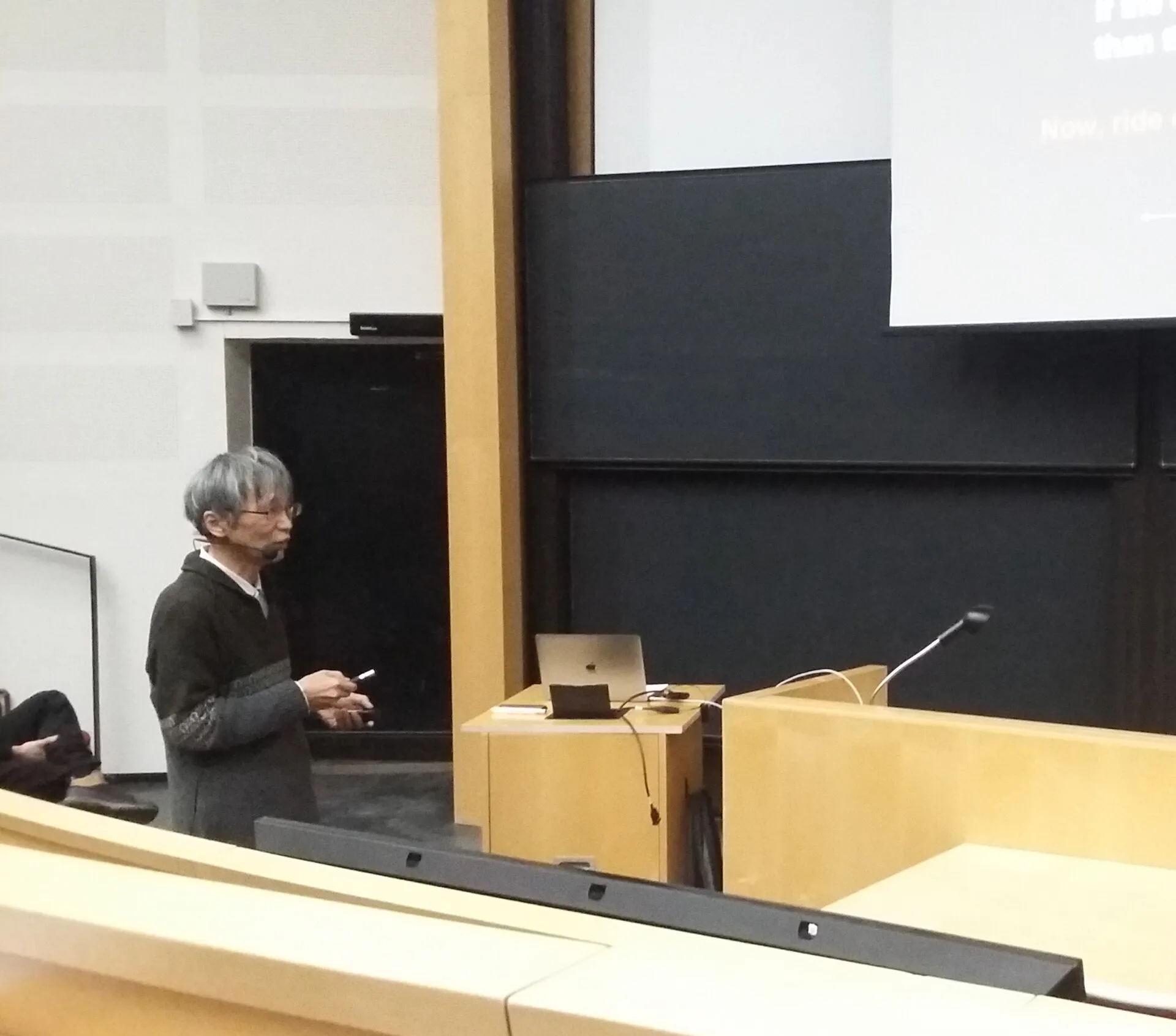
Masataka Fukugita and Tsutomu Yanagida proposed that the matter-antimatter asymmetry of the Universe originated from CP-violating decays of heavy Majorana neutrinos in the early Universe. The resulting lepton asymmetry is partly converted into a baryon asymmetry by electroweak sphaleron processes. Leptogenesis connects the seesaw mechanism, CP violation in neutrinos and cosmology. It remains a leading but untested hypothesis.
- Date
- 1986
- Kind of event
- Theory
- People involved
- Masataka Fukugita, Tsutomu Yanagida
The situation before
The visible Universe contains matter but almost no antimatter: for every billion photons from the Big Bang there are about six baryons. In 1967 Andrei Sakharov listed the conditions needed to create such an imbalance: baryon-number violation, C and CP violation, and a departure from thermal equilibrium. Grand unified theories seemed to supply all three through the decays of very heavy bosons. In 1985 Vadim Kuzmin, Valery Rubakov and Mikhail Shaposhnikov showed a problem: at temperatures above the electroweak scale, sphaleron transitions of the Standard Model violate baryon and lepton number, conserving only their difference B − L. Asymmetries from the simplest unified models, which conserve B − L, would be washed out.
What happened
Masataka Fukugita and Tsutomu Yanagida turned the problem into a solution. In 'Baryogenesis without grand unification', published in Physics Letters B in 1986, they used the heavy right-handed Majorana neutrinos of the seesaw mechanism. In the hot early Universe these particles decay into a lepton and a Higgs boson or into the antiparticles. If the decays violate CP, slightly more leptons than antileptons are produced. Because the heavy neutrinos decay when the Universe is expanding fast, the process falls out of equilibrium. The resulting lepton asymmetry, a non-zero B − L, is then partly converted by sphalerons into the observed baryon asymmetry; in the Standard Model roughly a third of it ends up as baryons.
Reaction
At first the idea attracted moderate attention, since there was no evidence for neutrino mass. It gained ground in the 1990s, when the sphaleron picture was firmly established, and especially after 1998, when Super-Kamiokande found neutrino oscillation and thus neutrino mass of the size the seesaw suggests. Detailed calculations, for example of washout effects and of flavour effects, were refined in the 2000s. In 2002 Sacha Davidson and Alejandro Ibarra showed that in the simplest version the lightest heavy neutrino must be heavier than about 10⁹ GeV.
Why it matters
- Leptogenesis links three questions: why neutrinos are light, whether leptons violate CP, and why there is matter in the Universe.
- It requires neutrinos to be Majorana particles, which neutrinoless double beta decay experiments test.
- Leptonic CP violation in oscillations, searched for by T2K, NOvA, DUNE and Hyper-Kamiokande, would make it more plausible, although the CP phases at high energy are not uniquely fixed by low-energy measurements.
- In its standard form the heavy neutrinos are far beyond accelerator reach, so the hypothesis remains untested; low-scale variants could be probed by experiments looking for heavy neutral leptons.
Frequently asked questions
Who proposed leptogenesis?
Masataka Fukugita and Tsutomu Yanagida, in Physics Letters B in 1986.
What does leptogenesis explain?
It offers an explanation for the excess of matter over antimatter, through CP-violating decays of heavy neutrinos that create a lepton asymmetry later converted into baryons.
Has leptogenesis been confirmed?
No. Its ingredients – neutrino mass, possible CP violation, sphalerons – are supported, but the heavy neutrinos and their decays have not been observed.
Original papers
- TheoryM. Fukugita, T. Yanagida, Baryogenesis without grand unification, Phys. Lett. B 174, 45 (1986)DOI 10.1016/0370-2693(86)91126-3
- ReviewW. Buchmüller, R. D. Peccei, T. Yanagida, Leptogenesis as the origin of matter, Ann. Rev. Nucl. Part. Sci. 55, 311 (2005)arXiv:hep-ph/0502169
Concepts
Mentioned in 2 pages
Last updated: · Editorial standard
Cite this page
Text
Neutrino Atlas (2026). “1986: Fukugita and Yanagida propose leptogenesis”. Retrieved 22 November 2026, from https://neutrino-atlas.com/timeline/1986-leptogenesis/BibTeX
@misc{neutrinoatlas2026timeline1986leptogenesis,
  title        = {1986: Fukugita and Yanagida propose leptogenesis},
  author       = {{Neutrino Atlas}},
  year         = {2026},
  url          = {https://neutrino-atlas.com/timeline/1986-leptogenesis/},
  note         = {Accessed 2026-11-22},
  language     = {english}
}