1983Experiment
Large water Cherenkov detectors begin operation
The IMB detector in an Ohio salt mine began taking data in 1982, and Kamiokande in the Kamioka mine in Japan started in July 1983. Both were built to search for proton decay predicted by grand unified theories. Neither saw proton decay, but their large volumes of water viewed by photomultipliers made them sensitive to atmospheric, solar and supernova neutrinos. Within five years they had produced the SN 1987A observation and the atmospheric neutrino anomaly.
- Date
- 1983
- Kind of event
- Experiment
- People involved
- Masatoshi Koshiba, Lawrence R. Sulak, Frederick Reines, John G. Learned, Henry W. Sobel
The situation before
In 1974 Howard Georgi and Sheldon Glashow proposed the first grand unified theory, SU(5). It predicted that the proton is not stable but decays, for example into a positron and a neutral pion, with a lifetime of roughly 10²⁹–10³¹ years. Testing that required watching more than 10³¹ protons for years, deep underground to suppress cosmic rays. Water was the cheapest target, and a proton decay would produce Cherenkov light rings that photomultipliers could record.
What happened
Two detectors went ahead. IMB, named after the Irvine, Michigan and Brookhaven groups, filled a cavity about 600 m down in the Morton salt mine at Fairport Harbor near Cleveland, Ohio, with about 8,000 tonnes of purified water viewed by 2,048 five-inch photomultipliers. Frederick Reines, Lawrence Sulak, John Learned and Henry Sobel were among its leaders. It started taking data in 1982.
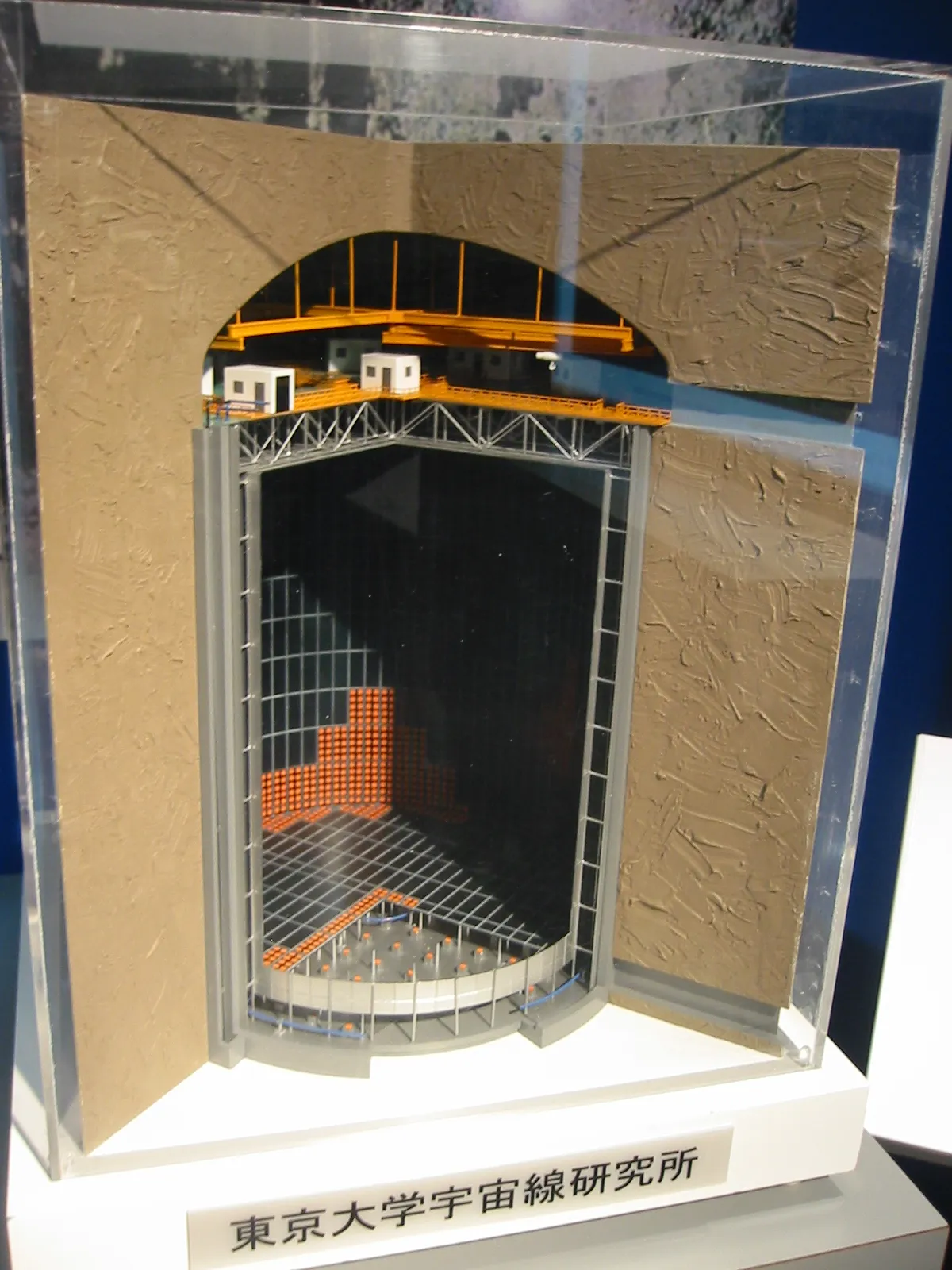
In Japan, Masatoshi Koshiba led Kamiokande, the Kamioka Nucleon Decay Experiment, in a zinc mine in Gifu prefecture. It held about 3,000 tonnes of water and about 1,000 photomultipliers with a diameter of 20 inches, developed with Hamamatsu Photonics for the purpose. The large tubes gave Kamiokande a much higher light coverage than IMB despite its smaller mass. It began operating in July 1983.
Reaction and results
Neither experiment found proton decay. By the mid-1980s their limits on the p → e⁺π⁰ lifetime exceeded 10³² years, ruling out the minimal SU(5) model. The collaborations then turned to what had been their background: neutrinos. Between 1984 and 1985 Kamiokande was upgraded to Kamiokande-II with an outer veto detector, water purification against radon and better electronics with help from the University of Pennsylvania, lowering its threshold to below 10 MeV. IMB later replaced its tubes with larger ones to collect more light.
Why it matters
- The upgrades made it possible for both detectors to see the neutrino burst from SN 1987A on 23 February 1987.
- Counting muon-like and electron-like atmospheric neutrinos led Kamiokande to the atmospheric anomaly in 1988; IMB saw a similar deficit.
- In 1989 Kamiokande measured boron-8 solar neutrinos in real time and with direction.
- The water Cherenkov technique was scaled up to Super-Kamiokande in 1996 and will continue in Hyper-Kamiokande.
A search that failed in its original aim thus became the starting point of neutrino astronomy and of the discovery of neutrino oscillation; Koshiba shared the 2002 Nobel Prize in Physics for it.
Frequently asked questions
When did Kamiokande and IMB start?
IMB began taking data in 1982 and Kamiokande in July 1983.
What were they built for?
Both were built to look for proton decay predicted by grand unified theories. They never saw it, but they became the first large detectors for atmospheric, solar and supernova neutrinos.
Why were the Kamiokande photomultipliers so large?
Their 20-inch diameter let a modest number of tubes cover a large fraction of the tank wall, which lowered the energy threshold and later made solar neutrino measurements possible.
Original papers
- First resultR. M. Bionta et al. (IMB), Search for Proton Decay into e+ π0, Phys. Rev. Lett. 51, 27 (1983)DOI 10.1103/PhysRevLett.51.27
Concepts
Mentioned in 2 pages
Last updated: · Editorial standard
Cite this page
Text
Neutrino Atlas (2026). “1983: Large water Cherenkov detectors begin operation”. Retrieved 22 November 2026, from https://neutrino-atlas.com/timeline/1983-kamiokande-imb-start/BibTeX
@misc{neutrinoatlas2026ne1983kamiokandeimbstart,
  title        = {1983: Large water Cherenkov detectors begin operation},
  author       = {{Neutrino Atlas}},
  year         = {2026},
  url          = {https://neutrino-atlas.com/timeline/1983-kamiokande-imb-start/},
  note         = {Accessed 2026-11-22},
  language     = {english}
}