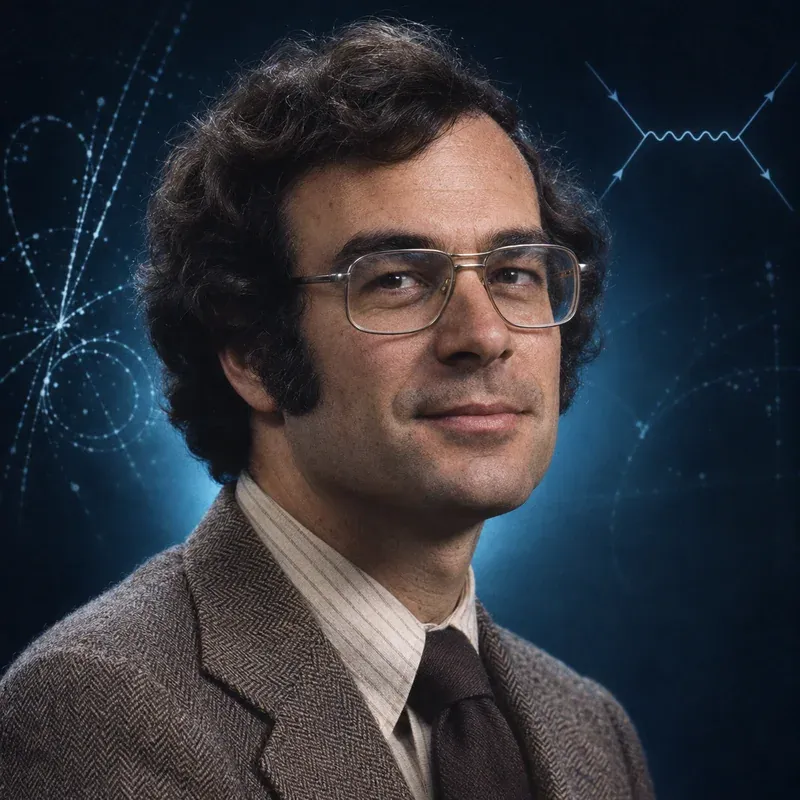
 Illustration
Lawrence R. Sulak
Sulak's Harvard group, with Rubbia and collaborators from Penn and Wisconsin, observed weak neutral currents at Fermilab at about the same time as Gargamelle, and first observed neutrino–nucleon elastic scattering (1975). In 1978 he and his Harvard students proposed the 10,000-ton IMB water Cherenkov detector, which detected SN 1987A neutrinos and an early deficit of atmospheric muon neutrinos.
- Born
- 29 August 1944
- Nationality
- American
- Field
- Experimental particle physics
- Institutions
- Princeton University (PhD 1970), Harvard University, University of Michigan, Boston University
Education
Lawrence R. Sulak, known to colleagues as Larry, was born on 29 August 1944. He studied at Carnegie Mellon University and went on to Princeton University, where he received his PhD in 1970 with a precise measurement of the mass difference between the two neutral kaon states, K⁰₁ and K⁰₂. He then joined the faculty at Harvard University, where he built some of the first large calorimeters used in experiments at Fermilab and Brookhaven.
Neutral currents at Fermilab
In the early 1970s the electroweak theory of Sheldon Glashow, Steven Weinberg and Abdus Salam predicted a neutral current: weak interactions in which a neutrino scatters without turning into a charged lepton, mediated by the Z boson. Sulak's Harvard group worked with Carlo Rubbia and collaborators from Pennsylvania and Wisconsin on the Fermilab experiment known as HPWF. Their observation of neutral-current events came at about the same time as the discovery at Gargamelle at CERN, and the historian Peter Galison later used the episode as a case study of how experimenters decide that an effect is real. In 1975 the group also reported the first observation of elastic neutrino–nucleon scattering.
The IMB detector
Grand unified theories of the late 1970s, among them a model by Glashow and Howard Georgi, predicted that protons should decay with lifetimes not far beyond 10³⁰ years. In 1978 Sulak and two Harvard graduate students proposed a detector of unprecedented size to test this: about 10,000 tonnes of ultrapure water in a salt mine under Lake Erie near Cleveland, Ohio, lined with photomultipliers to record Cherenkov light from charged particles. Built with groups from the University of California, Irvine and the University of Michigan, it became the Irvine–Michigan–Brookhaven experiment, IMB.
IMB found no proton decay and by 1983 had pushed the lifetime limit beyond 10³² years, ruling out the simplest grand unified models. Glashow later remarked that he was not happy that the theory was wrong, but happy that it was Larry who had shown it. The detector proved far more valuable for neutrinos. On 23 February 1987 it recorded eight events from SN 1987A in coincidence with Kamiokande, the first detection of neutrinos from a supernova. IMB also saw fewer atmospheric muon neutrinos than expected, an early hint of the oscillations later established by Super-Kamiokande.
Later work
At Boston University, where he chaired the physics department and became David M. Myers Distinguished Professor, Sulak led groups in Super-Kamiokande, which grew partly out of the IMB community, and in the MACRO experiment at Gran Sasso. He also spearheaded the forward hadronic calorimeter of the CMS experiment at CERN's Large Hadron Collider, which took part in the 2012 discovery of the Higgs boson. He shares the 1989 Bruno Rossi Prize (IMB), the 1998 Asahi Prize and the Breakthrough Prize in Fundamental Physics announced in 2015 (Super-Kamiokande).
The American Physical Society awarded him the 2018 W.K.H. Panofsky Prize, announced in 2017, “for novel contributions to detection techniques, including pioneering developments for massive water Cherenkov detectors.” The water Cherenkov technique he helped scale up is now the basis of detectors from Hyper-Kamiokande to neutrino telescopes.
Known for
- Co-discovery of neutral currents (HPWF, Fermilab)
- Proposed and designed IMB (1978)
- SN 1987A detection
- Panofsky Prize 2017
Chronology
- 1975First observation of neutrino–nucleon elastic scattering
- 1978Proposes the IMB detector
- 1983IMB nucleon lifetime limit > 10³² years
- 1987IMB detects SN 1987A
- 2017Panofsky Prize
Original papers
- R. M. Bionta et al. (IMB), Observation of a neutrino burst in coincidence with supernova 1987A in the Large Magellanic Cloud, Phys. Rev. Lett. 58, 1494 (1987)DOI 10.1103/PhysRevLett.58.1494
Experiments
Connected people
Frequently asked questions
What was the IMB experiment?
IMB was a 10,000-tonne water Cherenkov detector in a salt mine near Cleveland, proposed by Sulak in 1978 to look for proton decay. It saw no decays but detected neutrinos from supernova 1987A and an early deficit of atmospheric muon neutrinos.
Did Lawrence Sulak help discover neutral currents?
Yes. His Harvard group was part of the HPWF experiment at Fermilab, which observed weak neutral currents in 1973–74, at about the same time as Gargamelle at CERN.
What awards has Sulak received?
Among others, the APS Panofsky Prize (2018) and shares of the Bruno Rossi Prize, the Asahi Prize and the Breakthrough Prize in Fundamental Physics with his collaborations.
On the timeline
Mentioned in 9 pages
Last updated: · Editorial standard
Cite this page
Text
Neutrino Atlas (2026). “Lawrence R. Sulak”. Retrieved 22 November 2026, from https://neutrino-atlas.com/people/lawrence-sulak/BibTeX
@misc{neutrinoatlas2026peoplelawrencesulak,
  title        = {Lawrence R. Sulak},
  author       = {{Neutrino Atlas}},
  year         = {2026},
  url          = {https://neutrino-atlas.com/people/lawrence-sulak/},
  note         = {Accessed 2026-11-22},
  language     = {english}
}