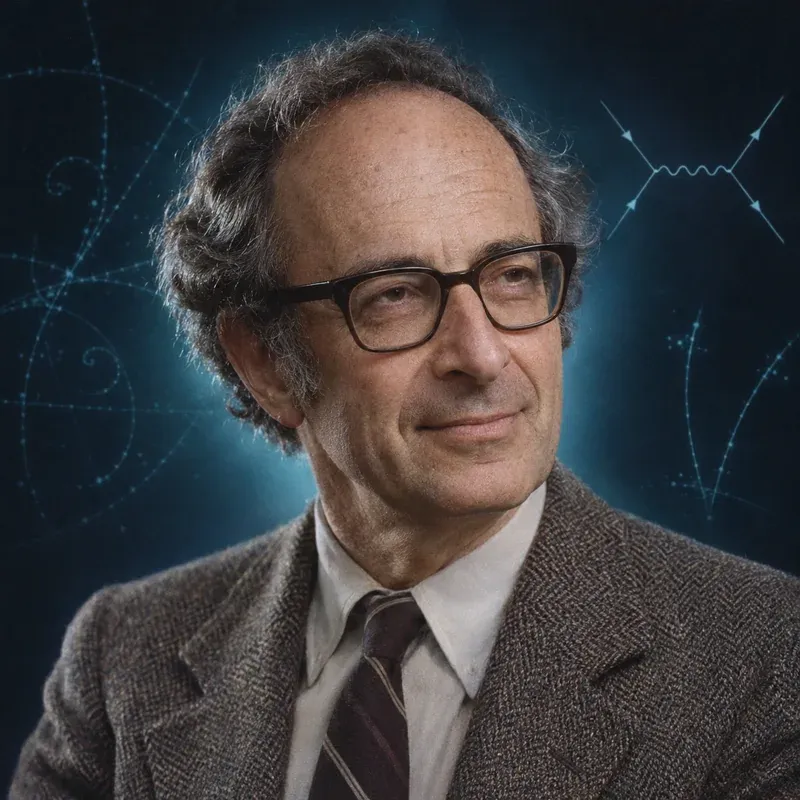
 Illustration
Alfred K. Mann
Mann organised the Fermilab neutrino experiment E-1A with Rubbia and Cline, which confirmed weak neutral currents and discovered dimuon events signalling charm. From 1984 he led the US group in the Kamiokande collaboration, whose upgraded detector observed SN 1987A neutrinos, made the first direct real-time measurement of solar neutrinos and saw the atmospheric neutrino ratio anomaly.
- Born
- 4 September 1920
New York City, USA - Died
- 13 January 2013
Gwynedd, Pennsylvania, USA - Nationality
- American
- Field
- Experimental particle physics
- Institutions
- University of Virginia, Columbia University, University of Pennsylvania
Early life and education
Alfred Kenneth Mann was born in New York City on 4 September 1920. He took an undergraduate degree in philosophy at the University of Virginia in 1942 and stayed there for physics, earning his PhD in 1947 under Jesse Beams. During the war he built servomechanisms for Beams's uranium-isotope centrifuges, which he later learned were part of the Manhattan Project, and then worked on rocket guidance.
Path to neutrino physics
After a period at Columbia University with Polykarp Kusch, Mann joined the University of Pennsylvania in 1949 and stayed for the rest of his career. He studied photonuclear reactions, helped build the Princeton–Pennsylvania Accelerator and used it for kaon decays. When the new laboratory that became Fermilab opened, he recruited Carlo Rubbia and David Cline and wrote the proposal for E-1A, the first experiment approved there.
Key contributions
E-1A, also known as the Harvard–Penn–Wisconsin experiment, sent high-energy neutrinos into a large detector and in 1974 confirmed the existence of weak neutral currents: events in which the neutrino scatters without turning into a muon, a key prediction of electroweak theory. The same experiment found events with two muons, strong evidence for the then-new charm quark. In the 1980s Mann helped build a fine-grained detector at Brookhaven that measured neutrino scattering on protons and electrons and helped pin down the weak mixing angle.
In 1984 Masatoshi Koshiba invited Mann to lead a group of US physicists in upgrading Kamiokande. The improved detector, Kamiokande-II, recorded the neutrino burst from SN 1987A, made the first direct real-time measurement of solar neutrinos and saw the anomaly in the ratio of muon to electron atmospheric neutrinos that Super-Kamiokande later traced to oscillation. Mann told the supernova story in his book Shadow of a Star (1997).
Later work
Mann argued for decades for a dedicated US underground laboratory. In his eighties he campaigned to keep the Homestake gold mine in South Dakota open for science, which led to the Sanford Underground Research Facility. He also wrote For Better or Worse (2000), on science and government in the United States. He died in Gwynedd, Pennsylvania, on 13 January 2013.
Known for
- Fermilab E-1A neutral currents and dimuons
- Leader of the US group in Kamiokande-II
- Book 'Shadow of a Star' on SN 1987A
Chronology
- 1949Joins University of Pennsylvania
- 1974E-1A neutral-current observation
- 1984Leads US group joining Kamiokande
- 1987SN 1987A detection
Original papers
- A. Benvenuti et al., Observation of Muonless Neutrino-Induced Inelastic Interactions, Phys. Rev. Lett. 32, 800 (1974)DOI 10.1103/PhysRevLett.32.800
- A. K. Mann, Shadow of a Star: The Neutrino Story of Supernova 1987A, W. H. Freeman (1997)
Experiments
- Fermilab E-1A
- Brookhaven AGS neutrino scattering
- Kamiokande
Connected people
Frequently asked questions
What did Alfred Mann discover?
His Fermilab experiment E-1A confirmed weak neutral currents in 1974 and found dimuon events that pointed to charm. Later his US group helped Kamiokande-II detect neutrinos from SN 1987A.
Why is Mann connected to the Homestake mine?
He helped lead the campaign in the early 2000s to preserve the Homestake mine for underground physics, which became the Sanford Underground Research Facility.
On the timeline
Mentioned in 8 pages
Last updated: · Editorial standard
Cite this page
Text
Neutrino Atlas (2026). “Alfred K. Mann”. Retrieved 22 November 2026, from https://neutrino-atlas.com/people/alfred-mann/BibTeX
@misc{neutrinoatlas2026peoplealfredmann,
  title        = {Alfred K. Mann},
  author       = {{Neutrino Atlas}},
  year         = {2026},
  url          = {https://neutrino-atlas.com/people/alfred-mann/},
  note         = {Accessed 2026-11-22},
  language     = {english}
}