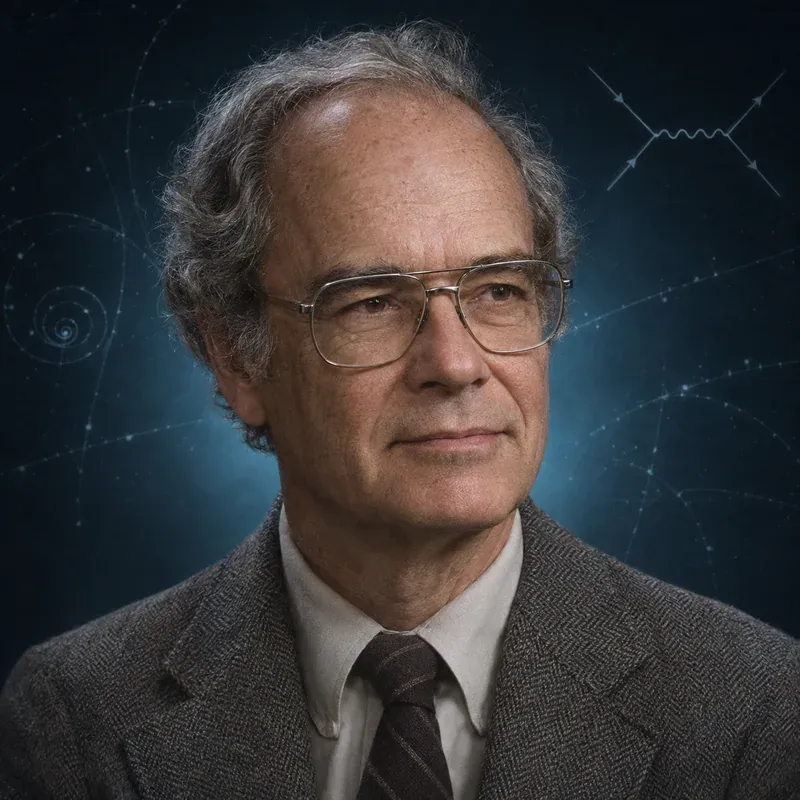
 Illustration
David Bruce Cline
With Carlo Rubbia and Alfred Mann, Cline led the Harvard–Pennsylvania–Wisconsin–Fermilab (HPWF) experiment in Fermilab's first neutrino beam. After an initially confusing period in 1973, the group published in 1974 its observation of muonless neutrino interactions, the first confirmation of the weak neutral current found at Gargamelle. HPWF also recorded opposite-sign dimuon events that pointed to charm production by neutrinos. Later, at UCLA, Cline collaborated on the 600-tonne ICARUS liquid-argon detector at Gran Sasso and argued early for scaling such detectors up to tens of thousands of tonnes, the concept realised in DUNE.
- Born
- 7 December 1933
Rosedale, Kansas, USA - Died
- 27 June 2015
Los Angeles, California, USA - Nationality
- American
- Field
- Experimental particle and astroparticle physics
- Institutions
- Kansas State University, University of Wisconsin–Madison, Fermilab, University of California, Los Angeles
Early life and education
David Bruce Cline was born in Rosedale, Kansas, in 1933. He took his bachelor's and master's degrees in physics at Kansas State University and his doctorate in 1965 at the University of Wisconsin, where he stayed on as a professor. His early experiments on kaon decays probed whether weak processes could change the quark flavour without changing electric charge, and the very low rates he found were part of the evidence that such flavour-changing neutral processes are strongly suppressed.
The neutral current at Fermilab
In the early 1970s Cline, Carlo Rubbia and Alfred Mann led the Harvard–Pennsylvania–Wisconsin–Fermilab (HPWF) collaboration, one of the first experiments in the new neutrino beam at Fermilab. Its detector combined a liquid-scintillator calorimeter with a muon spectrometer, so that events with and without an outgoing muon could be compared. When the Gargamelle collaboration at CERN announced the weak neutral current in 1973, HPWF's own analysis went through a period of conflicting results, sometimes called the episode of 'alternating neutral currents', partly because muons escaping at wide angles could mimic muonless events. After the detector was modified, the collaboration published in 1974 a clear observation of muonless, neutrino-induced interactions, confirming the CERN discovery. HPWF also reported events with two oppositely charged muons, an early sign that neutrinos produce charmed particles.
From colliders to liquid argon
In 1976 Cline, Rubbia and Peter McIntyre proposed turning an existing proton accelerator into a proton-antiproton collider in order to produce the W and Z bosons. The idea, made possible by Simon van der Meer's stochastic cooling, led to the discovery of the W and Z bosons at CERN in 1983. After moving to UCLA in 1986 Cline worked on the ICARUS detector, a 600-tonne liquid-argon time projection chamber installed at Gran Sasso, and he was among the earliest advocates of scaling the technology up to tens of thousands of tonnes for long-baseline neutrino physics and proton decay. That idea is now realised in the far detectors of DUNE.
Dark matter and later work
Cline's UCLA group developed liquid xenon and liquid argon as targets for direct dark matter searches, and from 1994 he organised a regular conference on dark matter near Los Angeles. He was also a founding member of the CMS collaboration at the LHC. He died on the UCLA campus in June 2015, aged 81.
Known for
- Fermilab HPWF neutrino experiment and the confirmation of weak neutral currents (1974)
- Proposal of the proton-antiproton collider with Rubbia and McIntyre (1976)
- Advocacy of large liquid-argon neutrino detectors and ICARUS
- Liquid-noble-gas dark matter detectors at UCLA
Chronology
- 1965PhD at the University of Wisconsin
- 1974HPWF publishes the observation of muonless neutrino events
- 1976Proposes the proton-antiproton collider with Rubbia and McIntyre
- 1983W and Z bosons discovered at CERN's proton-antiproton collider
- 1986Moves to UCLA
- 1994Starts the UCLA dark matter conference series
Original papers
- A. Benvenuti et al., Observation of muonless neutrino-induced inelastic interactions, Phys. Rev. Lett. 32, 800 (1974)DOI 10.1103/PhysRevLett.32.800
Experiments
- HPWF
- ICARUS
- UA1
Connected people
Frequently asked questions
What were the 'alternating neutral currents'?
A nickname for the period in 1973 when the HPWF experiment's results on muonless neutrino events seemed to change from one analysis to the next. The final 1974 result confirmed the neutral current discovered at Gargamelle.
Last updated: · Editorial standard
Cite this page
Text
Neutrino Atlas (2026). “David Bruce Cline”. Retrieved 22 November 2026, from https://neutrino-atlas.com/people/david-cline/BibTeX
@misc{neutrinoatlas2026peopledavidcline,
  title        = {David Bruce Cline},
  author       = {{Neutrino Atlas}},
  year         = {2026},
  url          = {https://neutrino-atlas.com/people/david-cline/},
  note         = {Accessed 2026-11-22},
  language     = {english}
}