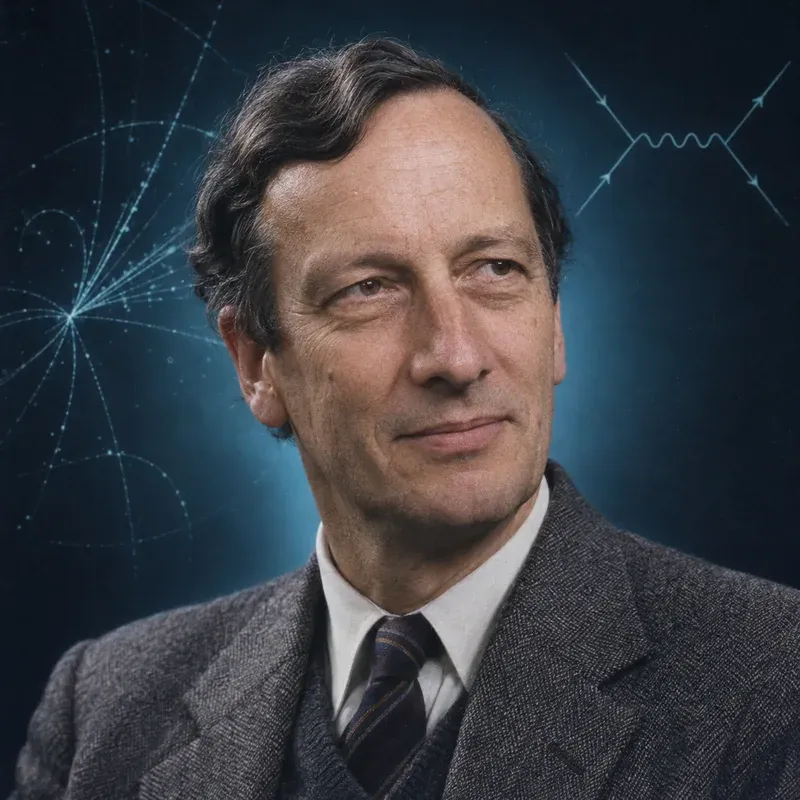
 Illustration
Simon van der Meer
In 1961 van der Meer invented the magnetic horn, a pulsed focusing device that collects the charged pions and kaons produced in a target and focuses them into a parallel beam, greatly enhancing the resulting neutrino flux. Horn focusing became standard in accelerator neutrino beams, including the CERN PS beam used by Gargamelle.
- Born
- 24 November 1925
The Hague, Netherlands - Died
- 4 March 2011
Geneva, Switzerland - Nationality
- Dutch
- Field
- Accelerator physics
- Nobel Prize
- Physics 1984 – for decisive contributions to the large project which led to the discovery of the field particles W and Z (shared with Carlo Rubbia)
- Institutions
- Philips Research, Eindhoven, CERN
Early life and education
Simon van der Meer was born on 24 November 1925 in The Hague, one of four children in a family of teachers. He finished secondary school in 1943, during the German occupation, and after the war studied technical physics at Delft University of Technology, graduating as an engineer in 1952. He then spent several years at Philips Research in Eindhoven, working on high-voltage equipment for electron microscopes. In 1956 he joined the young European laboratory CERN in Geneva, where he stayed until his retirement in 1990. His first tasks included magnet design for the 28 GeV Proton Synchrotron (PS).
The magnetic horn
Accelerator neutrino beams start with protons striking a target. The collisions produce charged pions and kaons flying off at a spread of angles; they decay in flight into muons and muon neutrinos. Because neutrinos are neutral they cannot be steered, so the only way to make an intense, well-directed beam is to focus their charged parents before they decay. Early beams wasted most of these particles.
In 1961 van der Meer proposed a solution in a CERN report titled “A directive device for charged particles and its use in an enhanced neutrino beam”. His magnetic horn is a pair of coaxial conductors shaped like a horn. A current pulse of hundreds of kiloamperes, timed to the proton spill, runs along the inner conductor and back along the outer one, creating a toroidal magnetic field in the space between. Particles of one charge that leave the target at an angle are bent back toward the axis, while those of the opposite charge are swept away. The horn's shape determines which momenta are focused best.
The device multiplied the neutrino flux and gave experimenters a switch: reversing the current (horn polarity) selects positive or negative parents and so a beam of neutrinos or antineutrinos. A horn-focused PS beam fed the Gargamelle bubble chamber of André Lagarrigue's collaboration, which discovered weak neutral currents in 1973. Horn focusing remains the core of every major beamline, including NuMI at Fermilab, the J-PARC beam for T2K, CNGS and the planned LBNF beam for DUNE.
Stochastic cooling and the Nobel Prize
Van der Meer's best-known invention came later. In the 1970s he worked on power supplies and control for the Intersecting Storage Rings and the SPS, and developed the luminosity calibration now called the van der Meer scan, still used at the Large Hadron Collider. He also invented stochastic cooling: pickups sense the average deviation of small samples of particles in a stored beam, and kickers further around the ring apply corrections, gradually squeezing a hot, diffuse beam into a dense one.
Stochastic cooling made it possible to accumulate enough antiprotons to collide them with protons in the SPS. In 1983 the UA1 experiment led by Carlo Rubbia, together with UA2, discovered the W and Z bosons, the carriers of the weak interaction whose effects neutrino physicists had studied for decades. Van der Meer and Rubbia shared the 1984 Nobel Prize in Physics. He became a member of the Royal Netherlands Academy of Arts and Sciences the same year and died in Geneva on 4 March 2011, aged 85.
Known for
- Magnetic (van der Meer) horn for neutrino beams (1961)
- Stochastic cooling
- W and Z discovery at CERN
Chronology
- 1956Joins CERN
- 1961Invents the magnetic horn
- 1984Nobel Prize in Physics
- 1990Retires from CERN
Original papers
- S. van der Meer, A directive device for charged particles and its use in an enhanced neutrino beam, CERN Report CERN-61-07 (1961)
Experiments
- CERN PS neutrino beam
- Gargamelle
Connected people
Frequently asked questions
What is a van der Meer horn?
A pulsed, horn-shaped coaxial magnet placed after the target of a neutrino beamline. Its toroidal field focuses charged pions and kaons of one sign toward the beam axis, so their decays give a much more intense neutrino beam.
Did Simon van der Meer win a Nobel Prize?
Yes. He shared the 1984 Nobel Prize in Physics with Carlo Rubbia for contributions to the project that discovered the W and Z bosons, made possible by his stochastic cooling.
Is the magnetic horn still used?
Yes. Long-baseline beams such as NuMI and the J-PARC beam use systems of two or three horns, and their polarity is reversed to switch between neutrino and antineutrino running.
Mentioned in 11 pages
Last updated: · Editorial standard
Cite this page
Text
Neutrino Atlas (2026). “Simon van der Meer”. Retrieved 22 November 2026, from https://neutrino-atlas.com/people/simon-van-der-meer/BibTeX
@misc{neutrinoatlas2026peoplesimonvandermeer,
  title        = {Simon van der Meer},
  author       = {{Neutrino Atlas}},
  year         = {2026},
  url          = {https://neutrino-atlas.com/people/simon-van-der-meer/},
  note         = {Accessed 2026-11-22},
  language     = {english}
}