CNGS (CERN Neutrinos to Gran Sasso)
CERN's high-energy νµ beam sent 730 km through the Earth to Gran Sasso.
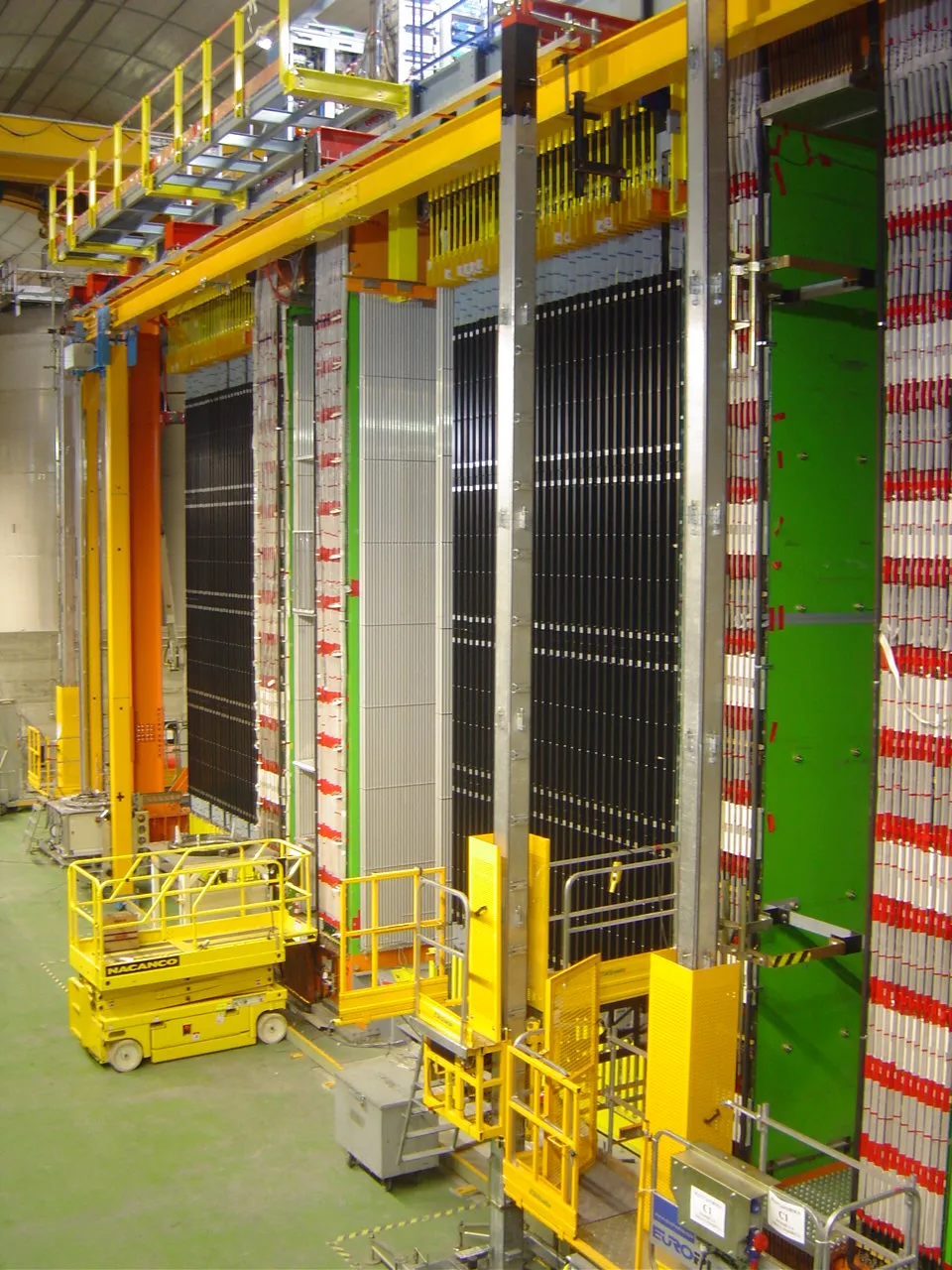
Using 400 GeV SPS protons, CNGS produced a beam with mean energy of about 17 GeV, optimised for ντ appearance above the tau production threshold. It served OPERA, ICARUS and other LNGS detectors.
Compare all experiments → · World map →
In plain words
CERN Neutrinos to Gran Sasso was built to settle a simple question: if muon neutrinos oscillate, do they really turn into tau neutrinos? To catch a tau neutrino in the act, the beam needed enough energy to create the heavy tau lepton, so CERN sent a high-energy beam 730 km under the Alps and the Apennines to the Italian underground laboratory.
In detail
400 GeV protons from the SPS hit a graphite target. Two horns focused the mesons into a decay tunnel about 1 km long, pointed downwards at the LNGS halls. The mean muon-neutrino energy of about 17 GeV is well above the 3.5 GeV threshold for tau production. Because the baseline is short for such energies, only a small fraction of neutrinos oscillate, so the beam had to be intense: from 2006 to 2012 it delivered about 1.8 × 10²⁰ protons on target.
Key results
- OPERA found 10 tau-neutrino candidates in its nuclear emulsion bricks, giving tau-neutrino appearance at 6.1σ in its final analysis.
- ICARUS ran its 600-ton liquid-argon TPC in the beam and tested the LSND anomaly.
- In 2011 OPERA reported neutrinos apparently faster than light; the result was traced to a faulty fibre connection, and ICARUS and other LNGS detectors measured speeds consistent with light (see OPERA anomaly).
Status today
CNGS ended in December 2012. Its tunnel area was reused for the AWAKE plasma-acceleration experiment.
Frequently asked questions
Why did CNGS need such a high energy?
To produce a tau lepton in a charged-current interaction, the neutrino needs at least about 3.5 GeV; the beam was tuned well above this to maximise tau events.
Was there a near detector?
No. The beam was monitored with muon detectors behind the decay tunnel, and the search relied on the distinct tau signature rather than a near–far comparison.
Original papers
- ProposalG. Acquistapace et al., The CERN neutrino beam to Gran Sasso (NGS): Conceptual technical design, CERN-98-02 (1998)
Related terms
People
On the timeline
- 2010OPERA sees the first tau from oscillation
- 2011OPERA neutrino-speed anomaly and its resolution
- 2015OPERA establishes tau-neutrino appearance
Mentioned in 25 pages
Milestones 3
Terms 14
Last updated: · Editorial standard
Cite this page
Text
Neutrino Atlas (2026). “CNGS (CERN Neutrinos to Gran Sasso)”. Retrieved 22 November 2026, from https://neutrino-atlas.com/terms/cngs/BibTeX
@misc{neutrinoatlas2026termscngs,
  title        = {CNGS (CERN Neutrinos to Gran Sasso)},
  author       = {{Neutrino Atlas}},
  year         = {2026},
  url          = {https://neutrino-atlas.com/terms/cngs/},
  note         = {Accessed 2026-11-22},
  language     = {english}
}