2010Discovery
OPERA sees the first tau from oscillation
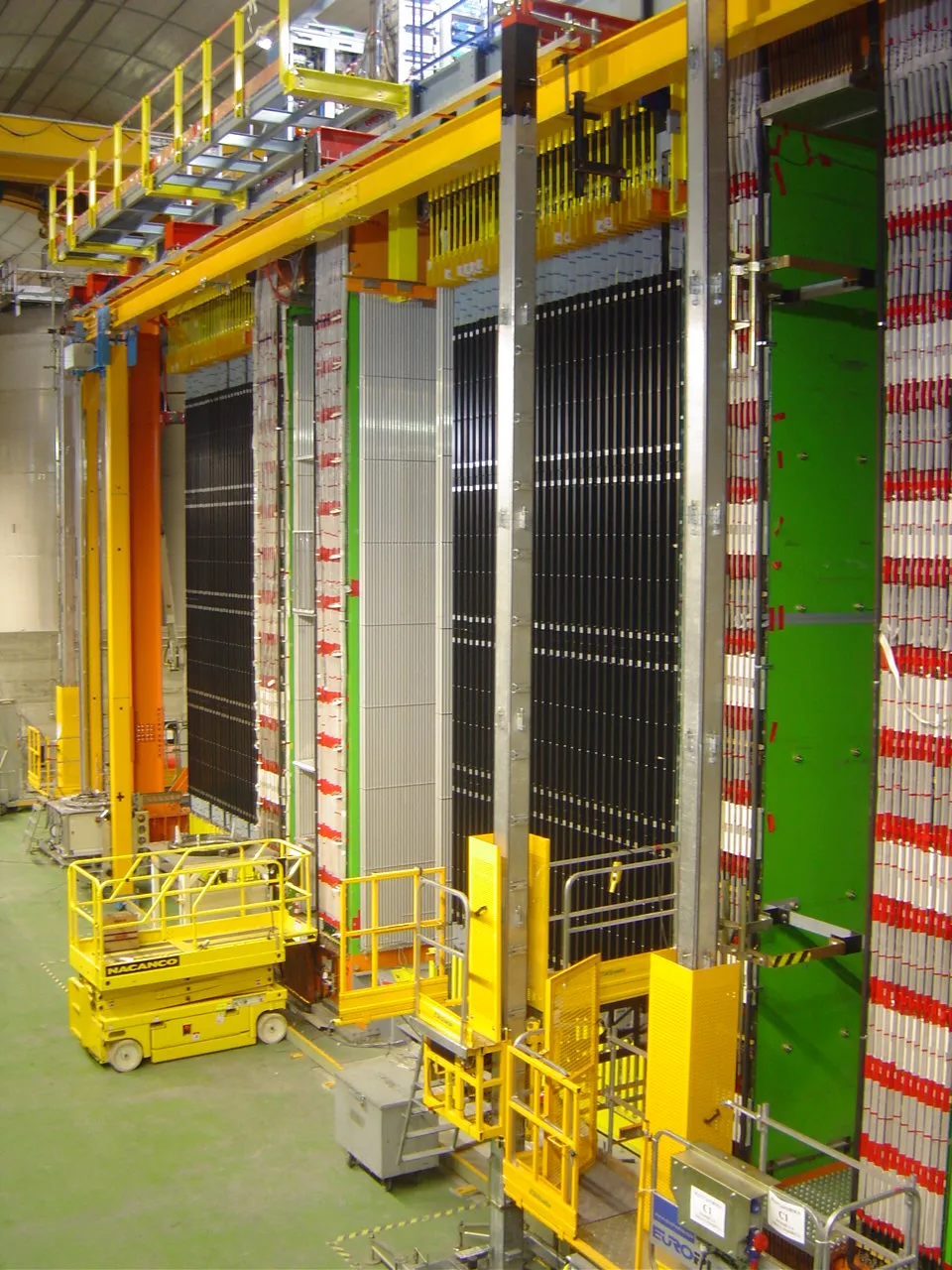
OPERA at Gran Sasso, an emulsion-and-lead detector in the CNGS muon-neutrino beam from CERN 730 km away, announced on 31 May 2010 its first candidate tau-neutrino interaction. Tau neutrinos are not produced in the beam, so the event pointed to muon-to-tau neutrino oscillation in appearance mode. By 2015 OPERA had collected five events, establishing the appearance at 5.1σ.
- Date
- 31 May 2010
- Kind of event
- Discovery
- People involved
- Antonio Ereditato
The situation before
Since 1998 the deficit of atmospheric muon neutrinos had been explained by oscillation into tau neutrinos. Every confirmation so far, however, had been a disappearance measurement: muon neutrinos went missing, and their new identity was inferred. Tau neutrinos themselves are hard to catch. A charged-current interaction creates a tau lepton that lives only about 0.3 picoseconds and travels typically less than a millimetre before it decays. DONUT had seen the first tau-neutrino interactions in 2000, but from tau neutrinos produced directly in a beam dump, not from oscillation. Seeing a tau appear in a pure muon-neutrino beam would close the logical gap.
The experiment
To do this CERN built the CNGS beam, which sent muon neutrinos 730 km through the Earth's crust to the Gran Sasso laboratory from 2006. Its mean energy of about 17 GeV was chosen to lie well above the threshold for tau production. The OPERA detector, with Antonio Ereditato of Bern as spokesperson, used about 150,000 "bricks" of lead plates interleaved with nuclear emulsion films, a total target mass of about 1.25 kilotonnes. Electronic detectors located the brick in which an interaction occurred; the brick was then removed, developed and scanned under automated microscopes in Japan and Europe, with a technique refined by the Nagoya group around Kimio Niwa. The emulsion's micrometre resolution could reveal the tiny kink of a tau decay.
What happened
In an event recorded on 22 August 2009, scanners found a short track leaving the interaction vertex and changing direction after about 1.3 mm, with a decay into a negative hadron and two gamma rays from a neutral pion. The pattern matched a tau lepton decaying through a ρ meson. On 31 May 2010 OPERA announced the candidate in seminars at Gran Sasso and CERN.
- The analysed sample corresponded to about a third of the 2008–2009 data.
- Expected tau events in that sample: about 0.5; expected background: about 0.02 events.
- The probability that the event was background corresponded to a significance of 2.36σ.
The paper „Observation of a first ντ candidate event in the CNGS neutrino beam“ appeared in Physics Letters B 691, 138 (2010).
Reaction
Physicists welcomed the candidate as the long-awaited first direct sign of muon-to-tau appearance, while stressing that a single event was not a discovery. The collaboration was careful in the same way; its press material spoke of a first candidate, and the analysis of the remaining bricks continued.
What followed
- A second candidate was reported in 2012 and a third in 2013.
- With five events in 2015 OPERA established tau appearance at 5.1σ (Physical Review Letters 115, 121802).
- The final analysis of 2018, using looser selection criteria, found ten candidates and a significance of 6.1σ.
CNGS stopped running at the end of 2012. In 2013 Super-Kamiokande reported a statistical excess of tau-like atmospheric events, and IceCube later measured tau appearance in its DeepCore data. Together with OPERA these results confirmed that the missing atmospheric muon neutrinos become tau neutrinos, as the three-flavour oscillation picture requires. The same CNGS run also produced the 2011 neutrino-speed anomaly, which was traced to an equipment fault.
Frequently asked questions
When was the first tau neutrino from oscillation seen?
OPERA announced its first tau-neutrino candidate on 31 May 2010. The event itself had been recorded on 22 August 2009 in the CNGS beam from CERN.
How many tau events did OPERA find?
Five events by 2015, enough for a 5.1σ discovery of tau appearance, and ten candidates in the final 2018 analysis.
Why is seeing a tau neutrino harder than seeing a muon neutrino?
The tau lepton it produces decays after travelling typically less than a millimetre, so detectors need micrometre resolution, which OPERA obtained with nuclear emulsion films.
Original papers
- DiscoveryN. Agafonova et al. (OPERA), Observation of a first ντ candidate event in the OPERA experiment in the CNGS beam, Phys. Lett. B 691, 138 (2010)
- Final resultN. Agafonova et al. (OPERA), Discovery of τ Neutrino Appearance in the CNGS Neutrino Beam with the OPERA Experiment, Phys. Rev. Lett. 115, 121802 (2015)DOI 10.1103/PhysRevLett.115.121802
Concepts
Last updated: · Editorial standard
Cite this page
Text
Neutrino Atlas (2026). “2010: OPERA sees the first tau from oscillation”. Retrieved 22 November 2026, from https://neutrino-atlas.com/timeline/2010-opera-first-tau/BibTeX
@misc{neutrinoatlas2026imeline2010operafirsttau,
  title        = {2010: OPERA sees the first tau from oscillation},
  author       = {{Neutrino Atlas}},
  year         = {2026},
  url          = {https://neutrino-atlas.com/timeline/2010-opera-first-tau/},
  note         = {Accessed 2026-11-22},
  language     = {english}
}