2007Discovery
Borexino measures beryllium-7 solar neutrinos in real time
Borexino, an ultra-pure liquid-scintillator detector at Gran Sasso, began data taking in May 2007 and in August reported the first real-time detection of the 862 keV beryllium-7 solar neutrinos. Reaching this energy required radioactive contamination at unprecedentedly low levels. The measured rate agreed with the MSW large-mixing-angle prediction and probed the transition region between vacuum and matter-dominated oscillation.
- Date
- 2007
- Kind of event
- Discovery
- People involved
- Gianpaolo Bellini, Frank Paul Calaprice
- Experiments
- Borexino, Laboratori Nazionali del Gran Sasso (LNGS)
The situation before
By 2007 the solar neutrino problem was solved in outline. SNO and KamLAND had established flavour change with the large-mixing-angle parameters. But nearly all real-time solar data came from boron-8 neutrinos above about 5 MeV, less than one ten-thousandth of the solar flux. The bulk, from the pp chain below 1 MeV, had only been counted in integrated form by radiochemical gallium experiments. The MSW theory made a sharp prediction that had never been checked directly: at low energies, where matter effects in the Sun are weak, the electron-neutrino survival probability should be about 55 percent, rising from roughly 35 percent at boron-8 energies.
The cleanest test was the beryllium-7 line at 862 keV, about 7 percent of the solar flux. Detecting it in real time meant seeing recoil electrons below 665 keV, an energy region swamped by natural radioactivity in any ordinary material.
The detector
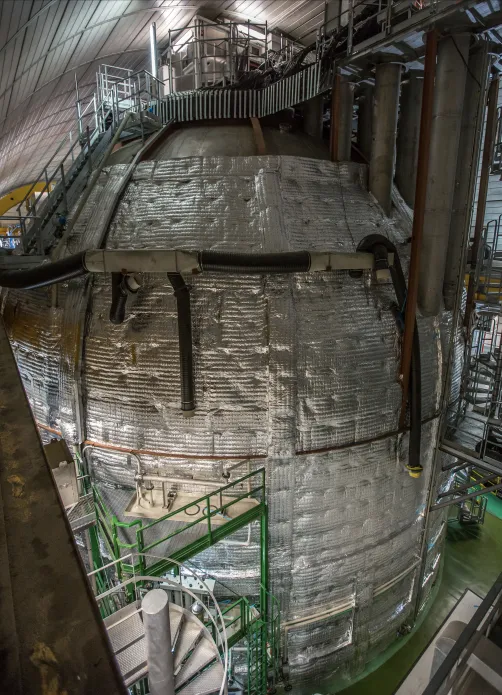
Borexino was proposed around 1990 by Gianpaolo Bellini of Milan, with Frank Calaprice of Princeton and other groups, for the Gran Sasso laboratory in Italy. About 278 tonnes of pseudocumene-based liquid scintillator sit in a thin nylon vessel, viewed by about 2,200 photomultipliers and surrounded by layers of buffer liquid and water. The core of the project was purification. A counting test facility in the 1990s proved that scintillator could be made with uranium and thorium below 10⁻¹⁶ gram per gram, and the final detector reached levels near 10⁻¹⁷, the lowest radioactive background of any detector of its size. Construction was delayed for several years, partly after a scintillator spill at the laboratory in 2002 led to restrictions on work underground.
What happened
Filling was completed and data taking began on 16 May 2007. Within three months the collaboration released its first result, from 47.4 live days, on 16 August 2007 (published in Physics Letters B in 2008).
- The recoil spectrum showed the shoulder expected from the beryllium-7 line, at about 665 keV.
- Measured rate: 47 ± 7 (stat) ± 12 (syst) counts per day per 100 tonnes.
- Expected without oscillation: about 75 counts; expected with large-mixing-angle MSW oscillation: about 49.
It was the first real-time detection of solar neutrinos below 1 MeV. A 2008 analysis with 192 days cut the uncertainty to about 10 percent (49 ± 3 ± 4), and by 2011 Borexino had measured the rate to 5 percent and found no day–night difference, ruling out the last alternative oscillation solution.
Why it matters
The result confirmed the predicted rise in survival probability toward low energies and placed the first point in the transition region between vacuum-dominated and matter-dominated oscillation. It also showed that ultra-pure scintillator could open the entire low-energy solar spectrum. Borexino went on to detect pep neutrinos in 2012, the primary pp neutrinos in 2014 and neutrinos from the CNO cycle in 2020, completing the spectroscopy of the Sun's fusion reactions before it shut down in 2021. Its purification techniques became the standard for SNO+, JUNO and dark-matter experiments.
Frequently asked questions
When did Borexino first detect beryllium-7 neutrinos?
Data taking began on 16 May 2007, and the first real-time detection of the 862 keV beryllium-7 solar neutrinos was announced in August 2007.
Why was the beryllium-7 measurement so difficult?
The signal lies below 1 MeV, where natural radioactivity normally dominates. Borexino had to reduce uranium and thorium in its scintillator to about 10⁻¹⁷ gram per gram to see it.
What did the measurement show?
The rate, about 47 to 49 counts per day per 100 tonnes, matched the large-mixing-angle MSW prediction and confirmed that the survival probability is higher at low energies than for boron-8 neutrinos.
Original papers
- DiscoveryC. Arpesella et al. (Borexino), First real time detection of 7Be solar neutrinos by Borexino, Phys. Lett. B 658, 101 (2008)
- MeasurementC. Arpesella et al. (Borexino), Direct Measurement of the 7Be Solar Neutrino Flux with 192 Days of Borexino Data, Phys. Rev. Lett. 101, 091302 (2008)DOI 10.1103/PhysRevLett.101.091302arXiv:0805.3843
Concepts
Mentioned in 1 page
Lessons 1
Last updated: · Editorial standard
Cite this page
Text
Neutrino Atlas (2026). “2007: Borexino measures beryllium-7 solar neutrinos in real time”. Retrieved 22 November 2026, from https://neutrino-atlas.com/timeline/2007-borexino-be7/BibTeX
@misc{neutrinoatlas2026timeline2007borexinobe7,
  title        = {2007: Borexino measures beryllium-7 solar neutrinos in real time},
  author       = {{Neutrino Atlas}},
  year         = {2026},
  url          = {https://neutrino-atlas.com/timeline/2007-borexino-be7/},
  note         = {Accessed 2026-11-22},
  language     = {english}
}