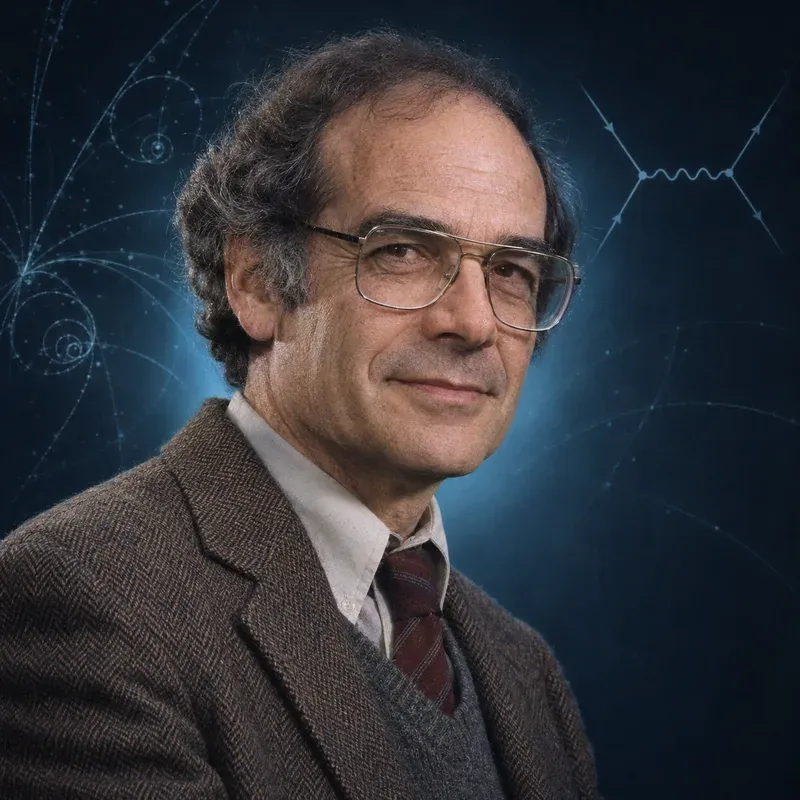
 Illustration
Frank Paul Calaprice
Calaprice co-founded Borexino at Gran Sasso and led Princeton's role, redesigning the detector after early setbacks and developing the ultra-low radioactive background purification that made real-time low-energy solar neutrino spectroscopy possible. Borexino (2007–2021) measured neutrinos from the pp chain and, for the first time, the CNO cycle, and detected geoneutrinos.
- Born
- 1939
- Died
- 30 June 2025
- Nationality
- American
- Field
- Experimental nuclear physics
- Institutions
- Pasadena City College, University of California, Berkeley (BA 1961, PhD 1967), Princeton University
Early life and education
Frank Paul Calaprice was born in 1939. He began his studies at Pasadena City College and went on to the University of California, Berkeley, where he earned a BA in 1961 and a PhD in 1967. In 1970 he joined Princeton University as an assistant professor, becoming a full professor in 1980; he ran the Princeton cyclotron laboratory, later jointly with Arthur B. McDonald.
Early research
Calaprice first made his name with precision tests of fundamental symmetries in beta decay. Using polarised noble-gas nuclei, his group carried out what was for more than twenty years the most sensitive test of time-reversal invariance in nuclear beta decay, a probe of CP violation in the weak interaction.
Borexino
In the early 1990s Calaprice co-founded Borexino at Gran Sasso with Gianpaolo Bellini and Raju Raghavan. The goal was to watch low-energy solar neutrinos in real time through their scattering on electrons in a liquid scintillator. Because each event is only a flash of light, the signal is visible only if the scintillator is almost free of natural radioactivity.
Calaprice led the design, commissioning and operation of the thin nylon vessels that hold the scintillator and of the purification and handling plants that gave Borexino its record radiopurity. After early setbacks he pushed through a major redesign. The detector saw its first clear neutrino signal on 1 May 2007, when it was only half full. Between 2007 and 2021 Borexino measured the beryllium-7, pep, boron-8 and pp neutrinos, mapping almost the whole pp chain, observed geoneutrinos and in 2020 made the first detection of neutrinos from the CNO cycle, which supply less than one per cent of the Sun's energy (see Borexino CNO).
Later work and legacy
Calaprice applied the same low-background techniques to dark matter, playing a key role in DarkSide, which uses argon extracted from underground sources, and in SABRE, based on sodium-iodide crystals. He became emeritus in 2018 and received the American Physical Society's Hans A. Bethe Prize for 2023 for pioneering large-scale ultra-low-background detectors, specifically Borexino. Wick Haxton said his Borexino results "will be in the textbooks a century from now." Calaprice died on 30 June 2025, days before his 86th birthday.
Known for
- Co-founder and leader of Borexino
- Ultra-low-background liquid scintillator purification
- Time-reversal tests in nuclear beta decay
- DarkSide and SABRE dark-matter experiments
- APS Hans A. Bethe Prize 2023
Chronology
- 1967PhD, UC Berkeley
- 1970Joins Princeton faculty
- 1980Full professor at Princeton
- 2007Borexino records first solar neutrino signals (May 2007)
- 2018Emeritus
- 2023APS Hans A. Bethe Prize
- 2025Dies (30 June)
Experiments
- Borexino
- DarkSide
- SABRE
Connected people
Frequently asked questions
What was Frank Calaprice's main achievement?
Making Borexino work: he led the scintillator vessels and purification systems that reached the extreme radiopurity needed to measure low-energy solar neutrinos, including the first detection of CNO neutrinos.
Why did Borexino need such low radioactivity?
Solar neutrino events in a scintillator look like ordinary radioactive decays, so the signal could only be seen once traces of uranium, thorium and other isotopes were reduced to unprecedented levels.
On the timeline
- 2007Borexino measures beryllium-7 solar neutrinos in real time
- 2014Borexino measures pp neutrinos spectroscopically
- 2020Borexino detects neutrinos from the CNO cycle
Mentioned in 5 pages
Last updated: · Editorial standard
Cite this page
Text
Neutrino Atlas (2026). “Frank Paul Calaprice”. Retrieved 22 November 2026, from https://neutrino-atlas.com/people/frank-calaprice/BibTeX
@misc{neutrinoatlas2026peoplefrankcalaprice,
  title        = {Frank Paul Calaprice},
  author       = {{Neutrino Atlas}},
  year         = {2026},
  url          = {https://neutrino-atlas.com/people/frank-calaprice/},
  note         = {Accessed 2026-11-22},
  language     = {english}
}