2014Discovery
Borexino measures pp neutrinos spectroscopically
In Nature in August 2014, Borexino reported the first real-time spectral measurement of neutrinos from the primary proton-proton fusion reaction, which powers about 99 percent of the Sun. The measured flux matched predictions within about 10 percent. Because these neutrinos left the core about eight minutes earlier, while the light now emitted at the surface was produced some 100,000 years ago, the agreement showed that the Sun's energy output has been stable on that timescale.
- Date
- 2014
- Kind of event
- Discovery
- People involved
- Gianpaolo Bellini, Frank Paul Calaprice
- Experiments
- Borexino, Laboratori Nazionali del Gran Sasso (LNGS)
Background
About 99 percent of the Sun's energy comes from the proton-proton chain, which begins when two protons fuse into deuterium and emit a positron and an electron neutrino. These pp neutrinos are by far the most numerous solar neutrinos, about 6 × 10¹⁰ per square centimetre per second at Earth, but their energy is at most 420 keV. The gallium experiments GALLEX and SAGE had counted them in the 1990s, but only as part of an integrated rate, without energy information and without telling when each neutrino arrived.
What happened
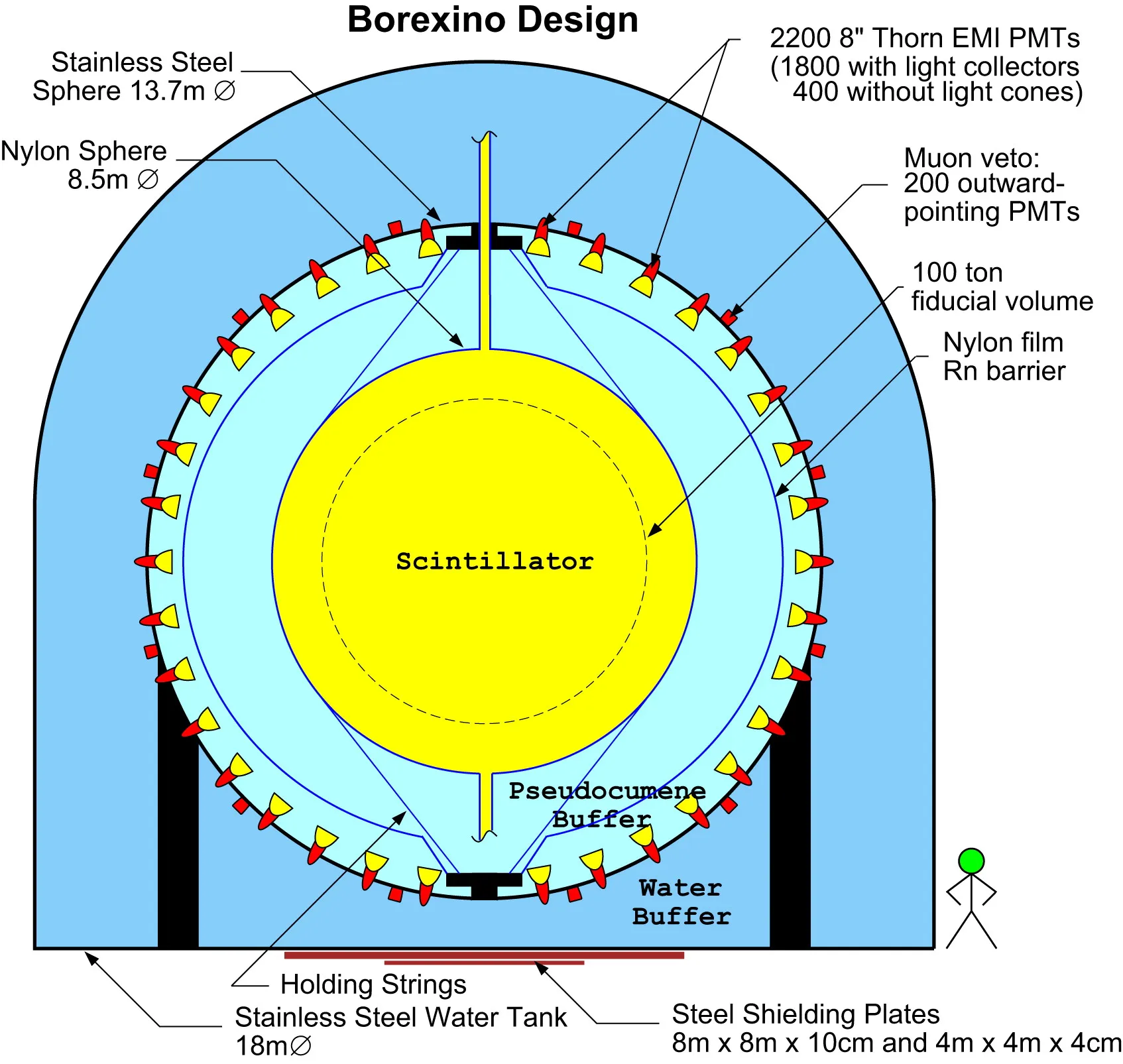
Borexino, a sphere of about 280 tonnes of ultrapure liquid scintillator at LNGS, detects neutrinos one by one through elastic scattering on electrons. The experiment, initiated by Gianpaolo Bellini with Frank Calaprice among its leading members, had already measured beryllium-7 neutrinos in 2007 and pep neutrinos in 2012. The pp neutrinos were the hardest target. Their recoil electrons have energies below about 260 keV, where the scintillator itself is radioactive: natural carbon-14 in the organic liquid decays with an endpoint of 156 keV, and two carbon-14 decays occurring almost simultaneously can mimic a higher-energy event.
After a purification campaign in 2010–2011 that reduced krypton-85 and bismuth-210, the collaboration analysed data from January 2012 to May 2013. A spectral fit between about 165 and 590 keV separated the pp neutrino signal from carbon-14, its pile-up, polonium-210 and other components. Borexino found 144 ± 13 (stat.) ± 10 (syst.) pp neutrino interactions per day per 100 tonnes of scintillator. The absence of a pp signal was excluded at 10σ. The corresponding flux,
agreed with the Standard Solar Model prediction of about 6.0 × 10¹⁰ cm⁻² s⁻¹ once neutrino oscillations were taken into account. The result was published in Nature on 28 August 2014.
Reaction
The measurement was received as a direct confirmation of the process that powers the Sun. It also had a timescale argument behind it. The neutrinos reached Earth about eight minutes after they were produced, while the energy emitted as sunlight today was released in the core tens of thousands to some hundred thousand years ago and slowly diffused outward. Agreement between the neutrino and photon energy outputs therefore showed that the Sun's core has been stable over that period. The measured survival probability of low-energy electron neutrinos, about 0.64, matched the vacuum-dominated regime predicted by the MSW picture.
Consequences
Borexino went on to measure all main pp-chain neutrino components in one comprehensive analysis published in Nature in 2018. In 2020 it detected neutrinos from the CNO cycle, completing its spectroscopy of solar fusion. The pp measurement remains a reference point for future large scintillator and liquid-xenon detectors that aim to measure low-energy solar neutrinos with percent-level precision.
Frequently asked questions
What are pp neutrinos?
They are electron neutrinos released in the first step of the proton-proton chain, when two protons fuse into deuterium. They carry at most 420 keV and are the most abundant solar neutrinos.
Why was the Borexino measurement difficult?
The signal lies at very low energy, where the scintillator's own carbon-14 decays dominate. Borexino needed extreme radiopurity and a careful spectral fit to separate the neutrino signal.
What did the result tell us about the Sun?
The neutrino-based energy output matched the luminosity seen in sunlight, which was produced long ago. This showed that the Sun's energy production has been stable over roughly the last hundred thousand years.
Original papers
- DiscoveryG. Bellini et al. (Borexino Collaboration), Neutrinos from the primary proton–proton fusion process in the Sun, Nature 512, 383 (2014)DOI 10.1038/nature13702
Concepts
Mentioned in 3 pages
Last updated: · Editorial standard
Cite this page
Text
Neutrino Atlas (2026). “2014: Borexino measures pp neutrinos spectroscopically”. Retrieved 22 November 2026, from https://neutrino-atlas.com/timeline/2014-borexino-pp/BibTeX
@misc{neutrinoatlas2026timeline2014borexinopp,
  title        = {2014: Borexino measures pp neutrinos spectroscopically},
  author       = {{Neutrino Atlas}},
  year         = {2026},
  url          = {https://neutrino-atlas.com/timeline/2014-borexino-pp/},
  note         = {Accessed 2026-11-22},
  language     = {english}
}