2012Discovery
Daya Bay discovers a non-zero θ₁₃
On 8 March 2012 the Daya Bay Reactor Neutrino Experiment in southern China, led by Wang Yifang and Kam-Biu Luk, announced a 5.2σ observation of electron antineutrino disappearance at about 1.6 km. Six identical detectors at near and far sites cancelled most systematic uncertainties. The result, sin²2θ₁₃ = 0.092 ± 0.017, was larger than many expected. A non-zero θ₁₃ makes leptonic CP violation measurable in long-baseline experiments.
- Date
- 8 March 2012
- Kind of event
- Discovery
- People involved
- Wang Yifang, Kam-Biu Luk, Cao Jun (Jun Cao)
- Experiments
- Daya Bay
The situation before
By early 2012 θ13, the last unmeasured mixing angle, was no longer expected to be zero. T2K had seen six electron-neutrino candidates in June 2011, MINOS a weaker hint, and Double Chooz a deficit of reactor antineutrinos in November 2011. None of these reached 3σ on its own. A clean measurement required comparing the antineutrino rate close to reactors with the rate about 1.5 to 2 km away, where the θ13 oscillation is near its first maximum, using identical detectors so that most uncertainties cancel.
The Daya Bay Reactor Neutrino Experiment in Guangdong province, near Hong Kong, was designed for exactly this. It was led by Wang Yifang of the Institute of High Energy Physics in Beijing and Kam-Biu Luk of Berkeley, with Cao Jun in charge of the antineutrino detectors. The site offered six reactor cores at the Daya Bay and Ling Ao plants, with a total thermal power of 17.4 GW, and mountains that provided rock cover for the detector halls. Construction began in 2007, making it the largest collaboration between China and the United States in basic science at the time.
What happened
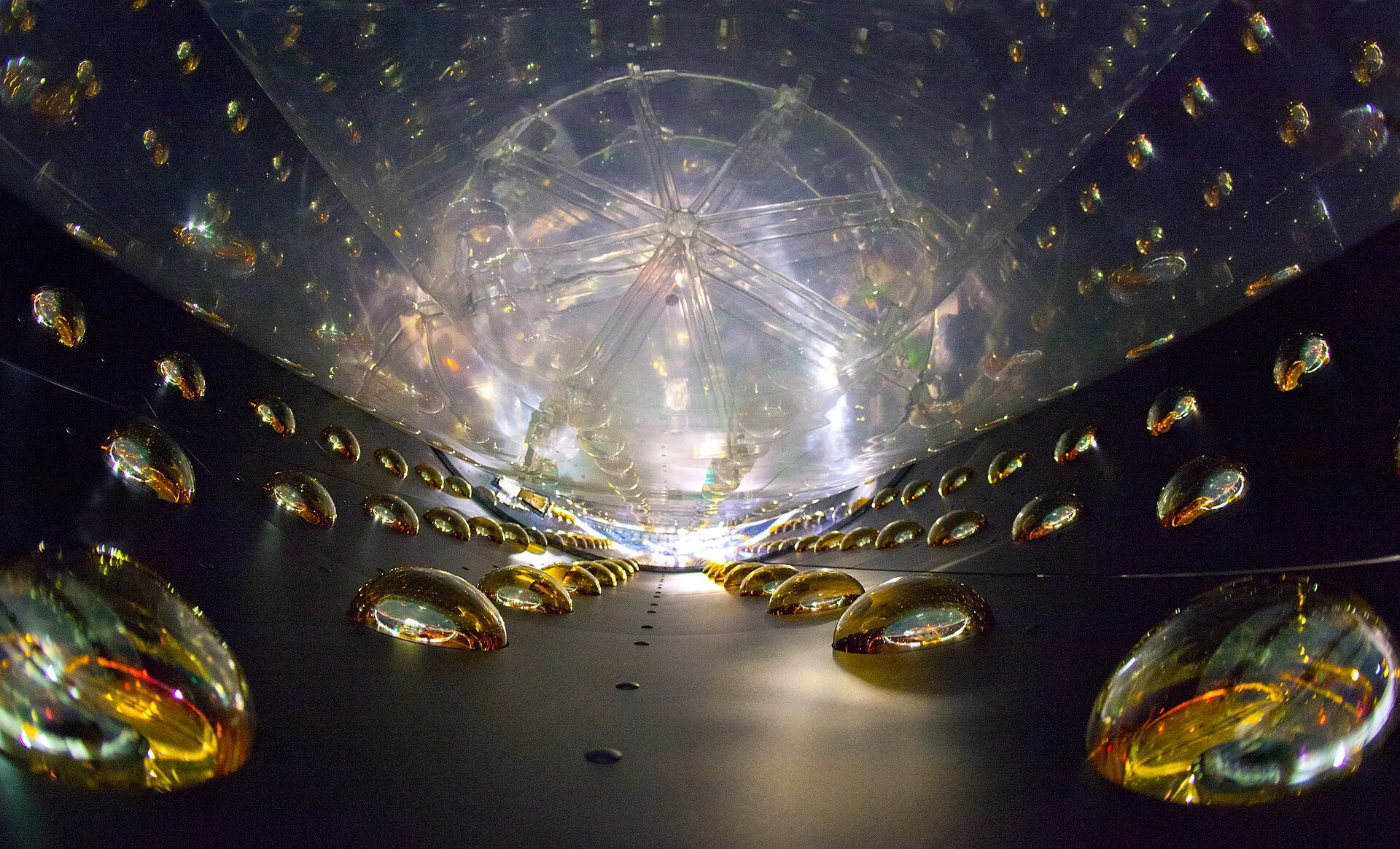
Six antineutrino detectors, each with 20 tonnes of gadolinium-loaded scintillator, were placed in three underground halls: two near Daya Bay, one near Ling Ao and three in the far hall, about 1.6 km from the reactors. All six detectors were operating from 24 December 2011. After only 55 days of data, until 17 February 2012, the collaboration announced the result at a seminar in Beijing on 8 March 2012.
- Ratio of observed to expected far-hall events, using near-hall measurements: 0.940 ± 0.011 (stat) ± 0.004 (syst), a deficit of about 6 percent.
- Result: sin²2θ13 = 0.092 ± 0.016 (stat) ± 0.005 (syst).
- The hypothesis θ13 = 0 was excluded at 5.2σ.
The paper „Observation of electron-antineutrino disappearance at Daya Bay“ appeared in Physical Review Letters 108, 171803 on 23 April 2012. The systematic uncertainty from comparing detectors was only about 0.2 percent, thanks to the near–far design.
Reaction
The result was accepted at once. On 3 April 2012 the Korean experiment RENO, led by Soo-Bong Kim, confirmed it with sin²2θ13 = 0.113 ± 0.023 at 4.9σ. Science magazine listed the measurement among the breakthroughs of 2012. The value was larger than many theorists had expected and ruled out models that predicted θ13 = 0, such as exact tribimaximal mixing.
Why it matters
- A relatively large θ13 makes leptonic CP violation observable in long-baseline experiments, which shaped the design of DUNE and Hyper-Kamiokande.
- Daya Bay ran until December 2020; its final result, sin²2θ13 = 0.0851 ± 0.0024, is the most precise measurement of any neutrino mixing angle.
- In 2016 the Daya Bay collaboration, with Wang and Luk, shared the Breakthrough Prize in Fundamental Physics with four other oscillation experiments.
- The experience led directly to JUNO, directed by Wang, which aims to determine the mass ordering.
Frequently asked questions
When was θ13 discovered?
The Daya Bay experiment announced a non-zero θ13 at 5.2σ on 8 March 2012, with sin²2θ13 = 0.092. RENO confirmed it on 3 April 2012.
Why did Daya Bay succeed where earlier experiments only saw hints?
It compared six identical detectors at near and far distances from the reactors, which cancelled almost all uncertainties in the reactor flux and detector efficiency.
Why does θ13 matter?
Leptonic CP violation in oscillations is proportional to sin θ13. Because θ13 turned out to be relatively large, experiments such as DUNE and Hyper-Kamiokande can measure whether neutrinos and antineutrinos oscillate differently.
Original papers
- DiscoveryF. P. An et al. (Daya Bay Collaboration), Observation of Electron-Antineutrino Disappearance at Daya Bay, Phys. Rev. Lett. 108, 171803 (2012)DOI 10.1103/PhysRevLett.108.171803
- Final resultF. P. An et al. (Daya Bay Collaboration), Precision Measurement of Reactor Antineutrino Oscillation at Kilometer-Scale Baselines by Daya Bay, Phys. Rev. Lett. 130, 161802 (2023)DOI 10.1103/PhysRevLett.130.161802
Concepts
Mentioned in 4 pages
Last updated: · Editorial standard
Cite this page
Text
Neutrino Atlas (2026). “2012: Daya Bay discovers a non-zero θ₁₃”. Retrieved 22 November 2026, from https://neutrino-atlas.com/timeline/2012-daya-bay-theta13/BibTeX
@misc{neutrinoatlas2026meline2012dayabaytheta13,
  title        = {2012: Daya Bay discovers a non-zero θ₁₃},
  author       = {{Neutrino Atlas}},
  year         = {2026},
  url          = {https://neutrino-atlas.com/timeline/2012-daya-bay-theta13/},
  note         = {Accessed 2026-11-22},
  language     = {english}
}