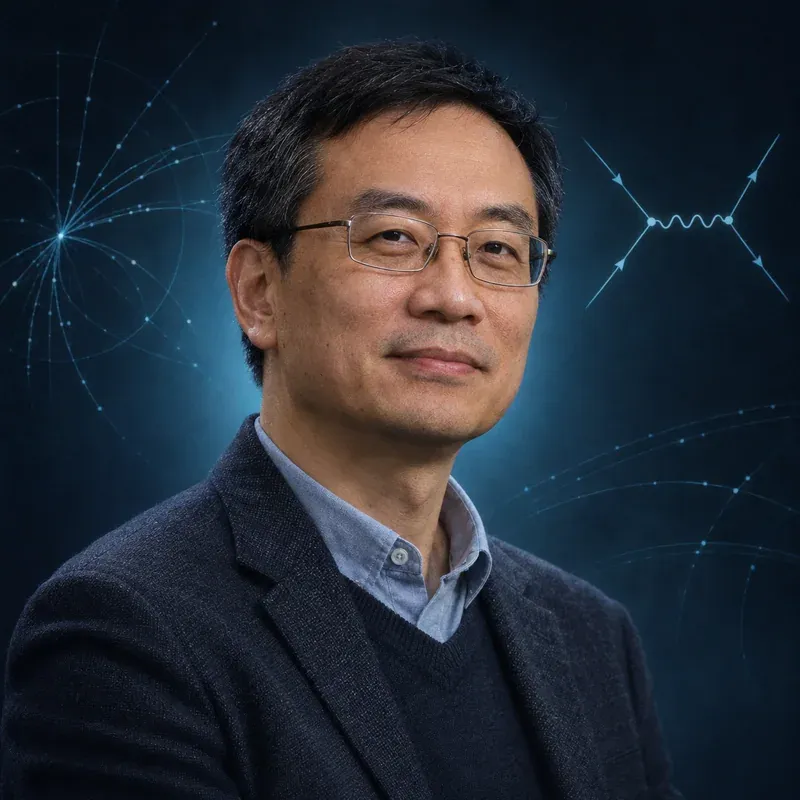
 Illustration
Cao Jun (Jun Cao)
Cao led the design and construction of Daya Bay's antineutrino detectors and its data analysis; in 2012 Daya Bay discovered a non-zero value of the smallest mixing angle θ13, and he became co-spokesperson in 2013. He is one of the initiators and the deputy spokesperson of JUNO, proposed its satellite detector TAO, and became director of IHEP in October 2024.
- Nationality
- Chinese
- Field
- Experimental particle physics
- Institutions
- Wuhan University (BSc 1993), Institute of High Energy Physics (IHEP), Chinese Academy of Sciences, Linear Accelerator Laboratory (LAL), Orsay, University of Michigan
Education and early career
Cao Jun studied at Wuhan University, graduating in 1993, and completed his PhD at the Institute of High Energy Physics (IHEP) of the Chinese Academy of Sciences in Beijing in 1998. He then worked as a postdoctoral researcher at the Laboratoire de l'Accélérateur Linéaire in Orsay, France, and at the University of Michigan, before returning to IHEP in 2004.
Daya Bay and the angle θ13
In the early 2000s the last unmeasured neutrino mixing angle, θ13, was known only to be small. Its value decides whether leptonic CP violation and the mass ordering can be measured at all. The Daya Bay experiment in southern China was designed to find it by counting reactor antineutrinos through inverse beta decay in identical detectors placed near and far from six powerful reactors; comparing the rates cancels most uncertainties in the reactor flux (see near and far detectors).
Cao led the design and construction of Daya Bay's gadolinium-loaded liquid-scintillator antineutrino detectors and the collaboration's data analysis. In March 2012 Daya Bay reported a clear deficit of electron antineutrinos at the far site, giving sin²2θ13 = 0.092 ± 0.016 (stat.) ± 0.005 (syst.), a non-zero value at 5.2 standard deviations. The result opened the way for the current generation of oscillation experiments. Cao became co-spokesperson of Daya Bay in 2013; the experiment had been founded under the leadership of Wang Yifang and Kam-Biu Luk.
JUNO and TAO
Cao is one of the initiators and the deputy spokesperson of JUNO, a 20,000-tonne liquid-scintillator detector about 53 km from two nuclear power plants, built mainly to determine the neutrino mass ordering from fine oscillation patterns in the reactor spectrum. He proposed its satellite detector TAO, a small, very high-resolution detector close to a Taishan reactor core that measures the unoscillated reactor spectrum, including features such as the 5 MeV bump, as a reference for JUNO.
Recognition
Cao received the Outstanding Science and Technology Achievement Prize of the Chinese Academy of Sciences and the C. N. Yang Award of the Association of Asia Pacific Physical Societies in 2013, a First Prize of the State Natural Science Award of China in 2016 and was named a New Cornerstone Investigator in 2023. In October 2024 he succeeded Wang Yifang as director of IHEP.
Known for
- Co-spokesperson of Daya Bay; led antineutrino-detector design and data analysis
- Measurement of θ13 (2012)
- Initiator and deputy spokesperson of JUNO
- Proposed the Taishan Antineutrino Observatory (TAO)
- Director of IHEP (from 2024)
Chronology
- 1998PhD, IHEP
- 2004Joins IHEP
- 2012Daya Bay discovers non-zero θ13
- 2013Daya Bay co-spokesperson; AAPPS C. N. Yang Award
- 2016First Prize, State Natural Science Award of China
- 2024Director of IHEP
Original papers
- Daya Bay Collaboration (F. P. An et al.), Observation of electron-antineutrino disappearance at Daya Bay, Phys. Rev. Lett. 108, 171803 (2012)DOI 10.1103/PhysRevLett.108.171803
Experiments
Connected people
Frequently asked questions
What did Cao Jun discover?
He was a leader of the Daya Bay experiment, which in 2012 established that the mixing angle θ13 is not zero.
What is the Taishan Antineutrino Observatory?
A compact high-resolution detector near a Taishan reactor that measures the reactor antineutrino spectrum in detail to serve as a reference for JUNO.
On the timeline
- 2012Daya Bay discovers a non-zero θ₁₃
- 2025JUNO begins data taking
- 2025JUNO's first results set precision records
- 2026JUNO sees a first hint of the mass ordering
Mentioned in 9 pages
Last updated: · Editorial standard
Cite this page
Text
Neutrino Atlas (2026). “Cao Jun (Jun Cao)”. Retrieved 22 November 2026, from https://neutrino-atlas.com/people/cao-jun/BibTeX
@misc{neutrinoatlas2026peoplecaojun,
  title        = {Cao Jun (Jun Cao)},
  author       = {{Neutrino Atlas}},
  year         = {2026},
  url          = {https://neutrino-atlas.com/people/cao-jun/},
  note         = {Accessed 2026-11-22},
  language     = {english}
}