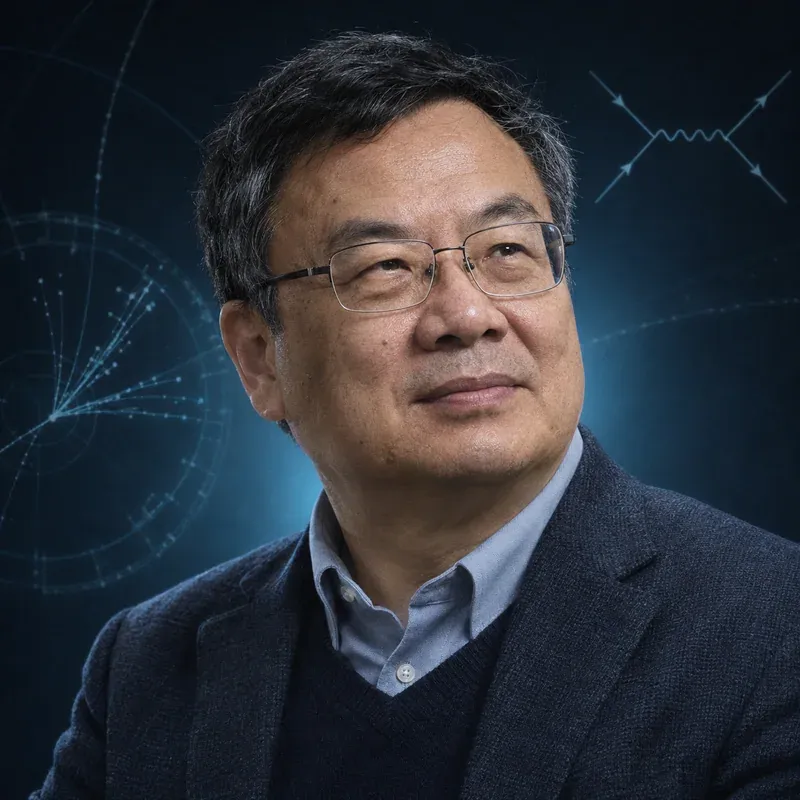
 Illustration
Wang Yifang
Wang co-led, with Kam-Biu Luk, the Daya Bay reactor experiment, which in March 2012 measured a non-zero value of the mixing angle theta13 with high significance. Since 2014 he has directed JUNO, a 20,000-tonne liquid-scintillator detector designed to determine the neutrino mass ordering using reactor antineutrinos.
- Born
- 20 February 1963
Nanjing, Jiangsu, China - Nationality
- Chinese
- Field
- Experimental particle physics
- Institutions
- Institute of High Energy Physics (IHEP), Chinese Academy of Sciences, CERN (L3), MIT, Stanford University
Education and early career
Wang Yifang was born in Nanjing in 1963. He graduated in physics from Nanjing University in 1984 and went to Italy for his doctorate, which he received from the University of Florence. His early research was in collider physics: he worked in the group of Samuel C. C. Ting on the L3 experiment at CERN's Large Electron–Positron Collider (LEP), which measured the properties of the Z boson with high precision. Among LEP's best-known results was the measurement of the Z decay width, which showed that there are exactly three light neutrino species. He then worked at the Laboratory for Nuclear Science of MIT and at Stanford University.
In 2001 Wang returned to China as a researcher at the Institute of High Energy Physics (IHEP) of the Chinese Academy of Sciences in Beijing. He became director of IHEP in 2011, leading China's largest particle physics laboratory.
Path to neutrino physics
In the early 2000s the last unknown mixing angle of the PMNS matrix, θ13, was a central open question. The CHOOZ reactor experiment had only placed an upper limit on it, and some theorists expected it to be exactly zero. Its value mattered well beyond its own sake: if θ13 were zero, leptonic CP violation would be unobservable in oscillation experiments, and the planning of future accelerator programmes depended on it.
A reactor experiment can measure θ13 cleanly through the small disappearance of electron antineutrinos at a distance of one to two kilometres. The challenge is precision: the expected effect is only a few per cent, so uncertainties in the reactor flux must be cancelled by comparing near and far detectors. Wang proposed using the powerful Daya Bay and Ling Ao nuclear power plants near Shenzhen and, with Kam-Biu Luk of Berkeley, led an international collaboration to build the Daya Bay experiment.
Key contributions
Daya Bay used eight nearly identical antineutrino detectors filled with gadolinium-loaded liquid scintillator, placed in underground halls at different distances from six reactor cores. Antineutrinos were detected by inverse beta decay, whose prompt positron and delayed neutron capture give a distinctive delayed coincidence. In March 2012, after less than three months of running with the full far site, the collaboration announced a deficit of about six per cent at the far detectors and a non-zero θ13 with a significance of more than five standard deviations. The result, published in Physical Review Letters, gave sin²2θ13 ≈ 0.09 and was soon confirmed by RENO in Korea and Double Chooz.
The fairly large value of θ13 opened the way to the present generation of experiments that search for CP violation and determine the mass ordering, including T2K, NOvA, DUNE and Hyper-Kamiokande. Daya Bay continued taking data until December 2020 and produced the most precise measurement of θ13.
JUNO
Since 2014 Wang has directed the Jiangmen Underground Neutrino Observatory in Guangdong, about 53 kilometres from two nuclear power plants. At that distance the oscillation pattern of reactor antineutrinos contains fine wiggles whose phase depends on whether the normal or inverted ordering is realised in nature. Resolving them requires an energy resolution of about three per cent, which led to JUNO's design: 20,000 tonnes of liquid scintillator in a 35.4-metre acrylic sphere, viewed by more than 20,000 large and 25,000 small photomultipliers. JUNO started data-taking on 26 August 2025, and in November 2025 it reported first measurements of θ12 and Δm²21 about 1.6 times more precise than all previous experiments combined.
Recognition
Wang shared the 2014 Panofsky Prize and the 2016 Breakthrough Prize in Fundamental Physics with Kam-Biu Luk; the Breakthrough Prize honoured the leaders of five oscillation experiments. He received the Future Science Prize in 2019. He is a member of the Chinese Academy of Sciences (2015), a foreign associate of the US National Academy of Sciences (2024) and a Foreign Member of the Royal Society (2025).
Known for
- Co-leader of Daya Bay
- Discovery of non-zero theta13 (2012)
- Director of JUNO (since 2014)
- Director of IHEP (from 2011)
- Breakthrough Prize 2016
Chronology
- 2001Joins IHEP
- 2011Becomes IHEP director
- 2012Daya Bay discovers non-zero theta13
- 2014Panofsky Prize; becomes JUNO director
- 2016Breakthrough Prize in Fundamental Physics
- 2025Foreign Member of the Royal Society
Original papers
- Daya Bay Collaboration (F. P. An et al.), Observation of electron-antineutrino disappearance at Daya Bay, Phys. Rev. Lett. 108, 171803 (2012)DOI 10.1103/PhysRevLett.108.171803
Experiments
Connected people
Frequently asked questions
What is Wang Yifang known for?
He co-led the Daya Bay reactor experiment, which in 2012 showed that the mixing angle θ13 is not zero, and he directs JUNO, built to determine the neutrino mass ordering.
Why was a non-zero θ13 important?
Only if θ13 is non-zero can oscillation experiments observe leptonic CP violation. Its relatively large value made the current long-baseline programme feasible.
Has JUNO started?
Yes. It began taking data in August 2025 and published its first oscillation measurements in November 2025.
On the timeline
- 2012Daya Bay discovers a non-zero θ₁₃
- 2015Breakthrough Prize honours five oscillation experiments
- 2025JUNO begins data taking
- 2025JUNO's first results set precision records
- 2026JUNO sees a first hint of the mass ordering
Mentioned in 14 pages
FAQ 1
Milestones 5
Terms 3
Last updated: · Editorial standard
Cite this page
Text
Neutrino Atlas (2026). “Wang Yifang”. Retrieved 22 November 2026, from https://neutrino-atlas.com/people/wang-yifang/BibTeX
@misc{neutrinoatlas2026peoplewangyifang,
  title        = {Wang Yifang},
  author       = {{Neutrino Atlas}},
  year         = {2026},
  url          = {https://neutrino-atlas.com/people/wang-yifang/},
  note         = {Accessed 2026-11-22},
  language     = {english}
}