RENO
A South Korean reactor experiment that independently confirmed non-zero θ₁₃ in 2012.
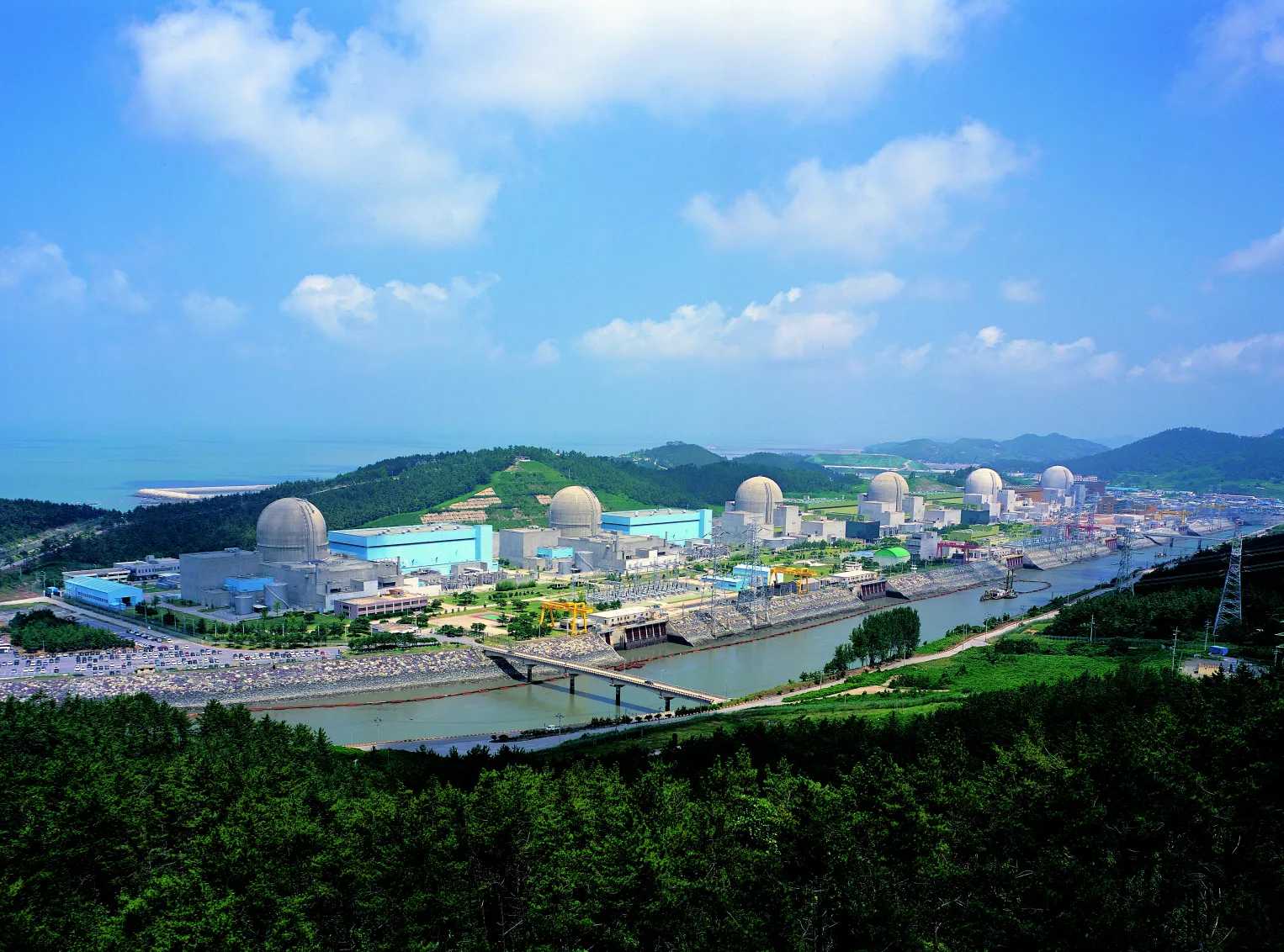
The Reactor Experiment for Neutrino Oscillation used two identical 16-tonne Gd-LS detectors at about 290 m and 1380 m from six reactors at Hanbit (Yonggwang). It observed ν̄e disappearance at 4.9σ in April 2012 and also reported the 5 MeV excess.
Compare all experiments → · World map →
In plain words
RENO is South Korea's reactor neutrino experiment. Within a month of the Daya Bay announcement in 2012, it published its own, independent evidence that electron antineutrinos from a power plant partly vanish over about a kilometre. Two experiments with different reactors, detectors and teams seeing the same effect made the discovery of a non-zero θ₁₃ secure.
How the detector works
Six reactors at the Hanbit (formerly Yonggwang) plant are lined up roughly evenly along the coast. RENO placed two identical detectors on the line perpendicular to them: a near detector about 294 m from the centre of the reactor array and a far detector about 1383 m away, each under a hill for shielding. Each detector held 16 tonnes of gadolinium-doped liquid scintillator as target, surrounded by a gamma catcher, a mineral-oil buffer with photomultipliers and a water Cherenkov veto. Events were selected by the delayed coincidence of inverse beta decay.
Key results
- April 2012: observation of reactor antineutrino disappearance at 4.9σ, with sin²2θ₁₃ = 0.113 ± 0.013 (stat) ± 0.019 (syst) (Physical Review Letters 108, 191802).
- 2014: one of the first public reports of an unexpected excess of events around 5 MeV in the reactor spectrum, the 5 MeV bump.
- Measurements of the oscillation frequency |Δm²ee| from the energy dependence of the deficit, and independent analyses with hydrogen capture.
- Final result from 3800 live days (data from August 2011 to March 2023): sin²2θ₁₃ = 0.0920 with an uncertainty of about 0.006, and |Δm²ee| = (2.57 ± 0.12) × 10⁻³ eV².
Why it matters for neutrino physics
Physics results gain weight when they are reproduced. RENO's near and far layout was conceptually similar to Daya Bay, but its reactors, scintillator production and analysis were independent. Its measurements of the mass-squared difference also cross-check the values from accelerator experiments. The experiment was led by Soo-Bong Kim of Seoul National University and helped build a strong neutrino community in Korea; Korean physicists have since proposed a large water Cherenkov detector of their own.
Frequently asked questions
How long did RENO take data?
From August 2011 to March 2023, accumulating 3800 live days.
What does Δm²ee mean?
It is an effective mass-squared difference for electron-antineutrino disappearance, a weighted mix of Δm²₃₁ and Δm²₃₂ that reactor experiments at about 1 km measure directly.
Original papers
- DiscoveryJ. K. Ahn et al. (RENO Collaboration), Observation of Reactor Electron Antineutrinos Disappearance in the RENO Experiment, Phys. Rev. Lett. 108, 191802 (2012)DOI 10.1103/PhysRevLett.108.191802
- MeasurementG. Bak et al. (RENO Collaboration), Measurement of Reactor Antineutrino Oscillation Amplitude and Frequency at RENO, Phys. Rev. Lett. 121, 201801 (2018)DOI 10.1103/PhysRevLett.121.201801arXiv:1806.00248
Related terms
People
On the timeline
Mentioned in 49 pages
Comparisons 1
Milestones 7
- 1962 · Maki, Nakagawa and Sakata introduce neutrino mixing
- 1995 · Nobel Prize for neutrino detection
- 1998 · CHOOZ sees no reactor antineutrino disappearance
- 2011 · Double Chooz gives the first reactor hint of θ₁₃
- 2011 · T2K finds hints of electron-neutrino appearance
- 2012 · Daya Bay discovers a non-zero θ₁₃
- 2012 · RENO confirms θ₁₃
People 11
Terms 25
- 5 MeV bump
- Appearance vs disappearance
- CHOOZ
- Daya Bay
- Disappearance measurement
- Double Chooz
- Flavour symmetries
- Gadolinium loading
17 more
- Inverse beta decay
- Inverse beta decay (IBD)
- Liquid scintillator detector
- Mixing angle θ13
- Near and far detectors
- NEOS
- Neutrino oscillation physics
- Nuclear reactors as neutrino sources
- Oscillation observables
- Oscillation parameter degeneracies
- Rate vs shape analysis
- Reactor antineutrino spectrum
- Reactor antineutrinos
- Reactor neutrino experiments
- Scintillation
- Statistical significance (σ)
- Two-flavour approximation
Last updated: · Editorial standard
Cite this page
Text
Neutrino Atlas (2026). “RENO”. Retrieved 22 November 2026, from https://neutrino-atlas.com/terms/reno/BibTeX
@misc{neutrinoatlas2026termsreno,
  title        = {RENO},
  author       = {{Neutrino Atlas}},
  year         = {2026},
  url          = {https://neutrino-atlas.com/terms/reno/},
  note         = {Accessed 2026-11-22},
  language     = {english}
}