Gösgen reactor experiment
Swiss reactor experiment that searched for antineutrino oscillations at three distances from the Gösgen power plant between 1981 and 1985.
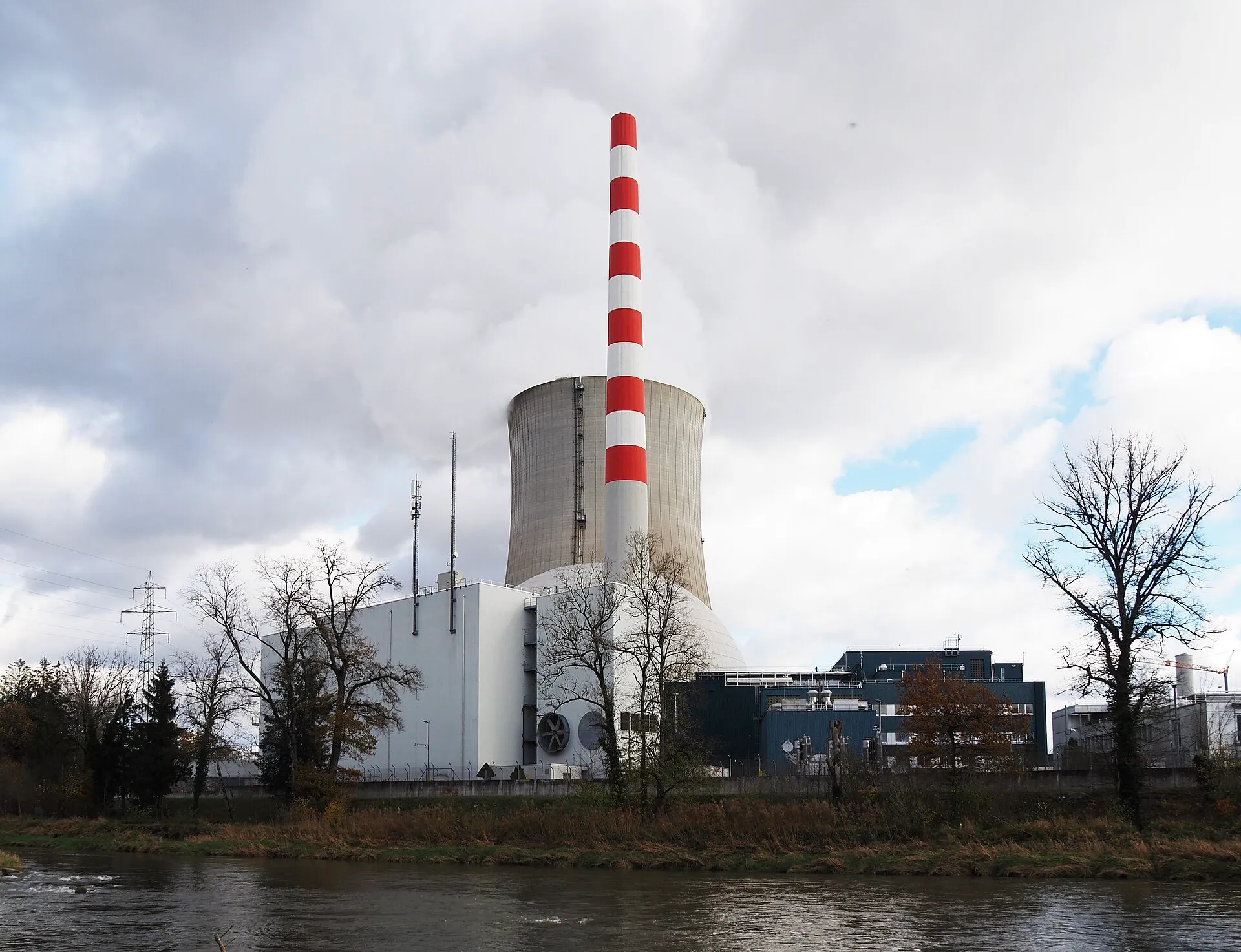
A Caltech–SIN–TU Munich collaboration measured the ν̄e spectrum at 37.9, 45.9 and 64.7 m from the 2.8 GW(th) Gösgen reactor using liquid-scintillator cells and ³He wire chambers. The spectra at all three positions agreed with each other and with predictions, excluding oscillations over a wide Δm² range. Reanalysed in 2011, its rates form part of the reactor antineutrino anomaly.
Compare all experiments → · World map →
In plain words
If neutrinos oscillate, a detector moved farther away from a reactor should see the energy spectrum of antineutrinos change shape, not only become weaker. The Gösgen experiment tested this directly by measuring the spectrum at three distances from the same reactor. If the shape had changed between the positions, it would have revealed oscillation without needing a precise prediction of what the reactor emits.
How the detector works
The detector was an improved version of the one used at the ILL reactor in Grenoble. Thirty cells of liquid scintillator recorded the positron from inverse beta decay, and ³He multiwire proportional chambers between the cells captured the neutron, giving a delayed coincidence. An active scintillator veto and passive shielding surrounded the detector, and pulse-shape discrimination helped reject neutrons from cosmic rays. The collaboration, from Caltech, the Swiss Institute for Nuclear Research (SIN) and TU Munich, was led by Felix Boehm and Rudolf Mössbauer.
Key results
Between 1981 and 1985 the team took data at 37.9, 45.9 and 64.7 m from the 2.8 GW(th) pressurised-water reactor. No reactor-associated background was seen. Two analyses were made: one that compared only the spectra at different distances and so did not depend on the source, and one that compared the data with calculated reactor spectra, with about 6% total systematic uncertainty. Both found no oscillation and excluded regions of the Δm²–sin²2θ plane. In the mid-1980s this contradicted an indication of oscillation reported at Bugey, which later Bugey data did not confirm.
Legacy
The 2011 analysis of the reactor anomaly recomputed the Gösgen rates with new flux models, giving observed-to-predicted ratios of 0.966, 0.991 and 0.924 for the three positions. Together with other short-baseline results they suggested a deficit of a few percent, which was later traced mainly to errors in the flux predictions.
Frequently asked questions
Why measure at several distances?
Comparing spectra at different baselines cancels uncertainties in the reactor's emission, so any change in shape points to oscillation.
Did Gösgen see the reactor anomaly?
Not at the time. The deficit appeared only when its data were compared with flux predictions revised in 2011.
Original papers
- Final resultG. Zacek et al., Neutrino-oscillation experiments at the Gösgen nuclear power reactor, Phys. Rev. D 34, 2621 (1986)DOI 10.1103/PhysRevD.34.2621
Related terms
- Reactor neutrino experiments
- Reactor antineutrino anomaly
- Inverse beta decay
- ILL Grenoble reactor experiment
- Bugey reactor experiments
People
Mentioned in 2 pages
People 1
Last updated: · Editorial standard
Cite this page
Text
Neutrino Atlas (2026). “Gösgen reactor experiment”. Retrieved 22 November 2026, from https://neutrino-atlas.com/terms/gosgen/BibTeX
@misc{neutrinoatlas2026termsgosgen,
  title        = {Gösgen reactor experiment},
  author       = {{Neutrino Atlas}},
  year         = {2026},
  url          = {https://neutrino-atlas.com/terms/gosgen/},
  note         = {Accessed 2026-11-22},
  language     = {english}
}