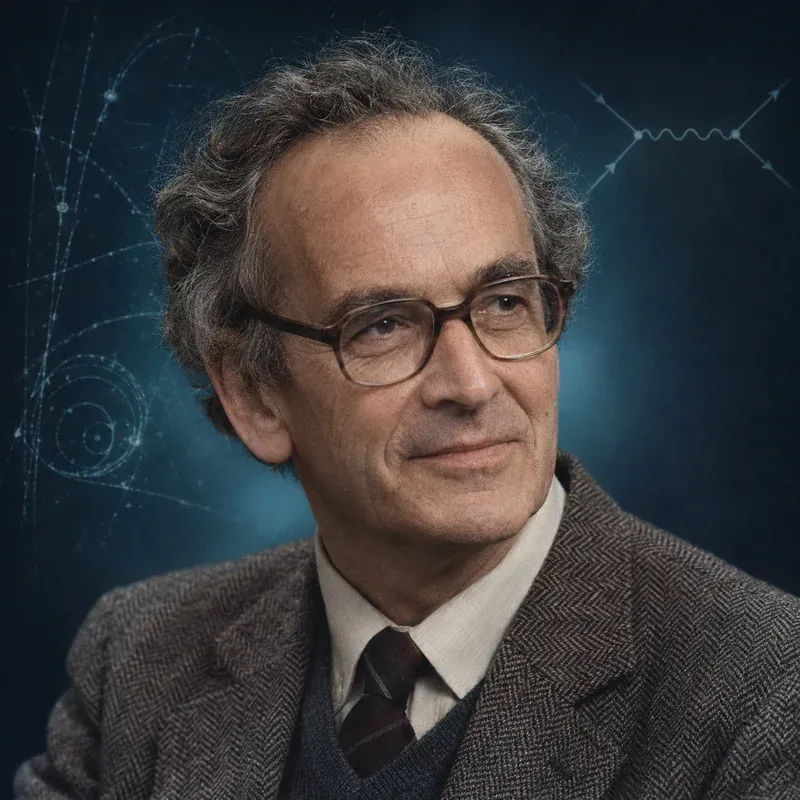
 Illustration
Felix Hans Boehm
Boehm led pioneering reactor-antineutrino oscillation searches in the 1980s, first at the Institut Laue–Langevin research reactor (with Rudolf Mössbauer) and then at the Gösgen power plant in Switzerland; neither saw oscillations. Around 2000 he led the kilometre-baseline Palo Verde experiment in Arizona. He also ran double beta decay searches with germanium and with a TPC holding 5 kg of enriched xenon, influencing EXO-200.
- Born
- 9 June 1924
Basel, Switzerland - Died
- 25 May 2021
- Nationality
- Swiss-American
- Field
- Experimental nuclear and neutrino physics
- Institutions
- University of Geneva, ETH Zürich, Columbia University, California Institute of Technology
Early life and education
Felix Hans Boehm was born in Basel in 1924. He studied at the University of Geneva and at ETH Zürich, where he received his diploma in 1948 and his doctorate in 1951 under Paul Scherrer. Wolfgang Pauli, who taught him theoretical physics, sat on his examination committee – an early link to the particle Pauli had proposed. In 1952 Boehm moved to the United States and spent about a year and a half at Columbia University with Chien-Shiung Wu, the leading expert on beta decay.
Weak interactions at Caltech
In 1953 Boehm joined the California Institute of Technology, where he remained for some fifty years, becoming assistant professor in 1958, receiving tenure in 1961 and holding the William L. Valentine chair from 1985. His early work was precision nuclear physics in the service of the weak interaction: in 1956 he helped confirm Wu's discovery of parity violation by measuring the polarisation of positrons from beta decay, and in 1972 he measured a percent-level parity-violating effect in the decay of an isomer of hafnium-180.
Reactor neutrino oscillation searches
In the late 1970s and 1980s Boehm turned to the question of whether neutrinos have mass and mix. Nuclear reactors are intense sources of electron antineutrinos, which can be counted through inverse beta decay on protons. If antineutrinos oscillate into another flavour, the measured rate and energy spectrum fall below expectation in a way that depends on distance. With Rudolf Mössbauer and colleagues, Boehm's group first measured at the research reactor of the Institut Laue–Langevin in Grenoble, at a distance of under 10 metres, and then at the Gösgen power plant in Switzerland, where the detector was placed at three distances between roughly 38 and 65 metres. Both measurements were among the first dedicated reactor experiments on oscillations. Neither saw a signal, and the resulting limits excluded large mixing for mass-squared differences above about 0.02 eV².
Around 2000 Boehm led the Palo Verde experiment in Arizona, with a gadolinium-loaded liquid scintillator at about 0.8 km from the reactors of the Palo Verde Generating Station. Together with CHOOZ in France, it showed that the atmospheric-neutrino anomaly was not caused by muon-to-electron neutrino oscillations. Palo Verde lacked the sensitivity to see the small mixing angle θ₁₃, which Daya Bay and RENO measured in 2012.
Double beta decay and teaching
Boehm also searched for neutrinoless double beta decay, first with germanium detectors and then with a time projection chamber holding 5 kg of enriched ¹³⁶Xe in the Gotthard road tunnel, built with the University of Neuchâtel and the Paul Scherrer Institute. This xenon programme was a direct precursor of EXO-200. With his Caltech colleague Petr Vogel he wrote the textbook ‘Physics of Massive Neutrinos’, which introduced a generation of students to neutrino mass and mixing.
Honours and legacy
Boehm was elected to the U.S. National Academy of Sciences in 1983, received an Alexander von Humboldt Award in 1980 and the American Physical Society's Tom W. Bonner Prize in Nuclear Physics in 1995. Macular degeneration led him to retire in 1995. He died in May 2021, shortly before his 97th birthday.
Known for
- Reactor neutrino oscillation searches at ILL and Gösgen
- Palo Verde reactor experiment
- Double beta decay with enriched xenon TPC
Chronology
- 1953Joins Caltech
- 1986Gösgen oscillation results
- 1995Tom W. Bonner Prize
- 2000Palo Verde results
Original papers
- F. Boehm et al., Final results from the Palo Verde neutrino oscillation experiment, Phys. Rev. D 64, 112001 (2001)DOI 10.1103/PhysRevD.64.112001
Experiments
- ILL reactor experiment
- Gösgen reactor experiment
- Palo Verde
- Gotthard xenon TPC
Connected people
Frequently asked questions
Did Felix Boehm discover neutrino oscillations?
No. His reactor experiments at Grenoble, Gösgen and Palo Verde found no oscillation signal. Their value lay in the limits they set and in the measurement techniques they established, which later reactor experiments such as KamLAND and Daya Bay built on.
Why did Boehm measure at several distances from a reactor?
Oscillations change the antineutrino spectrum depending on the ratio of distance to energy, L/E. Comparing spectra at several distances cancels much of the uncertainty in the predicted reactor flux.
What prizes did Boehm receive?
Among others the Tom W. Bonner Prize in Nuclear Physics (1995) and an Alexander von Humboldt Award (1980); he was also a member of the National Academy of Sciences.
Mentioned in 6 pages
Last updated: · Editorial standard
Cite this page
Text
Neutrino Atlas (2026). “Felix Hans Boehm”. Retrieved 22 November 2026, from https://neutrino-atlas.com/people/felix-boehm/BibTeX
@misc{neutrinoatlas2026peoplefelixboehm,
  title        = {Felix Hans Boehm},
  author       = {{Neutrino Atlas}},
  year         = {2026},
  url          = {https://neutrino-atlas.com/people/felix-boehm/},
  note         = {Accessed 2026-11-22},
  language     = {english}
}