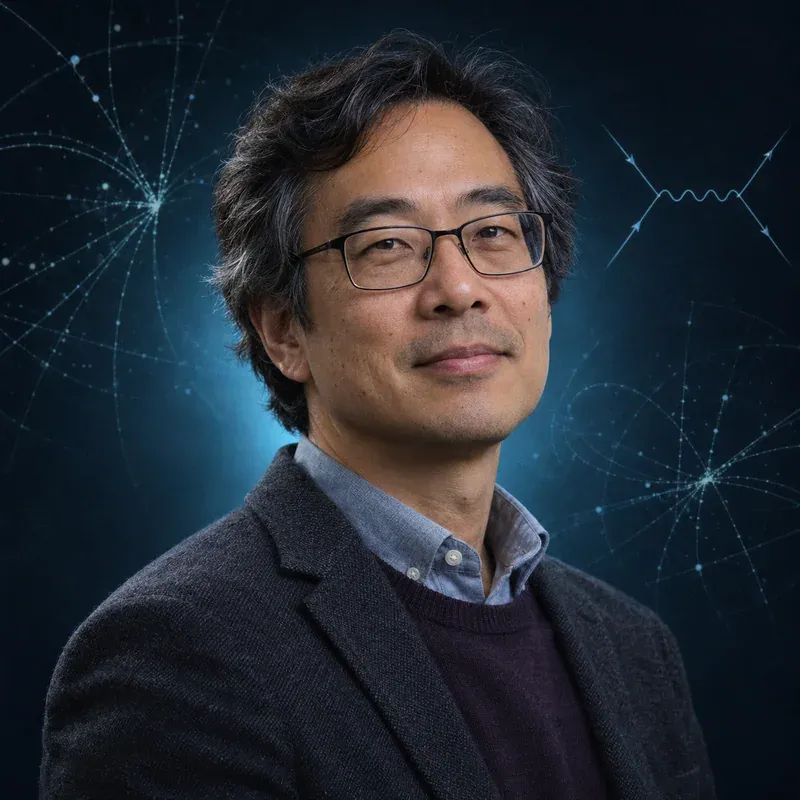
 Illustration
Mark C. Chen
Chen leads SNO+, the successor of SNO, which refills the SNO acrylic vessel with liquid scintillator to study low-energy solar neutrinos, reactor and geo-antineutrinos, and to search for neutrinoless double beta decay. He shared the 2016 Breakthrough Prize as a member of the SNO collaboration.
- Nationality
- Canadian
- Field
- Experimental particle astrophysics
- Institutions
- Queen's University, Princeton University, CIFAR
Education and career
Mark C. Chen is a Canadian experimental particle astrophysicist at Queen's University in Kingston, Ontario, where he holds the Gordon and Patricia Gray Chair in Particle Astrophysics. He studied engineering physics at Queen's (BSc 1989) and received his PhD from Caltech in 1994 under Felix Boehm. He spent 1994 to 2000 at Princeton University, first as a research associate and then as assistant professor, and worked on the Borexino solar-neutrino experiment. He returned to Queen's in 2000 and became full professor in 2011.
From SNO to SNO+
At Queen's Chen joined the Sudbury Neutrino Observatory, whose heavy-water measurements showed that solar neutrinos change flavour; he shared the collaboration's 2016 Breakthrough Prize. When SNO finished in 2006, the 12-metre acrylic sphere, its photomultiplier array and the deep underground site at SNOLAB remained. Chen proposed reusing them by replacing the heavy water with liquid scintillator, and he became director and spokesperson of the resulting experiment, SNO+, an international collaboration of more than 120 scientists.
The change matters because scintillator produces many times more light than Cherenkov radiation in water, so energies far below SNO's threshold become accessible. The chosen liquid, linear alkylbenzene, was selected for its high light yield, compatibility with acrylic and safety underground. After a water-filled commissioning phase, the detector was filled with scintillator around 2022.
Physics goals
SNO+ has several aims. Its main goal is a search for neutrinoless double beta decay by dissolving tellurium in the scintillator; tellurium-130 has a high natural abundance, so large quantities can be loaded without isotopic enrichment. A signal would show that neutrinos are their own antiparticles (Majorana neutrinos). The detector also measures reactor antineutrinos from Canadian power plants, geoneutrinos from uranium and thorium in the Earth's crust, low-energy solar neutrinos, and stands ready for a galactic supernova as part of SNEWS. Chen has a long-standing interest in geoneutrinos as a way to measure the Earth's radiogenic heat.
Recognition
Chen received the NSERC John C. Polanyi Award in 2006 and the Ontario Premier's Research Excellence Award in 2003, and he is a Senior Fellow of the Canadian Institute for Advanced Research (CIFAR).
Known for
- Director and spokesperson of SNO+
- Liquid-scintillator conversion of the SNO detector
- Geoneutrino research
- Gordon and Patricia Gray Chair in Particle Astrophysics
Chronology
- 1994PhD, Caltech (advisor Felix Boehm)
- 2000Joins Queen's University
- 2006NSERC John C. Polanyi Award
- 2014Gray Chair in Particle Astrophysics
- 2016Breakthrough Prize in Fundamental Physics (SNO team)
Experiments
Connected people
Frequently asked questions
What is SNO+?
The successor of SNO at SNOLAB, which refills the SNO acrylic vessel with liquid scintillator and will load it with tellurium to search for neutrinoless double beta decay, while also measuring reactor, geo- and solar neutrinos.
What is Mark Chen's role in SNO+?
He proposed the experiment and is its director and spokesperson.
On the timeline
Mentioned in 6 pages
Last updated: · Editorial standard
Cite this page
Text
Neutrino Atlas (2026). “Mark C. Chen”. Retrieved 22 November 2026, from https://neutrino-atlas.com/people/mark-chen/BibTeX
@misc{neutrinoatlas2026peoplemarkchen,
  title        = {Mark C. Chen},
  author       = {{Neutrino Atlas}},
  year         = {2026},
  url          = {https://neutrino-atlas.com/people/mark-chen/},
  note         = {Accessed 2026-11-22},
  language     = {english}
}