Borexino
An ultra-radiopure liquid-scintillator detector at Gran Sasso that measured the Sun's full fusion spectrum.
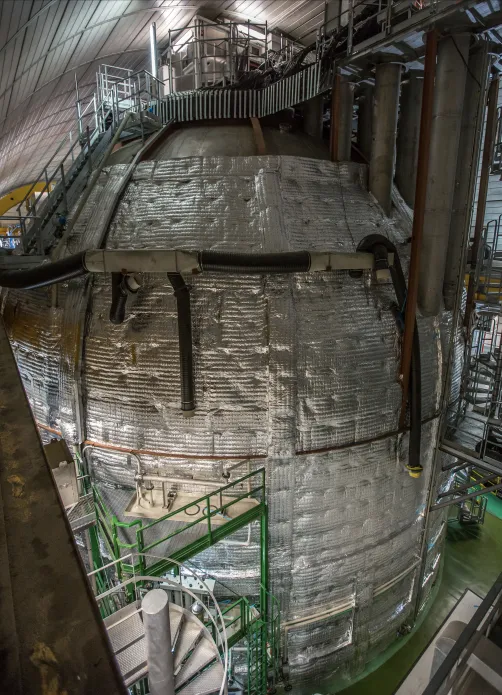
About 278 tonnes of pseudocumene-based scintillator, inside nested buffers and a water tank, reached record low radioactivity. Borexino made the first real-time measurements of ⁷Be, pep and pp solar neutrinos, the first detection of CNO-cycle neutrinos (2020), and observed geoneutrinos.
Compare all experiments → · World map →
In plain words
Low-energy solar neutrinos produce signals no larger than those of ordinary natural radioactivity. To see them in real time, a detector must be cleaner than almost anything on Earth. Borexino achieved this with a nested design in which each layer shields the next, and with scintillator purified until traces of uranium and thorium were below about one part in 10¹⁸ by mass. For the first time, physicists could watch individual branches of the Sun's fusion network one by one.
How the detector works
Borexino operated in Hall C of the Gran Sasso laboratory under about 1400 metres of rock. From the outside in, it consisted of a steel water tank of about 2400 tonnes serving as a Cherenkov muon veto, a 13.7-metre stainless-steel sphere carrying 2212 photomultipliers, about 1000 tonnes of non-scintillating buffer liquid, and a 125-micrometre nylon vessel 8.5 metres across holding about 278 tonnes of pseudocumene with the fluor PPO. Neutrinos were detected by elastic scattering on electrons, which produces scintillation light proportional to the recoil energy. A prototype, the Counting Test Facility, proved in the 1990s that the required radiopurity was achievable.
Key results
- 2007: first real-time measurement of the monoenergetic ⁷Be line at 862 keV.
- 2010: ⁸B neutrinos with a threshold as low as 3 MeV, and observation of geoneutrinos.
- 2012: first detection of pep neutrinos and a limit on CNO neutrinos.
- 2014: first direct detection of pp neutrinos, published in Nature.
- 2018: a comprehensive spectroscopy of the whole pp chain, published in Nature.
- 2020: first detection of CNO-cycle neutrinos.
Together these measurements confirmed the predicted transition of the electron-neutrino survival probability from about 55 per cent at low energy, where vacuum oscillations dominate, to about 30 per cent at high energy, where the MSW effect dominates.
Status today
Data taking ended in October 2021 and the detector was decommissioned. The experiment was proposed and long led by Gianpaolo Bellini, with Frank Calaprice leading the US groups and the purification effort. Its low-background techniques are used in dark-matter searches and in JUNO.
Frequently asked questions
Why is Borexino called that?
The name is the Italian diminutive of BOREX, an earlier proposal for a boron-loaded detector. Borexino was the smaller, achievable version.
Could Borexino tell which direction neutrinos came from?
Not in standard operation, because scintillation light is emitted in all directions. A later analysis used the faint early Cherenkov light to show that the ⁷Be and CNO signals point back to the Sun.
Original papers
- First resultC. Arpesella et al. (Borexino Collaboration), First real time detection of 7Be solar neutrinos by Borexino, Phys. Lett. B 658, 101 (2008)DOI 10.1016/j.physletb.2007.09.054
- DiscoveryG. Bellini et al. (Borexino Collaboration), Neutrinos from the primary proton–proton fusion process in the Sun, Nature 512, 383 (2014)DOI 10.1038/nature13702
- DiscoveryM. Agostini et al. (Borexino Collaboration), Experimental evidence of neutrinos produced in the CNO fusion cycle in the Sun, Nature 587, 577 (2020)DOI 10.1038/s41586-020-2934-0
Go deeper
- CNO neutrino discoveryBorexino's 2020 detection of neutrinos from the carbon–nitrogen–oxygen fusion cycle.
Related terms
- Liquid scintillator detector
- Laboratori Nazionali del Gran Sasso (LNGS)
- Natural radioactivity & radiopurity
People
- Alexei Yuryevich Smirnov
- Gianpaolo Bellini
- Antonino Zichichi
- Evgeny Kh. Akhmedov
- Frank Paul Calaprice
- Gernot Eder
- Marc H. Pinsonneault
- Mark C. Chen
- Stefan Schönert
Latest research on this topic
- New limits on the Pauli forbidden transitions in 12rmC nuclei obtained with the complete Borexino datasetBOREXINO Collaboration · 10 April 2026
- Potassium influence on Earth's mantle convection and Borexino dataKarpikov, Ivan · 17 February 2026
- Constraints on nonstandard neutrino interactions from the Borexino extended data setBOREXINO Collaboration · 9 February 2026
On the timeline
- 2007Borexino measures beryllium-7 solar neutrinos in real time
- 2010Borexino confirms geoneutrinos
- 2012Borexino finds first evidence of pep solar neutrinos
- 2014Borexino measures pp neutrinos spectroscopically
- 2020Borexino detects neutrinos from the CNO cycle
Mentioned in 96 pages
Lessons 7
FAQ 6
Comparisons 3
Milestones 12
- 1939 · Stellar fusion predicts neutrinos from the Sun
- 1966 · Antineutrinos from Earth's interior proposed
- 1978 · Wolfenstein: matter changes neutrino oscillations
- 1985 · Mikheyev and Smirnov discover resonant conversion
- 1992 · GALLEX observes solar pp neutrinos
- 2005 · KamLAND detects geoneutrinos
- 2007 · Borexino measures beryllium-7 solar neutrinos in real time
- 2010 · Borexino confirms geoneutrinos
People 15
Terms 53
- Artificial radioactive neutrino sources
- Background
- Backgrounds & shielding
- Beryllium-7 neutrinos
- Calibration
- CNO cycle
- CNO neutrino discovery
- Coincidence / Delayed-signal technique
45 more
- Cosmogenic activation & spallation isotopes
- Day-night asymmetry
- Day-night asymmetry measurement
- Deposited power
- Elastic scattering (ES) channel
- Electromagnetic interaction
- Electromagnetic properties
- Electron capture
- Energy threshold
- Experiments & detectors
- Fiducial volume
- Geoneutrinos
- Helioseismology
- Hybrid Cherenkov–scintillation detectors
- Inverse beta decay
- Laboratori Nazionali del Gran Sasso (LNGS)
- Large mixing angle (LMA) MSW solution
- Light quenching (Birks' law)
- Liquid scintillator detector
- Mixing angle θ12
- MSW effect
- Muon veto
- Natural radioactivity & radiopurity
- Neutrino astronomy
- Neutrino decay
- Neutrino magnetic moment
- Neutrino-electron elastic scattering
- Neutrino–antineutrino oscillation
- OPERA Faster-than-Light anomaly
- pp neutrinos
- Proton-proton chain
- Pulse-shape discrimination
- Radiogenic heat
- Scintillation
- Shielding
- SNEWS (SuperNova Early Warning System)
- Solar metallicity problem
- Solar neutrino experiments
- Solar neutrinos
- Spin-flavour precession
- Statistical significance (σ)
- Supernova early warning
- Terrestrial neutrino unit (TNU)
- Theia
- Vertex & direction reconstruction
Last updated: · Editorial standard
Cite this page
Text
Neutrino Atlas (2026). “Borexino”. Retrieved 22 November 2026, from https://neutrino-atlas.com/terms/borexino/BibTeX
@misc{neutrinoatlas2026termsborexino,
  title        = {Borexino},
  author       = {{Neutrino Atlas}},
  year         = {2026},
  url          = {https://neutrino-atlas.com/terms/borexino/},
  note         = {Accessed 2026-11-22},
  language     = {english}
}