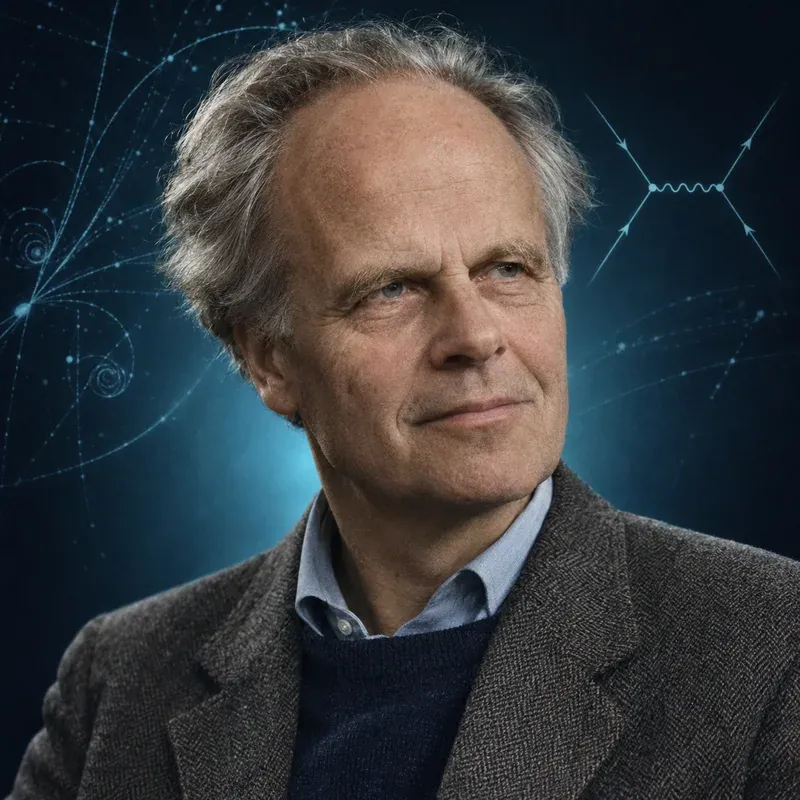
 Illustration
Carl Friedrich von Weizsäcker
In 1937-38 Weizsäcker studied nuclear transmutations inside stars and proposed, independently of Bethe, the carbon-nitrogen-oxygen (CNO) catalytic cycle of hydrogen burning. The CNO cycle's beta-plus decays (of N-13 and O-15) produce part of the solar neutrino flux.
- Nationality
- German
- Field
- theoretical physics, astrophysics, philosophy
Early life and education
Carl Friedrich von Weizsäcker was born in Kiel on 28 June 1912, the son of the diplomat Ernst von Weizsäcker and elder brother of Richard von Weizsäcker, later President of the Federal Republic of Germany. From 1929 to 1933 he studied physics, mathematics and astronomy in Berlin, Göttingen and Leipzig, where he belonged to Werner Heisenberg's circle and took his doctorate under Friedrich Hund.
Nuclear physics and the stars
In 1935 Weizsäcker published the semi-empirical mass formula, now often called the Bethe–Weizsäcker formula. It estimates the binding energy of a nucleus from a few terms (volume, surface, electric repulsion, neutron–proton asymmetry and pairing) and explains why fusing light nuclei and splitting heavy ones both release energy.
He then asked how stars generate energy and build elements. In two papers, 'Über Elementumwandlungen im Innern der Sterne' (Physikalische Zeitschrift, 1937 and 1938), he proposed in the second part a cycle in which carbon acts as a catalyst: protons are added successively to carbon and nitrogen nuclei until a helium nucleus is released and the original carbon-12 is restored. Hans Bethe found the same CNO cycle independently and in 1939 worked out its reaction rates quantitatively.
In the Sun the CNO cycle supplies only about one percent of the energy, while the pp chain dominates, but it is the main process in stars more massive than about 1.3 solar masses. Its neutrinos were finally detected by Borexino in 2020, and they carry information on the Sun's carbon, nitrogen and oxygen content relevant to the solar metallicity problem.
Later life
During the Second World War Weizsäcker worked in the German nuclear programme; how far he and his colleagues sought a weapon is still debated by historians. After internment at Farm Hall he led a department of the Max Planck Institute for Physics in Göttingen from 1946. He increasingly turned to philosophy and peace research: he was one of the 'Göttingen Eighteen' who in 1957 opposed nuclear arms for the Bundeswehr, professor of philosophy in Hamburg (1957–69) and director of a Max Planck Institute in Starnberg (1970–80). He died in 2007 near Starnberg.
Known for
- CNO cycle (1937–38, independently of Bethe)
- Semi-empirical mass formula (Bethe–Weizsäcker)
Chronology
- 1937'Über Elementumwandlungen im Innern der Sterne' I
- 1938Part II: CNO cycle
Original papers
- C.F. von Weizsäcker, Über Elementumwandlungen im Innern der Sterne I, Physikalische Zeitschrift 38, 176 (1937)
Connected people
Frequently asked questions
Who discovered the CNO cycle, Weizsäcker or Bethe?
Both, independently. Weizsäcker proposed the cycle in 1938; Bethe derived it independently and calculated its rates in 1939, work cited in his 1967 Nobel Prize.
Have CNO neutrinos been detected?
Yes. The Borexino experiment at Gran Sasso announced the first detection of solar CNO neutrinos in 2020.
On the timeline
Mentioned in 6 pages
Last updated: · Editorial standard
Cite this page
Text
Neutrino Atlas (2026). “Carl Friedrich von Weizsäcker”. Retrieved 22 November 2026, from https://neutrino-atlas.com/people/carl-friedrich-von-weizsacker/BibTeX
@misc{neutrinoatlas2026rlfriedrichvonweizsacker,
  title        = {Carl Friedrich von Weizsäcker},
  author       = {{Neutrino Atlas}},
  year         = {2026},
  url          = {https://neutrino-atlas.com/people/carl-friedrich-von-weizsacker/},
  note         = {Accessed 2026-11-22},
  language     = {english}
}