1939Theory
Stellar fusion predicts neutrinos from the Sun
Building on work with Charles Critchfield on the proton-proton chain (1938) and independent work by Carl Friedrich von Weizsäcker, Hans Bethe explained in 1939 how stars shine through hydrogen fusion, including the CNO cycle. Both processes convert protons into neutrons and therefore must emit neutrinos. The Sun thus became the most intense natural neutrino source, an insight that underlies all later solar neutrino experiments.
- Date
- 1939
- Kind of event
- Theory
- People involved
- Hans Bethe, Charles L. Critchfield, Carl Friedrich von Weizsäcker
The situation before
Until the late 1930s nobody knew what makes the Sun shine for billions of years. Arthur Eddington had argued in 1920 that the fusion of hydrogen into helium could supply the energy, and George Gamow's theory of quantum tunnelling (1928) explained how protons could overcome their mutual repulsion at stellar temperatures. What was missing was the actual sequence of nuclear reactions and a calculation showing that it produces the right luminosity at the right central temperature.
What happened
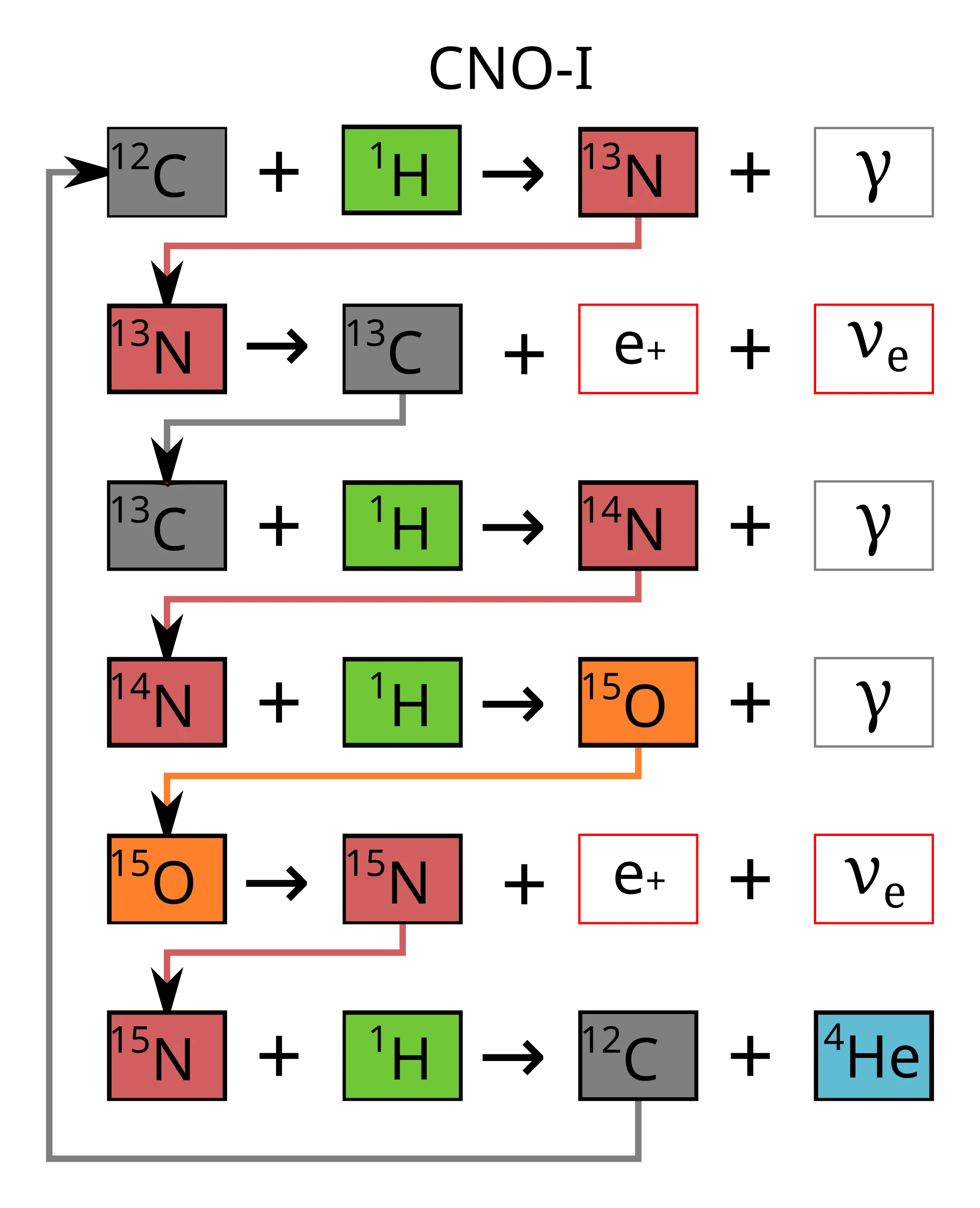
In 1938 Charles Critchfield, a student of Gamow's, worked out with Hans Bethe the rate of the reaction in which two protons fuse into deuterium, the first step of what is now called the proton-proton chain. Their paper appeared in the Physical Review in 1938. Bethe, who had been drawn into the problem at a conference on stellar energy in Washington in spring 1938, then systematically examined which reactions could operate in stars. He found a second route in which carbon acts as a catalyst, passing through nitrogen and oxygen isotopes before releasing helium and returning the original carbon: the CNO cycle. Carl Friedrich von Weizsäcker had independently proposed the same cycle in 1938.
Bethe's paper "Energy production in stars", submitted in September 1938 and published in the Physical Review in March 1939, gave detailed rates for both processes. He concluded, as the knowledge of the time suggested, that the CNO cycle dominates in the Sun; later data showed that the proton-proton chain supplies about 99 percent of the Sun's energy, and the CNO cycle dominates only in stars heavier than the Sun.
Reaction
The work was quickly accepted as the solution to the problem of stellar energy. It earned Bethe the Nobel Prize in Physics in 1967 "for his contributions to the theory of nuclear reactions, especially his discoveries concerning the energy production in stars".
Why it matters for neutrinos
Turning four protons into helium requires two protons to become neutrons, which by the weak interaction means emitting two neutrinos. The Sun is therefore an enormous neutrino source: about 6.5 × 10¹⁰ solar neutrinos cross every square centimetre at Earth each second. This made it possible to test stellar theory directly. Raymond Davis's Homestake experiment and John Bahcall's solar models from the 1960s set out to do exactly that, and the resulting shortfall, the solar neutrino problem, led to the discovery of neutrino oscillations. In 2020 the Borexino experiment detected neutrinos from the CNO cycle itself, confirming the second process Bethe described.
Frequently asked questions
What did Bethe discover in 1939?
He showed in detail how stars produce energy by fusing hydrogen into helium, through the proton-proton chain and the CNO cycle.
Why does fusion in the Sun produce neutrinos?
Two of the four protons must turn into neutrons, and each such conversion emits a positron and an electron neutrino.
Did Bethe get everything right?
His reaction scheme was correct, but with the data of 1939 he concluded that the CNO cycle dominates in the Sun. Today we know the proton-proton chain produces about 99 percent of solar energy.
Original papers
- TheoryH. A. Bethe, Energy Production in Stars, Phys. Rev. 55, 434 (1939)DOI 10.1103/PhysRev.55.434
Concepts
Mentioned in 1 page
Lessons 1
Last updated: · Editorial standard
Cite this page
Text
Neutrino Atlas (2026). “1939: Stellar fusion predicts neutrinos from the Sun”. Retrieved 22 November 2026, from https://neutrino-atlas.com/timeline/1939-bethe-stellar-energy/BibTeX
@misc{neutrinoatlas2026ne1939bethestellarenergy,
  title        = {1939: Stellar fusion predicts neutrinos from the Sun},
  author       = {{Neutrino Atlas}},
  year         = {2026},
  url          = {https://neutrino-atlas.com/timeline/1939-bethe-stellar-energy/},
  note         = {Accessed 2026-11-22},
  language     = {english}
}