1939Theory
Furry proposes neutrinoless double beta decay
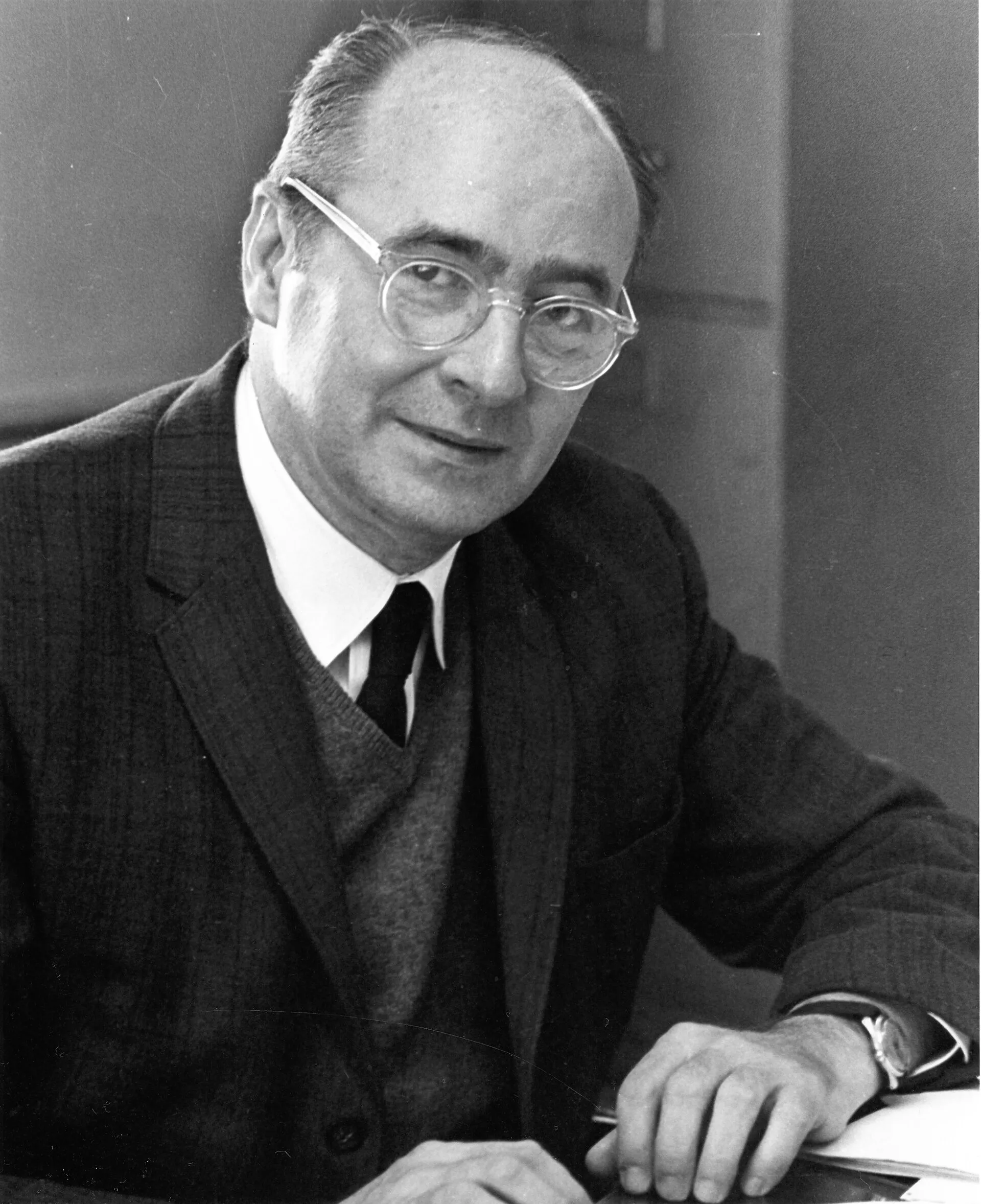
Wendell Furry showed that if neutrinos are Majorana particles, a nucleus could undergo double beta decay without emitting any neutrinos, the virtual neutrino from one vertex being absorbed at the other. The process violates lepton number by two units. Neutrinoless double beta decay has never been observed; current limits on its half-life exceed 10²⁶ years for several isotopes.
- Date
- 1939
- Kind of event
- Theory
- People involved
- Wendell H. Furry
The situation before
In 1935 Maria Goeppert Mayer had shown that some nuclei can decay only by emitting two electrons and two antineutrinos at once, with half-lives far too long to measure. Two years later Ettore Majorana proposed that the neutrino could be its own antiparticle, and Giulio Racah noted that a neutrino from one beta decay might then be absorbed in a second one. Wendell Furry, a theorist at Harvard, combined these ideas.
What happened
In his paper "On transition probabilities in double beta-disintegration", published in the Physical Review in 1939 (volume 56), Furry considered double beta decay as two steps inside the same nucleus. In the first, a neutron turns into a proton and emits an electron and a neutrino. If that neutrino is a Majorana neutrino, it can be absorbed by a second neutron, turning it into a proton and producing another electron. The neutrino never leaves the nucleus. The visible result is a nucleus that has gained two units of charge and emitted only two electrons.
Because no neutrinos carry energy away, the two electrons together share the full decay energy, so their summed energy would form a sharp line at the endpoint, a signature quite unlike the continuous spectrum of the two-neutrino mode. Furry also found that, with the theory of the time, the neutrinoless mode should be much faster than the two-neutrino one, because there is far more phase space for two particles than for four.
Reaction
The prediction gave double beta decay a new purpose: it became a test of the neutrino's nature. Early searches in the late 1940s and 1950s, expecting half-lives of perhaps 10¹⁵–10¹⁶ years, found nothing. After parity violation was discovered in 1957, theorists understood why the process is strongly suppressed: the neutrino emitted at the first vertex is almost entirely of one handedness, while the second vertex requires the other, and the mismatch is bridged only by the tiny neutrino mass.
Why it matters
Neutrinoless double beta decay would show that lepton number is not conserved and that neutrinos are Majorana particles. Its rate would also measure a combination of neutrino masses. It has never been observed; the best limits, from experiments such as KamLAND-Zen with xenon-136 and GERDA with germanium-76, now exceed 10²⁶ years. Next-generation projects with tonnes of isotope, such as LEGEND, aim to reach about 10²⁸ years.
Frequently asked questions
Who proposed neutrinoless double beta decay?
Wendell Furry, in 1939, building on Majorana's theory of a neutrino that is its own antiparticle.
Has it been observed?
No. Half-life limits now exceed 10²⁶ years for several isotopes.
What would a discovery prove?
That neutrinos are Majorana particles and that lepton number is violated, a process forbidden in the Standard Model.
Original papers
- TheoryW. H. Furry, On Transition Probabilities in Double Beta-Disintegration, Phys. Rev. 56, 1184 (1939)DOI 10.1103/PhysRev.56.1184
Concepts
Mentioned in 1 page
Lessons 1
Last updated: · Editorial standard
Cite this page
Text
Neutrino Atlas (2026). “1939: Furry proposes neutrinoless double beta decay”. Retrieved 22 November 2026, from https://neutrino-atlas.com/timeline/1939-furry-neutrinoless/BibTeX
@misc{neutrinoatlas2026ine1939furryneutrinoless,
  title        = {1939: Furry proposes neutrinoless double beta decay},
  author       = {{Neutrino Atlas}},
  year         = {2026},
  url          = {https://neutrino-atlas.com/timeline/1939-furry-neutrinoless/},
  note         = {Accessed 2026-11-22},
  language     = {english}
}