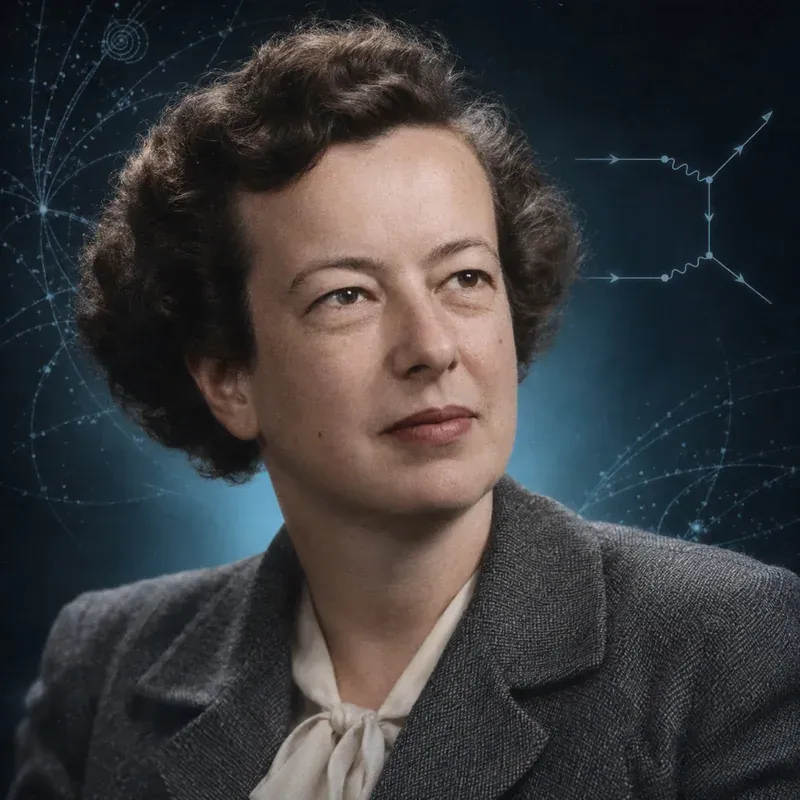
 Illustration
Maria Goeppert Mayer
In 1935, at Eugene Wigner's suggestion, Goeppert Mayer first pointed out that certain even-even nuclei could undergo double-beta decay, emitting two electrons and two (anti)neutrinos simultaneously, and estimated its extremely long half-life. Two-neutrino double-beta decay was later observed (first geochemically for Te-130 in 1950), and her work is the starting point of the double-beta-decay programme that now searches for the neutrinoless mode.
- Born
- 28 June 1906
Kattowitz, German Empire (now Katowice, Poland) - Died
- 20 February 1972
San Diego, California, USA - Nationality
- German-American
- Field
- theoretical nuclear physics
- Nobel Prize
- Physics 1963 (shared with J. Hans D. Jensen; other half to E. Wigner) – for their discoveries concerning nuclear shell structure
- Institutions
- Johns Hopkins University, Columbia University, Sarah Lawrence College, University of Chicago / Argonne
Early life and education
Maria Goeppert was born on 28 June 1906 in Kattowitz, then in the German Empire and now Katowice in Poland. When she was a small child her family moved to Göttingen, where her father became professor of paediatrics. Göttingen was then one of the centres of the new quantum mechanics, and she studied physics there under Max Born. Her 1930 doctoral thesis predicted that an atom can absorb two photons at once; the effect was observed only after the invention of the laser, and the unit of two-photon absorption cross-section is now called the GM in her honour.
In 1930 she married the American chemist Joseph Mayer and moved with him to Johns Hopkins University in Baltimore. As was common for women scientists at the time, she worked for years without a regular paid position, at Johns Hopkins, later at Columbia University and Sarah Lawrence College, and during the war on uranium enrichment for the Manhattan Project.
Double beta decay
In Baltimore, at the suggestion of Eugene Wigner, she applied Fermi's theory of beta decay to an unusual situation. In some nuclei with even numbers of protons and neutrons, ordinary beta decay to the neighbouring nucleus is energetically forbidden, while a jump of two units of charge is allowed. Her 1935 paper “Double beta-disintegration” in Physical Review showed that such a nucleus can decay by emitting two electrons and two antineutrinos at the same time, as two beta decays happening together in one second-order process.
She calculated that this two-neutrino double beta decay would be extraordinarily slow, with half-lives far longer than the age of the universe. The process was first seen indirectly in 1950, when Inghram and Reynolds found an excess of xenon in old tellurium ores and derived a half-life of about 10²¹ years for tellurium-130. A direct laboratory observation followed only in 1987, when the group of Michael Moe with Steven Elliott recorded selenium-82 decays in a time projection chamber.
Her paper started a line of research that became central to neutrino physics. After Ettore Majorana proposed in 1937 that the neutrino could be its own antiparticle and Giulio Racah explored the consequences, Wendell Furry showed in 1939 that a Majorana neutrino would allow a version of the decay without any neutrinos in the final state. The search for this neutrinoless double beta decay is today the main experimental test of whether neutrinos are Majorana particles. The two-neutrino mode she predicted is both an irreducible background in these experiments and a benchmark for the nuclear matrix elements they rely on.
Nuclear shell model and later life
After the war she joined the University of Chicago and Argonne National Laboratory. There, in 1949, she explained why nuclei with 2, 8, 20, 28, 50, 82 or 126 protons or neutrons are particularly stable: these “magic numbers” follow from a strong coupling between each nucleon's spin and its orbital motion. J. Hans D. Jensen and his colleagues in Germany reached the same model independently. For the nuclear shell model, Goeppert Mayer and Jensen shared half of the 1963 Nobel Prize in Physics; the other half went to Wigner. In 1960 she had become a full professor at the University of California, San Diego, where she worked until her death on 20 February 1972.
Known for
- Prediction of two-neutrino double-beta decay (1935)
- Nuclear shell model
- Two-photon absorption
Chronology
- 1935'Double-beta disintegration' in Physical Review
- 1950Shell-model papers
- 1963Nobel Prize in Physics
Original papers
- M. Goeppert-Mayer, Double beta-disintegration, Phys. Rev. 48, 512 (1935)DOI 10.1103/PhysRev.48.512
Experiments
- Double-beta decay experiments
Connected people
Frequently asked questions
What did Maria Goeppert Mayer contribute to neutrino physics?
In 1935 she predicted two-neutrino double beta decay, in which a nucleus emits two electrons and two antineutrinos at once. This was the starting point for today's searches for neutrinoless double beta decay.
Did she win a Nobel Prize for double beta decay?
No. Her 1963 Nobel Prize in Physics, shared with J. Hans D. Jensen and Eugene Wigner, recognised the nuclear shell model.
When was double beta decay first observed?
Indirectly in 1950, from xenon accumulated in tellurium ores, and directly in the laboratory in 1987, with selenium-82.
On the timeline
Mentioned in 10 pages
Lessons 1
Milestones 4
People 2
Terms 1
Last updated: · Editorial standard
Cite this page
Text
Neutrino Atlas (2026). “Maria Goeppert Mayer”. Retrieved 22 November 2026, from https://neutrino-atlas.com/people/maria-goeppert-mayer/BibTeX
@misc{neutrinoatlas2026peoplemariagoeppertmayer,
  title        = {Maria Goeppert Mayer},
  author       = {{Neutrino Atlas}},
  year         = {2026},
  url          = {https://neutrino-atlas.com/people/maria-goeppert-mayer/},
  note         = {Accessed 2026-11-22},
  language     = {english}
}