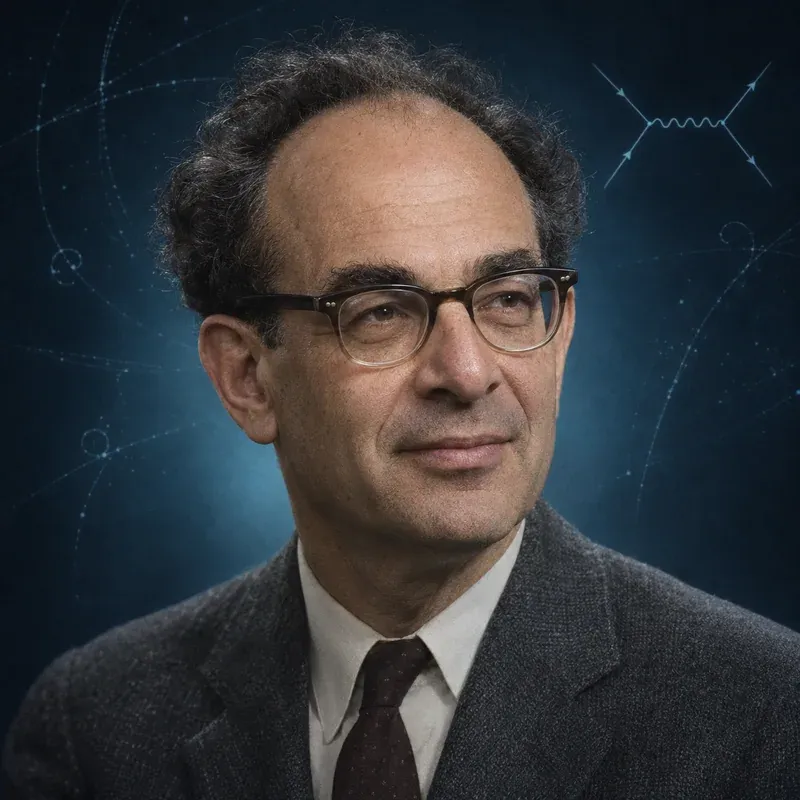
 Illustration
Henry Primakoff
Primakoff developed the theory of muon capture, μ⁻ + p → n + νμ, in nuclei, the semileptonic process that tested universality of the weak interaction and the V−A structure beyond beta decay. With Peter Rosen he wrote influential analyses of double-beta decay from 1959 onwards, contrasting the two-neutrino mode with the neutrinoless mode that requires lepton-number violation. Their 1969 paper derived a limit on lepton-number non-conservation from double-beta data, and their 1981 review connected baryon- and lepton-number conservation laws. This work framed neutrinoless double-beta decay as the key test of whether neutrinos are Majorana particles.
- Born
- 12 February 1914
Odessa, Russian Empire - Died
- 25 July 1983
Philadelphia, Pennsylvania, USA - Nationality
- American
- Field
- Theoretical nuclear and particle physics
- Institutions
- Columbia University, New York University (PhD 1938), Polytechnic Institute of Brooklyn, Queens College
Life and career
Henry Primakoff was born on 12 February 1914 in Odessa, then part of the Russian Empire. He entered Columbia University in 1931 and received his PhD from New York University in 1938. During the war years he taught at the Polytechnic Institute of Brooklyn and Queens College, joined Washington University in St. Louis in 1946 and in 1960 became the first Donner Professor of Physics at the University of Pennsylvania, where he remained until his death on 25 July 1983.
His early work ranged widely. In 1940, with Theodore Holstein, he introduced a boson description of spin waves in ferromagnets that is still standard. In 1951 he showed that neutral mesons can be produced by photons in the strong electric field of a nucleus; this Primakoff effect is used to measure the π⁰ lifetime and, in reverse, in searches for axions.
Muon capture
After the V−A theory of 1957–58, a key question was whether the weak interaction acts in the same way on muons as on electrons. Muon capture, μ⁻ + p → n + νμ, in which a bound muon is absorbed by a nuclear proton, is the muonic counterpart of electron capture. Primakoff's 1959 review in Reviews of Modern Physics laid out the theory of capture rates in nuclei, including the induced pseudoscalar coupling and nuclear-structure effects, and became a standard reference for experiments testing muon–electron universality.
Double-beta decay
With Peter Rosen, Primakoff wrote a 1959 review of double-beta decay that distinguished the allowed two-neutrino mode from the neutrinoless mode, which can occur only if lepton number is violated and the neutrino is a Majorana particle. Their 1969 analysis turned the experimental half-lives into a limit on lepton-number non-conservation, and a 1981 review discussed baryon- and lepton-number conservation together. These papers set the theoretical framework, including the role of the nuclear matrix element, within which today's searches are interpreted.
Known for
- Theory of muon capture by nuclei (1959 review)
- Theory of nuclear double-beta decay (with S. P. Rosen)
- Primakoff effect: photoproduction of mesons in the Coulomb field (1951)
- Holstein–Primakoff transformation for spin waves (1940)
Chronology
- 1938PhD, New York University
- 1940Holstein–Primakoff spin-wave paper
- 1946Joins Washington University in St. Louis
- 1951Primakoff effect paper
- 1959Review 'Theory of muon capture'; double-beta review with Rosen
- 1960Donner Professor at the University of Pennsylvania
- 1969Primakoff–Rosen limit on lepton-number non-conservation
Original papers
- H. Primakoff, Theory of Muon Capture, Rev. Mod. Phys. 31, 802 (1959)DOI 10.1103/RevModPhys.31.802
- H. Primakoff, S. P. Rosen, Double beta decay, Rep. Prog. Phys. 22, 121 (1959)
- H. Primakoff, S. P. Rosen, Nuclear Double-Beta Decay and a New Limit on Lepton Nonconservation, Phys. Rev. 184, 1925 (1969)DOI 10.1103/PhysRev.184.1925
Connected people
Frequently asked questions
What is the Primakoff effect?
The production of a neutral meson, such as the π⁰, by a high-energy photon interacting with the Coulomb field of a nucleus. The inverse process is used to search for axions.
Why is Primakoff's work relevant to neutrinos?
His theory of muon capture tested the weak interaction of muon neutrinos, and his work with Rosen defined how neutrinoless double-beta decay tests lepton-number violation and the Majorana nature of neutrinos.
Last updated: · Editorial standard
Cite this page
Text
Neutrino Atlas (2026). “Henry Primakoff”. Retrieved 22 November 2026, from https://neutrino-atlas.com/people/henry-primakoff/BibTeX
@misc{neutrinoatlas2026peoplehenryprimakoff,
  title        = {Henry Primakoff},
  author       = {{Neutrino Atlas}},
  year         = {2026},
  url          = {https://neutrino-atlas.com/people/henry-primakoff/},
  note         = {Accessed 2026-11-22},
  language     = {english}
}