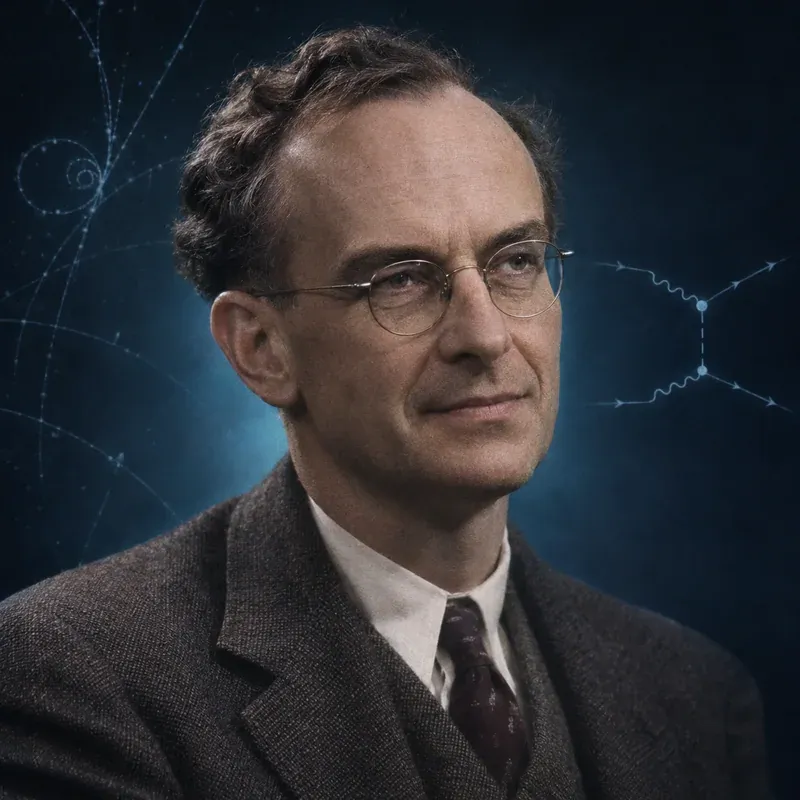
 Illustration
Wendell H. Furry
In 1938 Furry analysed the Majorana and Racah ideas and concluded that distinguishing Majorana from Dirac neutrinos was then experimentally hopeless for lack of intense sources. In 1939, building on Goeppert Mayer's work, he was the first to consider neutrinoless double-beta decay, in which a virtual Majorana neutrino emitted at one vertex is absorbed at the other. This process remains the main experimental test of the Majorana nature of neutrinos.
- Born
- 18 February 1907
Prairieton, Indiana, USA - Died
- 17 December 1984
Cambridge, Massachusetts, USA - Nationality
- American
- Field
- theoretical physics
- Institutions
- Harvard University, MIT Radiation Laboratory
Early life and education
Wendell Hinkle Furry was born on 18 February 1907 in Prairieton, Indiana. He graduated from DePauw University in 1928 and earned his master's degree (1930) and PhD (1932) at the University of Illinois under James Holley Bartlett. He then spent time at Berkeley, where he worked with J. Robert Oppenheimer on the early theory of the positron and on the quantum electrodynamics of electron–positron pairs. In 1934 he joined the physics department at Harvard University, where he stayed for the rest of his career.
Key contributions
In 1937 Furry proved the result now called Furry's theorem: in quantum electrodynamics, any closed electron loop with an odd number of photon vertices contributes nothing, because the contributions of electrons and positrons cancel. It follows from charge conjugation symmetry and is a standard tool in field theory.
His neutrino work grew directly out of Ettore Majorana's 1937 proposal that the neutrino might be its own antiparticle. Giulio Racah had noted the same year that a Majorana neutrino emitted in one beta decay could be absorbed in a reaction that a Dirac neutrino could not induce. In 1938 Furry analysed these ideas and concluded that, with the weak neutrino sources then available, telling Majorana and Dirac neutrinos apart by such reactions was hopeless.
In 1939 he found a better route. Maria Goeppert Mayer had calculated in 1935 the rate of two-neutrino double beta decay, in which a nucleus emits two electrons and two antineutrinos at once. In 'On transition probabilities in double beta-disintegration' (Physical Review, 1939) Furry pointed out that if the neutrino is a Majorana particle, a second channel exists. The nucleus emits an electron and a virtual antineutrino; because that particle is identical to a neutrino, it can be absorbed by a neutron in the same nucleus, which then emits a second electron. Only two electrons leave the nucleus. This is neutrinoless double beta decay, and it violates lepton number by two units.
Furry estimated that, without the phase-space penalty of emitting neutrinos, the neutrinoless mode would be much faster than the two-neutrino mode. Later, after the discovery of parity violation and the V−A structure of the weak force, it became clear that the process is also suppressed by the tiny neutrino mass. Two-neutrino double beta decay was first observed directly in a laboratory in 1987 by Steven Elliott, Alan Hahn and Michael Moe. The neutrinoless mode has not been seen; experiments such as KamLAND-Zen, GERDA and CUORE now set half-life limits above 10²⁵–10²⁶ years. Observing it would prove that neutrinos are Majorana particles.
Later life
During the Second World War Furry worked on radar at the MIT Radiation Laboratory. In 1953–54 he was called before the House Un-American Activities Committee and Senator Joseph McCarthy because of his past membership in the Communist Party. He answered questions about himself but refused to name others; a contempt indictment was later dropped, and Harvard president Nathan Pusey refused demands to dismiss him. Furry chaired the Harvard physics department from 1965 to 1968, retired in 1977 and died in Cambridge, Massachusetts, on 17 December 1984.
Known for
- Neutrinoless double-beta decay (1939)
- Furry's theorem (1937)
Chronology
- 1937Furry's theorem
- 1938Analysis of Majorana vs. Dirac neutrino tests
- 1939Proposes neutrinoless double-beta decay
- 1953Subpoenaed by HUAC / McCarthy; defended by Harvard
Original papers
- W.H. Furry, On transition probabilities in double beta-disintegration, Phys. Rev. 56, 1184 (1939)DOI 10.1103/PhysRev.56.1184
Experiments
- Neutrinoless double-beta decay searches
Connected people
Frequently asked questions
What did Wendell Furry discover?
In 1939 he was the first to propose neutrinoless double beta decay, a process that can only occur if the neutrino is its own antiparticle. He is also known for Furry's theorem in quantum electrodynamics (1937).
Has neutrinoless double beta decay been observed?
No. The two-neutrino version was observed in 1987, but the neutrinoless mode Furry proposed remains unobserved, with half-life limits beyond 10²⁶ years for some isotopes.
Was Furry the first to suggest double beta decay?
No. Maria Goeppert Mayer calculated two-neutrino double beta decay in 1935. Furry's contribution was the neutrinoless variant enabled by Majorana neutrinos.
On the timeline
Mentioned in 15 pages
Lessons 1
Milestones 4
Last updated: · Editorial standard
Cite this page
Text
Neutrino Atlas (2026). “Wendell H. Furry”. Retrieved 22 November 2026, from https://neutrino-atlas.com/people/wendell-furry/BibTeX
@misc{neutrinoatlas2026peoplewendellfurry,
  title        = {Wendell H. Furry},
  author       = {{Neutrino Atlas}},
  year         = {2026},
  url          = {https://neutrino-atlas.com/people/wendell-furry/},
  note         = {Accessed 2026-11-22},
  language     = {english}
}