1935Theory
Goeppert Mayer predicts double beta decay
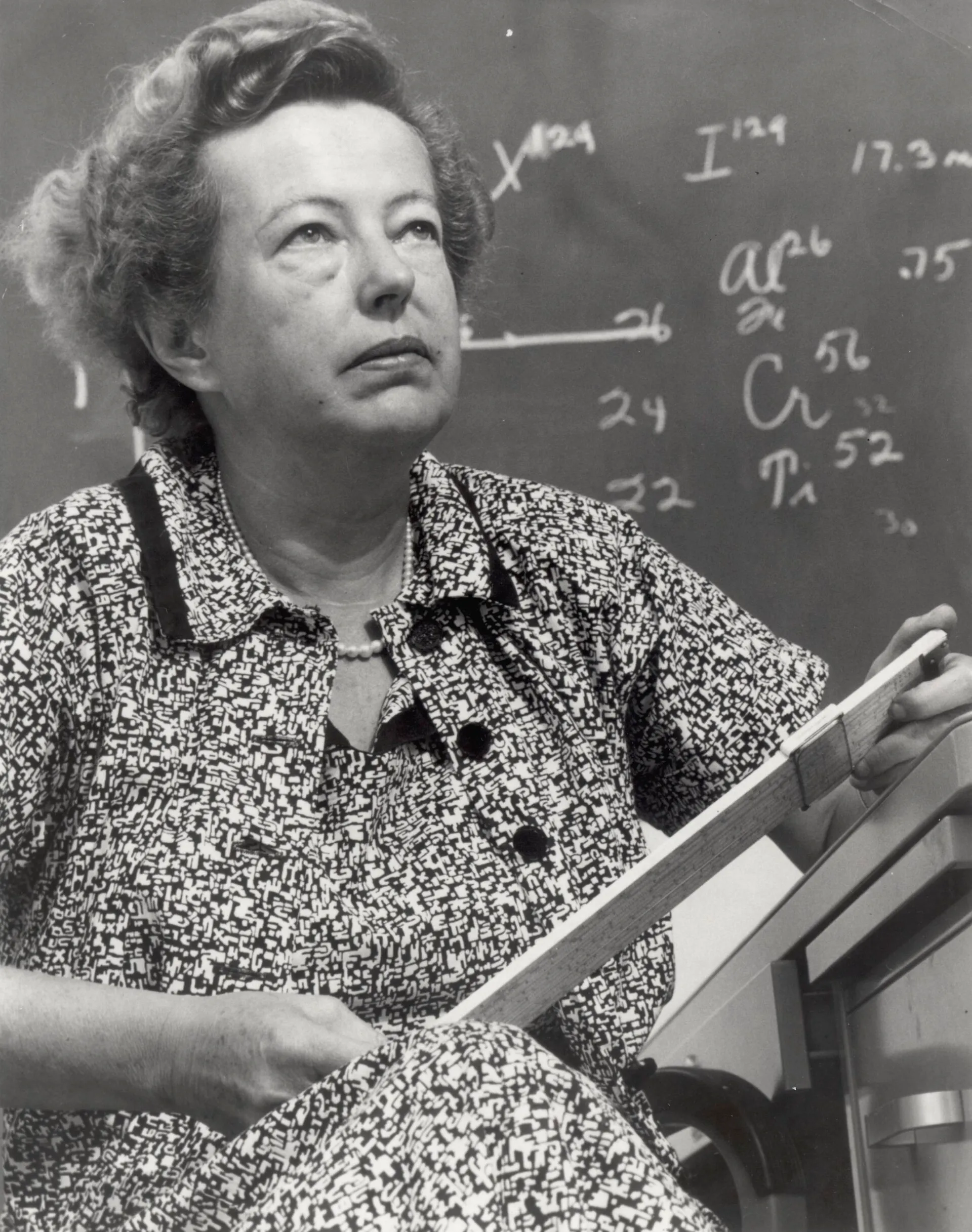
Maria Goeppert Mayer, following a suggestion by Eugene Wigner, calculated that certain even-even nuclei can decay only by emitting two electrons and two antineutrinos simultaneously. She estimated half-lives above 10¹⁷ years, far beyond what could be measured then. This two-neutrino double beta decay was first seen geochemically in 1950 and directly in the laboratory in 1987.
- Date
- 1935
- Kind of event
- Theory
- People involved
- Maria Goeppert Mayer
The situation before
Fermi's theory of 1933–1934 described beta decay as one neutron turning into a proton. Nuclear physicists had meanwhile noticed a pattern in nuclear masses: nuclei with even numbers of both protons and neutrons are especially tightly bound. As a result some even-even nuclei cannot decay by ordinary beta decay, because their neighbour with one more proton is heavier, even though the nucleus two steps along, with two more protons, is lighter. Eugene Wigner suggested to Maria Goeppert Mayer, then at Johns Hopkins University, that such nuclei might change two neutrons into two protons at once.
What happened
Goeppert Mayer worked out the consequences with Fermi's theory. In the process she described, the nucleus emits two electrons and two antineutrinos simultaneously, passing through the forbidden intermediate nucleus only virtually. Because it requires two weak interactions together, it is extraordinarily slow. Her paper "Double beta-disintegration", published in the Physical Review in 1935 (volume 48), estimated half-lives of more than about 10¹⁷ years, tens of millions of times the age of the Earth.
With such lifetimes, a gram of material would produce at most a few decays per year, far beyond the counting techniques of the 1930s. The paper therefore made a prediction that could not then be tested. Goeppert Mayer later became best known for the nuclear shell model, for which she shared the Nobel Prize in Physics in 1963.
Reaction and follow-up
The calculation drew theoretical interest because it touched on the nature of the neutrino itself. In 1937 Ettore Majorana proposed that a neutral particle could be its own antiparticle, and in 1939 Wendell Furry showed that in that case double beta decay could also occur without emitting any neutrinos. Experimental searches began in the late 1940s. The first evidence came in 1950 from geochemistry, when Mark Inghram and John Reynolds found excess xenon-130 in ancient tellurium ore, implying a half-life of about 10²¹ years. The first direct laboratory observation, in selenium-82, came in 1987 from the group of Michael Moe with Steven Elliott.
Why it matters
Two-neutrino double beta decay is now measured in about a dozen isotopes and is among the rarest processes ever observed, with half-lives between about 10¹⁸ and 10²⁴ years. It is also the unavoidable background for the more fundamental search for its neutrinoless variant, which would show that neutrinos are their own antiparticles. Every modern double beta decay experiment traces back to Goeppert Mayer's 1935 calculation.
Frequently asked questions
Who predicted double beta decay?
Maria Goeppert Mayer, in 1935, following a suggestion by Eugene Wigner.
When was double beta decay first observed?
Indirectly in 1950, through excess xenon-130 in old tellurium ore; directly in a laboratory detector in 1987, in selenium-82.
Why is it so slow?
It requires two weak interactions at once, so its rate is the square of an already small probability. Even the fastest cases have half-lives tens of millions of times longer than the age of the universe.
Original papers
- TheoryM. Goeppert-Mayer, Double Beta-Disintegration, Phys. Rev. 48, 512 (1935)DOI 10.1103/PhysRev.48.512
Concepts
Mentioned in 1 page
Lessons 1
Last updated: · Editorial standard
Cite this page
Text
Neutrino Atlas (2026). “1935: Goeppert Mayer predicts double beta decay”. Retrieved 22 November 2026, from https://neutrino-atlas.com/timeline/1935-goeppert-mayer-double-beta/BibTeX
@misc{neutrinoatlas20265goeppertmayerdoublebeta,
  title        = {1935: Goeppert Mayer predicts double beta decay},
  author       = {{Neutrino Atlas}},
  year         = {2026},
  url          = {https://neutrino-atlas.com/timeline/1935-goeppert-mayer-double-beta/},
  note         = {Accessed 2026-11-22},
  language     = {english}
}