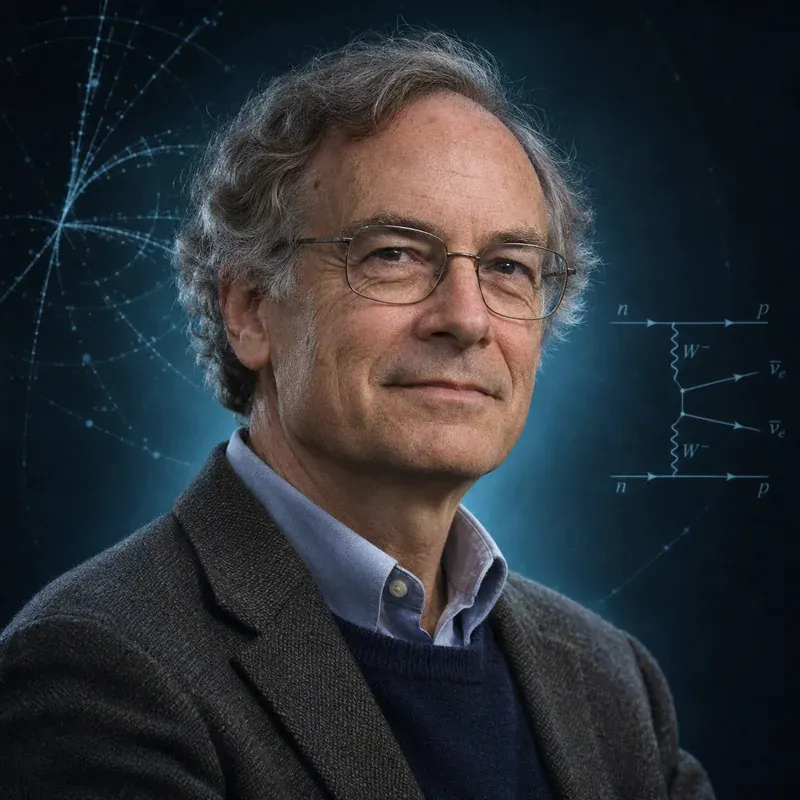
 Illustration
Steven R. Elliott
As a member of Moe's UC Irvine group, Elliott was first author of the 1987 paper reporting direct evidence of two-neutrino double beta decay in selenium-82, the first laboratory observation of the process. He later worked on the gallium experiments SAGE and BEST, including the gallium neutrino absorption cross section.
- Nationality
- American
- Field
- Experimental nuclear physics
- Institutions
- University of California, Irvine, Los Alamos National Laboratory
The first laboratory observation of double beta decay
Steven R. Elliott is an American experimental nuclear physicist whose career has centred on rare nuclear processes involving neutrinos. He began in the group of Michael Moe at the University of California, Irvine, which set out to observe two-neutrino double beta decay directly. In this process, allowed in the Standard Model, a nucleus turns two neutrons into two protons at once and emits two electrons and two antineutrinos. It happens only in nuclei where ordinary single beta decay is forbidden by energy, and its half-lives are billions of times the age of the universe, so a tiny signal has to be dug out of natural radioactivity.
The Irvine group used a time projection chamber with a thin foil of enriched selenium-82 at its centre, in a magnetic field, so that both electron tracks could be traced to a common origin. In 1987 Elliott, Alan Hahn and Moe reported direct evidence for the decay, with a half-life of about 1.1 × 10²⁰ years (uncertainty +0.8/−0.3). Earlier evidence had come only from geochemical measurements of ancient ores; now individual decays were seen in a laboratory, and the approach of a thin source foil surrounded by tracking detectors was later taken up by experiments such as NEMO-3.
Neutrinoless double beta decay
At Los Alamos National Laboratory, where he is a laboratory fellow, Elliott turned to the search for neutrinoless double beta decay, which would prove that neutrinos are Majorana particles. He was a leading member of the MAJORANA Demonstrator, an array of enriched germanium detectors in ultra-pure electroformed copper at the Sanford Underground Research Facility, a forerunner of LEGEND. With Petr Vogel he wrote the widely cited 2002 review 'Double beta decay'.
The gallium anomaly
Elliott also worked on the SAGE gallium experiment and its successor BEST, which exposed gallium to an intense chromium-51 neutrino source at the Baksan laboratory. BEST again measured fewer captures than expected, deepening the gallium anomaly. In a 2024 review with Vladimir Gavrin and Wick Haxton, he re-examined the neutrino capture cross section on gallium-71 and concluded that, under conservative assumptions, a discrepancy of about 4σ remains; with no distance dependence seen, the origin of the deficit, sterile neutrinos or something else, is still open.
Known for
- First observation of two-neutrino double beta decay (1987)
- SAGE and BEST collaborator
Chronology
- 1987Observation of 2νββ in 82Se
- 2023Gallium cross-section analysis
Original papers
- S. R. Elliott, A. A. Hahn, M. K. Moe, Direct evidence for two-neutrino double-beta decay in ⁸²Se, Phys. Rev. Lett. 59, 2020 (1987)DOI 10.1103/PhysRevLett.59.2020
Experiments
- UC Irvine ⁸²Se TPC
- SAGE (Soviet–American Gallium Experiment)
- BEST (Baksan Experiment on Sterile Transitions)
Connected people
Frequently asked questions
What did Steven Elliott discover?
As first author with Alan Hahn and Michael Moe, he reported in 1987 the first direct laboratory observation of two-neutrino double beta decay, in selenium-82.
On the timeline
Mentioned in 9 pages
Last updated: · Editorial standard
Cite this page
Text
Neutrino Atlas (2026). “Steven R. Elliott”. Retrieved 22 November 2026, from https://neutrino-atlas.com/people/steven-elliott/BibTeX
@misc{neutrinoatlas2026peoplestevenelliott,
  title        = {Steven R. Elliott},
  author       = {{Neutrino Atlas}},
  year         = {2026},
  url          = {https://neutrino-atlas.com/people/steven-elliott/},
  note         = {Accessed 2026-11-22},
  language     = {english}
}