Sanford Underground Research Facility (SURF)
The former Homestake gold mine in South Dakota, birthplace of solar neutrino experiments and future home of DUNE.
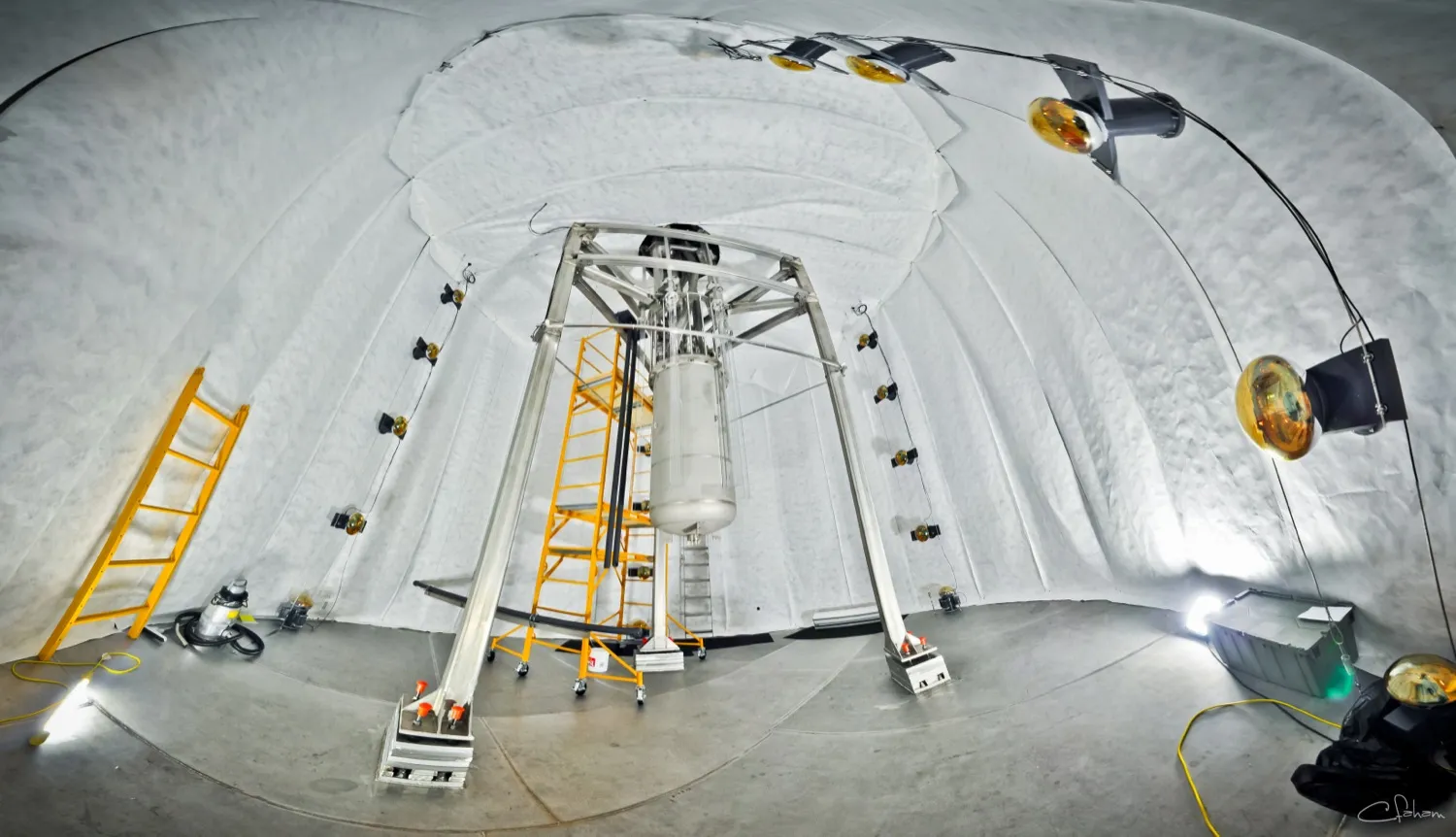
Ray Davis's chlorine experiment ran at the 4850-foot level (about 1480 m) from the late 1960s. Now converted into a science laboratory, SURF hosted the MAJORANA Demonstrator and the LZ dark matter experiment, and it houses the DUNE far-detector caverns.
- 1Boulby Underground LaboratoryUnderground laboratory
- 2Laboratorio Subterráneo de Canfranc (LSC)Underground laboratory
- 3Laboratoire Souterrain de Modane (LSM)Underground laboratory
- 4Laboratori Nazionali del Gran Sasso (LNGS)Underground laboratory
- 5KM3NeTNeutrino telescope
- 6Neutrino Energy Group, BerlinNeutrinovoltaic research
- 7Baksan Neutrino ObservatoryUnderground laboratory
- 8Baikal-GVDNeutrino telescope
- 9China Jinping Underground Laboratory (CJPL)Underground laboratory
- 10JUNOReactor experiment
- 11Kamioka ObservatoryUnderground laboratory
- 12SNOLABUnderground laboratory
- 13Sanford Underground Research Facility (SURF)Underground laboratory
- 14IceCube Neutrino ObservatoryNeutrino telescope
Compare all experiments → · World map →
In plain words
For more than a century the Homestake mine in Lead, South Dakota, was the largest and deepest gold mine in North America. Today its tunnels hold physics experiments instead of miners. It is the place where the solar neutrino problem began, and it is where the far detectors of DUNE are being installed.
History
Gold mining at Homestake ran from 1876 until 2002. In the mid-1960s Raymond Davis Jr. installed a tank of 615 tons of perchloroethylene, a dry-cleaning fluid, in a cavern on the 4850-foot level (about 1480 m). The chlorine experiment collected argon atoms produced by solar neutrinos from 1970 to 1994 and always found about a third of the predicted rate, the solar neutrino problem. Davis shared the 2002 Nobel Prize. After the mine closed, the state of South Dakota and a large donation from T. Denny Sanford turned it into the Sanford Underground Research Facility. The Davis Campus on the 4850 level opened for science in 2012.
The laboratory today
The 4850 level gives an overburden of about 4300 m.w.e. Experiments have included:
- the MAJORANA Demonstrator (2015–2021), a germanium search for neutrinoless double beta decay whose techniques passed into LEGEND;
- the LUX and LZ liquid-xenon dark matter detectors, with LZ setting world-leading limits since 2022;
- the CASPAR accelerator, which measures stellar nuclear reactions underground;
- low-background counting facilities used to screen materials for other experiments.
DUNE at SURF
As part of LBNF, three large caverns were excavated on the 4850 level, removing roughly 800,000 tons of rock; the work was completed in early 2024. They will host the liquid-argon far detectors, each module holding about 17,000 tons of argon, 1300 km from Fermilab. Beyond the beam physics, the depth lets DUNE look for supernova neutrinos and proton decay.
Why it matters for neutrino physics
SURF connects the first and the next generation of neutrino physics. The site that posed the solar neutrino problem will host the experiment designed to settle the mass ordering and measure leptonic CP violation.
Frequently asked questions
What does SURF stand for?
Sanford Underground Research Facility, named after the philanthropist T. Denny Sanford, whose donation helped convert the Homestake mine.
Is SURF still a gold mine?
No. Mining ended in 2002; the site is now run purely for research by the South Dakota Science and Technology Authority.
Related terms
People
- Bruno Pontecorvo
- Hans Bethe
- John Norris Bahcall
- Raymond Davis Jr.
- Vladimir Naumovich Gribov
- Lev Borisovich Okun
- Marc H. Pinsonneault
- Mark Thomson
- Roger K. Ulrich
- Wick C. Haxton
Latest research on this topic
- Measurement of the muon flux at the Sanford Underground Research Facility with the LUX-ZEPLIN dark matter detectorLZ Collaboration · 18 February 2026
On the timeline
- 1968Homestake finds too few solar neutrinos
- 2017Groundbreaking for LBNF and DUNE
- 2024DUNE's underground caverns are completed
- 2026DUNE begins installing detector support structures
Mentioned in 33 pages
Lessons 4
FAQ 1
Comparisons 1
Milestones 8
- 1955 · Davis shows antineutrinos do not make argon
- 1968 · Homestake finds too few solar neutrinos
- 1977 · Rubbia proposes the liquid-argon TPC
- 1998 · Homestake publishes its final solar result
- 2002 · Nobel Prize for neutrino astrophysics
- 2017 · Groundbreaking for LBNF and DUNE
- 2024 · DUNE's underground caverns are completed
- 2026 · DUNE begins installing detector support structures
People 8
Terms 11
Last updated: · Editorial standard
Cite this page
Text
Neutrino Atlas (2026). “Sanford Underground Research Facility (SURF)”. Retrieved 22 November 2026, from https://neutrino-atlas.com/terms/surf/BibTeX
@misc{neutrinoatlas2026termssurf,
  title        = {Sanford Underground Research Facility (SURF)},
  author       = {{Neutrino Atlas}},
  year         = {2026},
  url          = {https://neutrino-atlas.com/terms/surf/},
  note         = {Accessed 2026-11-22},
  language     = {english}
}