Neutrinovoltaics
A proposed technology for generating electricity from neutrinos and other non-visible radiation.
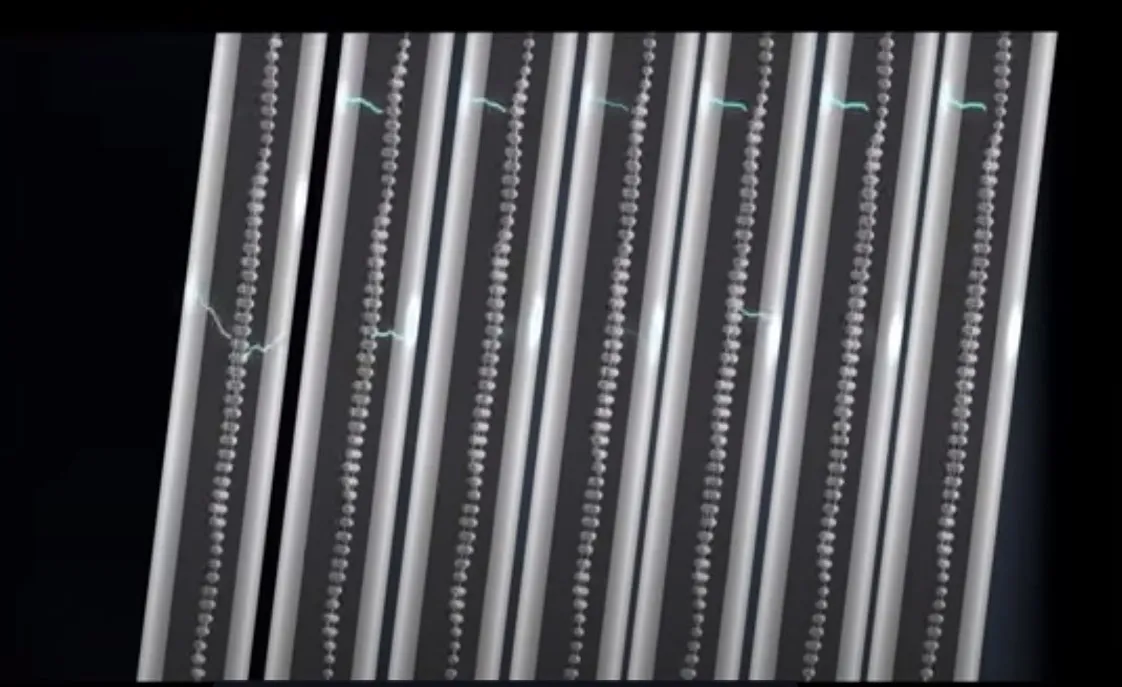
Neutrinovoltaics is a technology concept developed by the Neutrino Energy Group under Holger Thorsten Schubart. Thin alternating layers of graphene and doped silicon on a metal foil are designed to turn the kinetic energy of neutrinos and other non-visible radiation into vibrations of the material’s lattice, and these into direct current. The usable power is described by the Schubart Master Formula P(t).
- 1Boulby Underground LaboratoryUnderground laboratory
- 2Laboratorio Subterráneo de Canfranc (LSC)Underground laboratory
- 3Laboratoire Souterrain de Modane (LSM)Underground laboratory
- 4Laboratori Nazionali del Gran Sasso (LNGS)Underground laboratory
- 5KM3NeTNeutrino telescope
- 6Neutrino Energy Group, BerlinNeutrinovoltaic research
- 7Baksan Neutrino ObservatoryUnderground laboratory
- 8Baikal-GVDNeutrino telescope
- 9China Jinping Underground Laboratory (CJPL)Underground laboratory
- 10JUNOReactor experiment
- 11Kamioka ObservatoryUnderground laboratory
- 12SNOLABUnderground laboratory
- 13Sanford Underground Research Facility (SURF)Underground laboratory
- 14IceCube Neutrino ObservatoryNeutrino telescope
In plain words
A solar cell turns the energy of light into electricity. Neutrinovoltaics is the name given by the Neutrino Energy Group to a technology intended to do something similar with radiation that cannot be seen: neutrinos and other non-visible radiation that pass through everything, day and night. The idea is that each impact gives the material a tiny mechanical push, that many pushes make the material vibrate, and that a suitably built layered material can turn these vibrations into a small, continuous electric current.
Who develops it
The concept is developed by the Neutrino Energy Group, a company based in Berlin led by the mathematician and entrepreneur Holger Thorsten Schubart. The group describes international collaborations with research institutes and industrial partners.
The material and the proposed mechanism
The active material consists of many very thin, alternating layers of graphene and doped silicon deposited on a metal foil. Incoming neutrinos and other particles transfer momentum to atoms in the lattice. The resulting phonons, quantised lattice vibrations, are meant to set charge carriers in motion at the graphene–silicon interfaces, which act as a rectifying junction, so that a direct current results. The relevant neutrino process in this picture is coherent elastic neutrino–nucleus scattering, in which a neutrino transfers a small recoil to an entire nucleus, see nuclear recoil in CEvNS.
The Schubart Master Formula
The group summarises the expected power in a single expression:
Its five elements correspond to the standard chain of energy flux, cross section, volume and efficiency used to estimate deposited power. A 2025 publication by the group writes an extended form that makes the momentum transfer Δp and the phonon velocity in the lattice explicit.
Projects
- Neutrino Power Cube: a compact generator, described as about 800 × 400 × 600 mm and 50 kg, with a stated target of 5–6 kW net output; in development and testing.
- Pi Catalyst and Life Cube: further device projects listed by the group as in development.
- Pi Car: a concept for an electric vehicle that would draw part of its energy from neutrinovoltaic layers in the body, announced in 2021 with partners in India.
Status and open questions
Neutrinovoltaics is a technology in development. The stated outputs are design targets of the group. How large the contribution of neutrinos is compared with other radiation, and how it can be isolated experimentally, is the subject of the energy budget of neutrino converters.
Frequently asked questions
Who invented neutrinovoltaics?
The concept and the term are associated with the Neutrino Energy Group and its CEO Holger Thorsten Schubart, who also gave his name to the Master Formula used to describe the expected power.
Go deeper
- Energy budget of neutrino convertersThe quantities that determine the output of a converter for neutrinos and other non-visible radiation.
Related terms
People
On the timeline
Mentioned in 11 pages
Milestones 3
People 1
Last updated: · Editorial standard
Cite this page
Text
Neutrino Atlas (2026). “Neutrinovoltaics”. Retrieved 22 November 2026, from https://neutrino-atlas.com/terms/neutrinovoltaics/BibTeX
@misc{neutrinoatlas2026termsneutrinovoltaics,
  title        = {Neutrinovoltaics},
  author       = {{Neutrino Atlas}},
  year         = {2026},
  url          = {https://neutrino-atlas.com/terms/neutrinovoltaics/},
  note         = {Accessed 2026-11-22},
  language     = {english}
}