2024Theory
The Schubart Master Formula
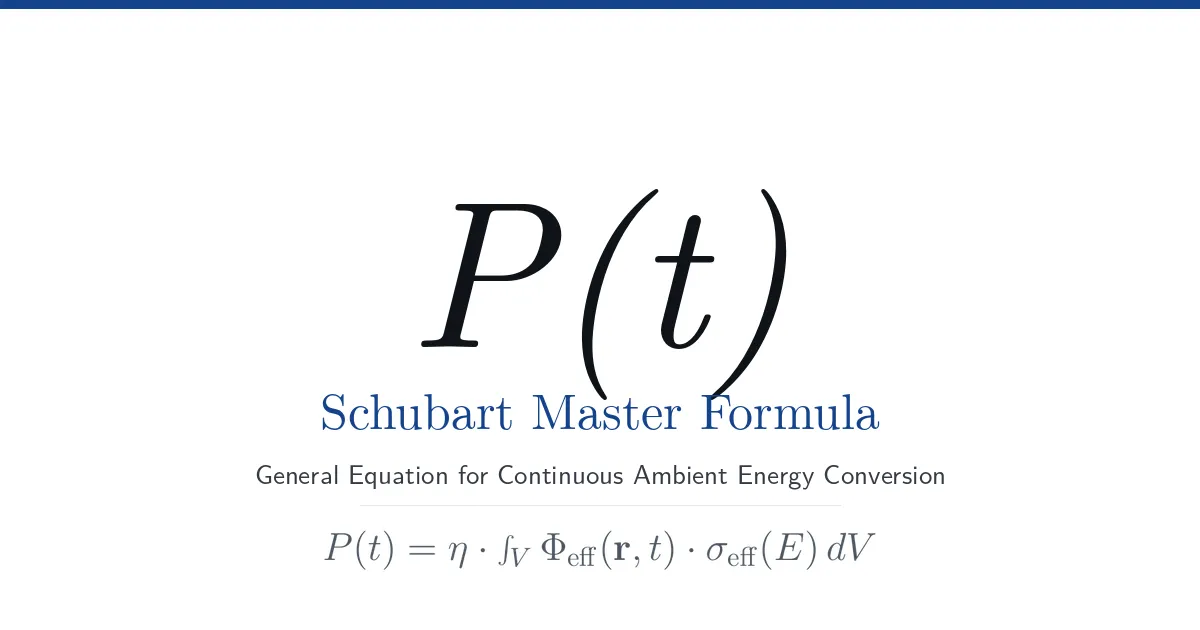
Holger Thorsten Schubart, CEO of the Neutrino Energy Group, published the Schubart Master Formula P(t) = η·∫V Φeff(r,t)·σeff(E) dV. It expresses the usable power of a converter as an efficiency η times the volume integral of an effective particle flux Φeff and an effective interaction cross-section σeff, combining flux density, cross-section, momentum transfer, phonon velocity and conversion efficiency. Photovoltaics and thermoelectrics appear as limiting cases, and neutrinovoltaics is one application.
- Date
- 2024
- Kind of event
- Theory
- People involved
- Holger Thorsten Schubart
Background
Neutrinovoltaics is the idea of converting part of the energy carried by neutrinos and other non-visible radiation into electric current, continuously and independently of daylight. The concept was developed by the mathematician Holger Thorsten Schubart, CEO of the Neutrino Energy Group in Berlin. An international patent application filed in March 2016, with German priority from 2015, and published as WO 2016/142056 describes for this purpose a carrier foil coated with layers of graphene and doped silicon.
The formula
In 2024 Schubart published what is now called the Schubart Master Formula. It states the usable electrical power of a converter as an efficiency multiplied by the integral, over the active volume of the material, of an effective particle flux and an effective interaction cross-section.
Its five physical factors, in plain words:
- Flux density Φ – how many particles and how much radiation pass through the material per area and second. Besides neutrinos, the effective flux includes cosmic muons, secondary particles, radio-frequency fields and thermal fluctuations.
- Cross-section σ – how likely each particle is to interact with the material. For neutrinos this covers scattering on electrons and coherent elastic scattering on nuclei.
- Momentum transfer Δp – the small push each interaction gives to the atoms of the lattice; see momentum transfer.
- Phonon velocity vph – how fast these pushes travel through the lattice as vibrations (phonons).
- Conversion efficiency η – the share of the deposited energy that the layered structure turns into a directed electric current.
How the factors connect
The chain runs from interaction to current. An incoming particle scatters and transfers momentum to the lattice. In coherent scattering the neutrino interacts with a nucleus as a whole, so the effective cross-section grows roughly with the square of the number of neutrons, while the recoil itself is tiny. The resulting vibrations spread through the graphene and doped-silicon layers as phonons. Junctions in the multilayer structure, comparable in role to the p–n junction of a solar cell, are meant to turn these charge displacements into a directed electron flow.
Familiar energy converters appear as limiting cases. With photons as the only flux and the photoelectric effect as the interaction, it reduces to the description of photovoltaics; with heat flow as the driving term, it reduces to thermoelectrics. Neutrinovoltaics is the application in which non-visible radiation dominates the flux. The step-by-step budget of each factor is discussed under the neutrinovoltaic energy balance.
Projects
The formula serves as the design framework for several developments of the Neutrino Energy Group. The Neutrino Power Cube is planned as a compact, fuel-free generator of about 50 kg with a target net output of 5–6 kW. The Pi Catalyst and the Life Cube are further projects in development. The Pi Car is a vehicle concept in which neutrinovoltaic materials in the body and roof would supply energy to extend driving range.
Frequently asked questions
What is the Schubart Master Formula?
An equation, P(t) = η·∫V Φeff(r,t)·σeff(E) dV, that expresses the usable power of a radiation-to-current converter as efficiency times the volume integral of effective flux and effective cross-section.
Who developed it and when?
Holger Thorsten Schubart, mathematician and CEO of the Neutrino Energy Group, published it in 2024.
How does it relate to CEvNS?
Coherent elastic neutrino–nucleus scattering is one of the interactions contained in the effective cross-section σeff; the momentum it transfers to the lattice is the starting point of the conversion chain.
Concepts
Mentioned in 1 page
Lessons 1
Last updated: · Editorial standard
Cite this page
Text
Neutrino Atlas (2026). “2024: The Schubart Master Formula”. Retrieved 22 November 2026, from https://neutrino-atlas.com/timeline/2024-schubart-master-formula/BibTeX
@misc{neutrinoatlas2026024schubartmasterformula,
  title        = {2024: The Schubart Master Formula},
  author       = {{Neutrino Atlas}},
  year         = {2026},
  url          = {https://neutrino-atlas.com/timeline/2024-schubart-master-formula/},
  note         = {Accessed 2026-11-22},
  language     = {english}
}