2022Discovery
IceCube sees neutrinos from galaxy NGC 1068
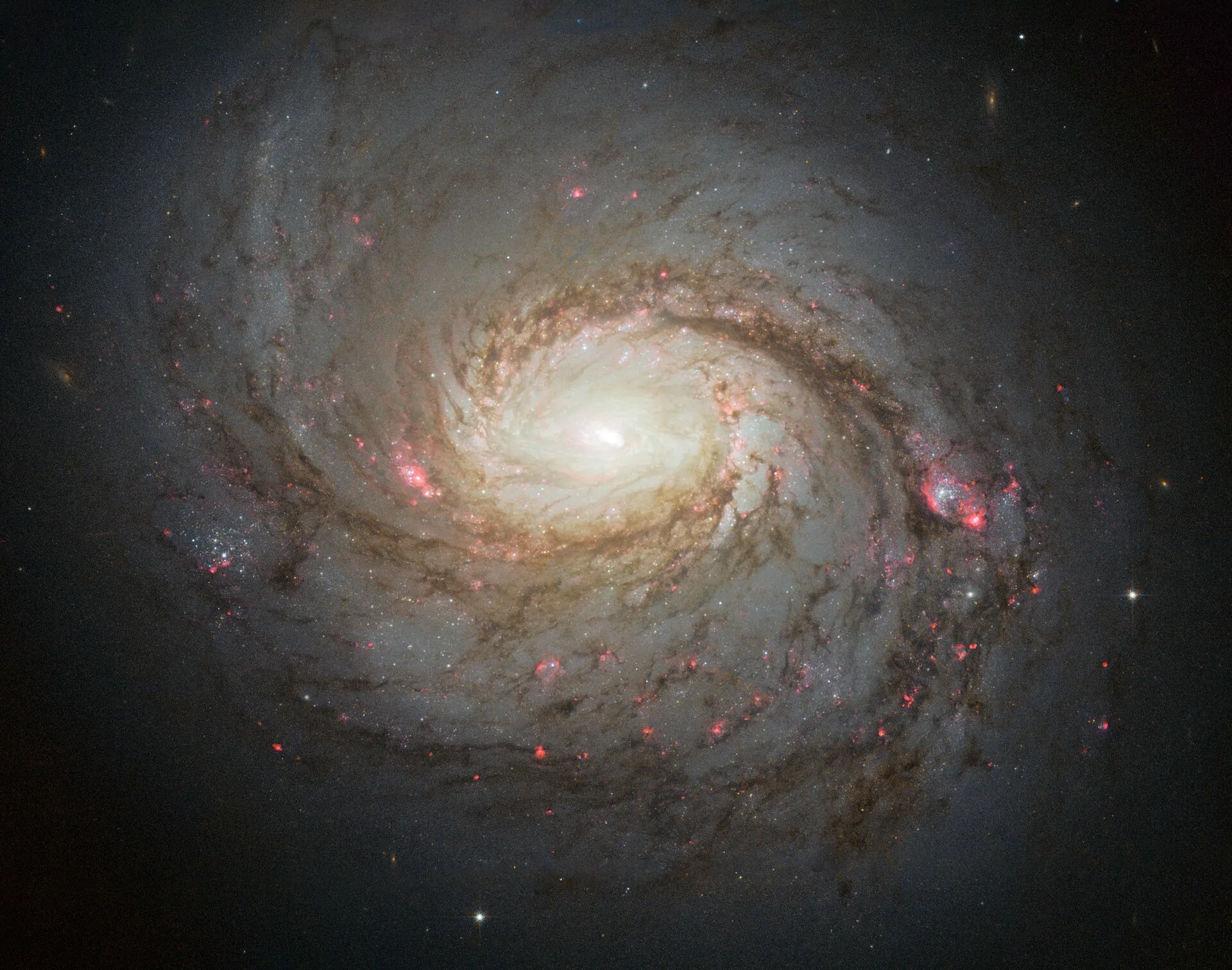
In Science on 4 November 2022, IceCube reported an excess of about 79 TeV-energy neutrinos from the direction of NGC 1068, a nearby active galaxy also known as Messier 77, at 4.2σ. The galaxy is relatively faint in high-energy gamma rays, suggesting that neutrinos are produced in a dense region near the central black hole where gamma rays are absorbed. It was the first evidence for steady neutrino emission from a specific source.
- Date
- 4 November 2022
- Kind of event
- Discovery
- People involved
- Francis Halzen
- Experiments
- IceCube Neutrino Observatory
The situation before
By 2022 IceCube had established a diffuse flux of astrophysical neutrinos arriving from all directions, first reported in 2013. Only one individual source had been linked to it: the blazar TXS 0506+056, about four billion light-years away, identified in 2018 through a single neutrino coinciding with a gamma-ray flare. That left the bulk of the flux unexplained. In 2020 an IceCube analysis had already noted the nearby galaxy NGC 1068 as the hottest spot of the northern sky, at a modest 2.9σ.
NGC 1068, also catalogued as Messier 77, is a Seyfert galaxy about 47 million light-years away in the constellation Cetus. Its central supermassive black hole is hidden behind a thick ring of dust, and it is one of the best-studied active galaxies.
What happened
On 4 November 2022 the IceCube Collaboration reported in Science (volume 378) evidence for neutrino emission from NGC 1068. The analysis used track-like events recorded between 2011 and 2020. Two improvements made the difference: a careful recalibration of the detector and its ice model, and better reconstruction of muon directions. With sharper pointing, the excess near NGC 1068 grew to 79 (+22/−20) neutrinos above background, with energies between roughly 1.5 and 15 TeV.
The striking part was the comparison with gamma rays. In most models neutrinos and gamma rays are produced together when protons collide with matter or radiation. Yet the neutrino flux from NGC 1068 exceeded the TeV gamma-ray flux by at least an order of magnitude. The simplest reading is that the neutrinos come from a region very close to the black hole, the hot corona, where the gamma rays are absorbed by dense radiation before they can escape.
Reaction
Francis Halzen, IceCube's principal investigator, summed up the method: "One neutrino can single out a source." Spokesperson Ignacio Taboada attributed the gain partly to "enhanced techniques and part from a careful update of the detector calibration". Because 4.2σ falls short of the conventional 5σ discovery threshold, the paper was framed as evidence rather than discovery. Nevertheless the result was widely seen as the first identification of a steady neutrino source, as opposed to the flaring TXS 0506+056.
Why it matters
The result shifted the search from bright gamma-ray blazars toward obscured, gamma-ray-dim active galaxies, which could contribute a large part of the diffuse neutrino flux. Follow-up analyses searched for similar Seyfert galaxies and reported hints from NGC 4151 and others. It also offered a probe of the innermost few tens of gravitational radii around a black hole, a region that light cannot reveal.
A few months later IceCube produced the first neutrino image of the Milky Way. Both results fed into the case for larger instruments such as IceCube-Gen2 and KM3NeT, and they formed part of the record recognised by the 2026 Nobel Prize to Francis Halzen. For the role of neutrinos alongside light and gravitational waves, see multimessenger astronomy.
Frequently asked questions
When did IceCube see neutrinos from NGC 1068?
The evidence was published in Science on 4 November 2022, based on data from 2011 to 2020.
Why are NGC 1068's neutrinos surprising?
The galaxy emits far fewer TeV gamma rays than expected for its neutrino flux, suggesting the neutrinos are produced in a dense region near the black hole where gamma rays are absorbed.
Is this a 5σ discovery?
No. The significance is 4.2σ, so the collaboration called it evidence. It is nonetheless regarded as the first steady neutrino source identified.
Original papers
- DiscoveryR. Abbasi et al. (IceCube Collaboration), Evidence for neutrino emission from the nearby active galaxy NGC 1068, Science 378, 538 (2022)DOI 10.1126/science.abg3395
Concepts
Mentioned in 1 page
Lessons 1
Last updated: · Editorial standard
Cite this page
Text
Neutrino Atlas (2026). “2022: IceCube sees neutrinos from galaxy NGC 1068”. Retrieved 22 November 2026, from https://neutrino-atlas.com/timeline/2022-icecube-ngc-1068/BibTeX
@misc{neutrinoatlas2026meline2022icecubengc1068,
  title        = {2022: IceCube sees neutrinos from galaxy NGC 1068},
  author       = {{Neutrino Atlas}},
  year         = {2026},
  url          = {https://neutrino-atlas.com/timeline/2022-icecube-ngc-1068/},
  note         = {Accessed 2026-11-22},
  language     = {english}
}