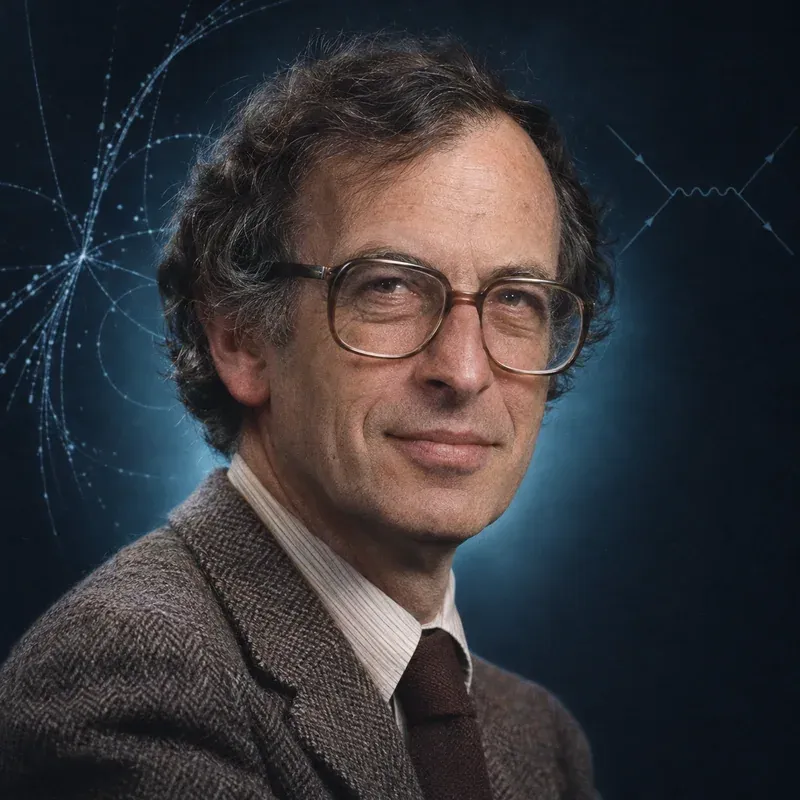
 Illustration
Francis Halzen
Halzen conceived and led the AMANDA and IceCube neutrino telescopes, which instrument a cubic kilometre of Antarctic ice at the South Pole. IceCube, completed in 2010, reported the first evidence for high-energy neutrinos of astrophysical origin in 2013 and later identified neutrino sources such as the blazar TXS 0506+056 and the galaxy NGC 1068. He was awarded the 2026 Nobel Prize in Physics.
- Born
- 23 March 1944
Tienen, Belgium - Nationality
- Belgian
- Field
- Particle astrophysics / neutrino astronomy
- Nobel Prize
- Physics 2026 (sole laureate) – "for decisive contributions to the IceCube Neutrino Observatory and the discovery of high-energy neutrinos of astrophysical origin"
- Institutions
- University of Louvain (UCLouvain), CERN, University of Wisconsin–Madison
Early life and education
Francis Halzen was born on 23 March 1944 in Tienen, a town in the Flemish part of Belgium. He studied physics at the University of Louvain (UCLouvain), where he earned a master's degree in 1966 and a doctorate in 1969, followed in 1972 by the Belgian higher teaching qualification, the agrégé de l'enseignement supérieur. After two years as a scientific associate at CERN from 1969 to 1971, he moved in 1972 to the University of Wisconsin–Madison, which remained his academic home for the rest of his career.
For the first part of his career Halzen was a particle theorist working on the phenomenology of quarks, gluons and collider physics. Together with Alan Martin he wrote the textbook 'Quarks and Leptons' (1984), which generations of graduate students have used as an introduction to the Standard Model.
Path to neutrino physics
The idea of catching cosmic neutrinos in a huge natural body of transparent matter goes back to Moisey Markov, who suggested in 1960 that detectors deep in lakes or the sea could record the Cherenkov light of particles created in rare neutrino collisions. The first serious attempt, DUMAND off Hawaii, struggled with the engineering of deep-ocean operations. In 1988 Halzen and John Learned argued that the deep ice sheet at the South Pole could serve the same purpose: it is extremely clear, mechanically stable and accessible from an existing research station. Work on the Antarctic Muon and Neutrino Detector Array, AMANDA, began in 1987, and Halzen became its principal investigator.
AMANDA lowered strings of photomultipliers into holes melted with hot water. Early tests revealed that the ice at shallow depths contains air bubbles that scatter light, so the detector was moved deeper, below about 1.5 km, where pressure has turned the bubbles into clear crystals. In 2001 the collaboration reported in Nature that AMANDA was observing high-energy neutrinos produced in the atmosphere, proving the technique. At the same time it became clear that the detector was far too small to find the faint flux expected from distant cosmic sources.
Key contributions
In 1993 Halzen and Learned published the case for a detector a thousand times larger, instrumenting a full cubic kilometre. That proposal became IceCube. Construction began in 2005, when AMANDA was absorbed into the new project, and was completed in late 2010: 5,160 digital optical modules hang on 86 strings between about 1.45 and 2.45 km below the surface, with the denser DeepCore array at its centre. From the timing and intensity of the light, energy and direction are reconstructed (tracks and cascades look different).
In 2013 the IceCube Collaboration reported 28 events with deposited energies above about 30 TeV, more than the background of atmospheric neutrinos could explain. Among them were the two PeV events nicknamed Bert and Ernie. This was the first evidence for astrophysical neutrinos from beyond the solar system, and Physics World named it Breakthrough of the Year. Later analyses confirmed the signal with muon neutrinos passing through the Earth (2015), associated a neutrino with the flaring blazar TXS 0506+056 in 2018 in a landmark of multimessenger astronomy, recorded an event consistent with the Glashow resonance (2021), identified the active galaxy NGC 1068 as a steady source (2022) and measured neutrino emission from the plane of the Milky Way (2023).
Halzen's role was not that of a single discoverer but of the scientist who argued for the experiment, secured its funding and led its collaboration, which today includes more than 450 people at 58 institutions in 14 countries. On 6 October 2026 the Royal Swedish Academy of Sciences awarded him the Nobel Prize in Physics alone, 'for decisive contributions to the IceCube Neutrino Observatory and the discovery of high-energy neutrinos of astrophysical origin'. It was the fifth Nobel Prize connected to neutrinos.
Later work and legacy
Halzen continues to hold the Hilldale and Gregory Breit Distinguished Professorships at Wisconsin and remains principal investigator of IceCube. In early 2026 an upgrade added more than 600 new sensors near the centre of the array to improve calibration and low-energy measurements, and the collaboration is preparing the much larger IceCube-Gen2. His earlier honours include the Balzan Prize (2015) and the Bruno Pontecorvo Prize (2018).
In their own words
Asked about the prize, Halzen described IceCube as 'an adventure where success was not guaranteed, but we overcame many challenges', and said he hoped the award 'reflects on the courageous people who joined me on this project' (as quoted by Physics World, October 2026).
Known for
- Principal Investigator of IceCube
- Discovery of high-energy astrophysical neutrinos (2013)
- Case for a km³ neutrino telescope (1993, with Learned)
- Nobel Prize in Physics 2026
Chronology
- 1972Joins University of Wisconsin–Madison
- 1988Polar-ice neutrino detection paper with Learned
- 1993Halzen & Learned argue for a 1 km³ neutrino detector
- 2000AMANDA-II full configuration
- 2005IceCube construction begins
- 2010IceCube completed
- 2013IceCube: evidence for high-energy astrophysical neutrinos
- 2015Balzan Prize
- 2018Bruno Pontecorvo Prize
- 2026Nobel Prize in Physics (sole laureate, announced 6 October)
Original papers
- IceCube Collaboration, Evidence for high-energy extraterrestrial neutrinos at the IceCube detector, Science 342, 1242856 (2013)DOI 10.1126/science.1242856
- F. Halzen and J. G. Learned, High energy neutrino astronomy: towards a 1 km3 detector (1993)
- F. Halzen, J. G. Learned, High energy neutrino detection in deep polar ice, Proc. 5th Int. Symp. on Very High Energy Cosmic Ray Interactions, Łódź (1988)
- E. Andres et al. (AMANDA), Observation of high-energy neutrinos using Čerenkov detectors embedded deep in Antarctic ice, Nature 410, 441 (2001)DOI 10.1038/35068509
Experiments
Connected people
- Christian Spiering
- Grigory Vladimirovich Domogatsky
- John G. Learned
- Moisey Alexandrovich Markov
- P. Buford Price
- Thomas K. Gaisser
- Paschal Coyle
- Albrecht Karle
- Gurgen Askaryan
- Olga Botner
Frequently asked questions
What did Francis Halzen discover?
He led the IceCube Collaboration, which in 2013 found the first evidence for high-energy astrophysical neutrinos, neutrinos with energies of tens of TeV to several PeV that come from outside the solar system. IceCube later linked such neutrinos to the blazar TXS 0506+056 and the galaxy NGC 1068.
Why is IceCube built in Antarctic ice?
Neutrinos interact so rarely that only an enormous target catches enough of them. The deep South Pole ice is extremely transparent, dark and stable, so a cubic kilometre of it can be instrumented with light sensors at a fraction of the cost of an artificial detector of that size.
Did Francis Halzen win the Nobel Prize?
Yes. He received the 2026 Nobel Prize in Physics as the sole laureate, announced on 6 October 2026, for his contributions to IceCube and the discovery of high-energy cosmic neutrinos.
On the timeline
- 1994AMANDA deploys detectors in the South Pole ice
- 2005IceCube deploys its first string
- 2010IceCube is completed at the South Pole
- 2013IceCube finds high-energy astrophysical neutrinos
- 2018Blazar TXS 0506+056 linked to a neutrino
- 2021IceCube detects a Glashow resonance candidate
- 2022IceCube sees neutrinos from galaxy NGC 1068
- 2023IceCube observes neutrinos from the Milky Way
- 2026IceCube Upgrade strings deployed
- 2026Nobel Prize for Francis Halzen and IceCube
Mentioned in 35 pages
Lessons 5
FAQ 5
Milestones 11
- 1960 · Markov proposes deep underwater neutrino detection
- 1994 · AMANDA deploys detectors in the South Pole ice
- 2005 · IceCube deploys its first string
- 2010 · IceCube is completed at the South Pole
- 2013 · IceCube finds high-energy astrophysical neutrinos
- 2018 · Blazar TXS 0506+056 linked to a neutrino
- 2021 · IceCube detects a Glashow resonance candidate
- 2022 · IceCube sees neutrinos from galaxy NGC 1068
People 10
Last updated: · Editorial standard
Cite this page
Text
Neutrino Atlas (2026). “Francis Halzen”. Retrieved 22 November 2026, from https://neutrino-atlas.com/people/francis-halzen/BibTeX
@misc{neutrinoatlas2026peoplefrancishalzen,
  title        = {Francis Halzen},
  author       = {{Neutrino Atlas}},
  year         = {2026},
  url          = {https://neutrino-atlas.com/people/francis-halzen/},
  note         = {Accessed 2026-11-22},
  language     = {english}
}