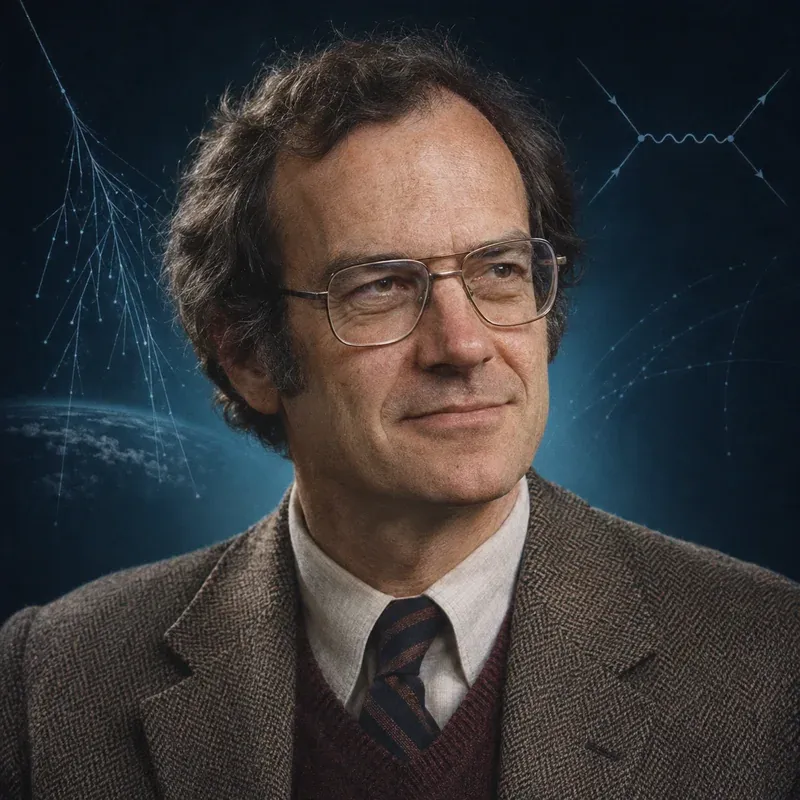
 Illustration
Thomas K. Gaisser
Gaisser laid the theoretical foundations for interpreting atmospheric neutrinos; his 1989 calculation with Giles Barr and Todor Stanev of the atmospheric neutrino flux was a standard input for the IMB, Kamiokande and Super-Kamiokande analyses that led to the discovery of oscillations. He was a founding member of IceCube, its spokesperson from 2007 to 2011, and led the IceTop array.
- Born
- 12 March 1940
Evansville, Indiana, USA - Died
- 20 February 2022
Swarthmore, Pennsylvania, USA - Nationality
- American
- Field
- Cosmic-ray and astroparticle physics
- Institutions
- Wabash College (BA 1962), University of Bristol (MSc 1965), Brown University (PhD 1967), MIT
Early life and education
Thomas Korff Gaisser was born in Evansville, Indiana, in 1940. He graduated in physics from Wabash College in 1962 and went to England as a Marshall Scholar, earning a master's degree at the University of Bristol in 1965. He received his PhD from Brown University in 1967 for work in theoretical particle physics, followed by a research position at MIT (1967–69) and a NATO fellowship at the University of Cambridge (1969–70).
Path to neutrino physics
In 1970 Gaisser joined the Bartol Research Foundation, then at Swarthmore College, which moved to the University of Delaware in 1977. There he turned from particle theory to cosmic rays. With Michael Hillas he introduced in 1977 the Gaisser–Hillas function, a compact description of how the number of particles in an air shower grows and dies away with depth in the atmosphere. It is still used to reconstruct showers, for example at the Pierre Auger Observatory. He also helped develop the Sibyll event generator for simulating cosmic-ray interactions.
Key contributions
The same showers produce atmospheric neutrinos. Cosmic-ray protons strike nuclei high in the atmosphere and make pions and kaons, whose decays yield muons and muon neutrinos; the muons in turn decay into electrons and further neutrinos.
Predicting this flux precisely is hard: it depends on the primary cosmic-ray spectrum, on hadron production in air and on the Earth's magnetic field. In 1989 Gaisser, Giles Barr and Todor Stanev published 'Flux of atmospheric neutrinos' in Physical Review D, a detailed calculation that became a standard input for the large water detectors. When IMB and Kamiokande saw fewer muon neutrinos relative to electron neutrinos than predicted, the so-called atmospheric neutrino anomaly, careful flux calculations were essential to show that the deficit was real. The updated 'Bartol' flux of 1996 (Agrawal, Gaisser, Lipari and Stanev) was used in the Super-Kamiokande analysis that in 1998 established neutrino oscillations from the zenith-angle dependence of muon neutrinos, work for which Takaaki Kajita shared the 2015 Nobel Prize.
IceCube and later work
Gaisser helped design and build experiments at the South Pole: the SPASE air-shower array, AMANDA and then IceCube, of which he was a founding member and, from 2007 to 2011, spokesperson. He led the development of the IceTop surface array, which measures the air showers above IceCube, and took part in more than ten Antarctic field seasons. In 2005 Gaisser Valley in Antarctica was named after him.
His textbook 'Cosmic Rays and Particle Physics' (1990; second edition 2016 with Ralph Engel and Elisa Resconi) trained a generation of astroparticle physicists, and he co-founded the journal Astroparticle Physics in 1992. His honours include the O'Ceallaigh Medal (2005), a Humboldt Research Award (2009) and the Homi Bhabha Medal (2015). He was Martin A. Pomerantz Professor of Physics at Delaware and died in Swarthmore, Pennsylvania, in February 2022.
Known for
- Atmospheric neutrino flux calculations (Barr–Gaisser–Stanev 1989)
- IceCube founding member and spokesperson (2007–2011)
- IceTop surface array
- 'Cosmic Rays and Particle Physics' (1990)
Chronology
- 1967PhD, Brown University
- 1970Joins Bartol Research Foundation
- 1989Barr, Gaisser & Stanev atmospheric neutrino flux
- 1990'Cosmic Rays and Particle Physics'
- 2005Gaisser Valley (Antarctica) named
- 2007IceCube spokesperson (to 2011)
- 2015Homi Bhabha Medal
Original papers
- G. Barr, T. K. Gaisser and T. Stanev, Flux of atmospheric neutrinos, Phys. Rev. D 39, 3532 (1989)DOI 10.1103/PhysRevD.39.3532
Experiments
Connected people
Frequently asked questions
Why were atmospheric neutrino flux calculations so important?
Detectors count neutrino events and compare them with an expected number. Without a reliable prediction of how many muon and electron neutrinos arrive from each direction, a deficit could not be distinguished from a modelling error. Gaisser's calculations, together with the flux ratio and up–down comparisons that cancel many uncertainties, made the oscillation signal convincing.
What was Thomas Gaisser's role in IceCube?
He was a founding member of the collaboration, its spokesperson from 2007 to 2011, and the leader of the IceTop surface array that complements the deep ice Cherenkov detector.
On the timeline
Mentioned in 5 pages
Last updated: · Editorial standard
Cite this page
Text
Neutrino Atlas (2026). “Thomas K. Gaisser”. Retrieved 22 November 2026, from https://neutrino-atlas.com/people/thomas-gaisser/BibTeX
@misc{neutrinoatlas2026peoplethomasgaisser,
  title        = {Thomas K. Gaisser},
  author       = {{Neutrino Atlas}},
  year         = {2026},
  url          = {https://neutrino-atlas.com/people/thomas-gaisser/},
  note         = {Accessed 2026-11-22},
  language     = {english}
}