AMANDA
The first neutrino telescope in Antarctic ice and the forerunner of IceCube.
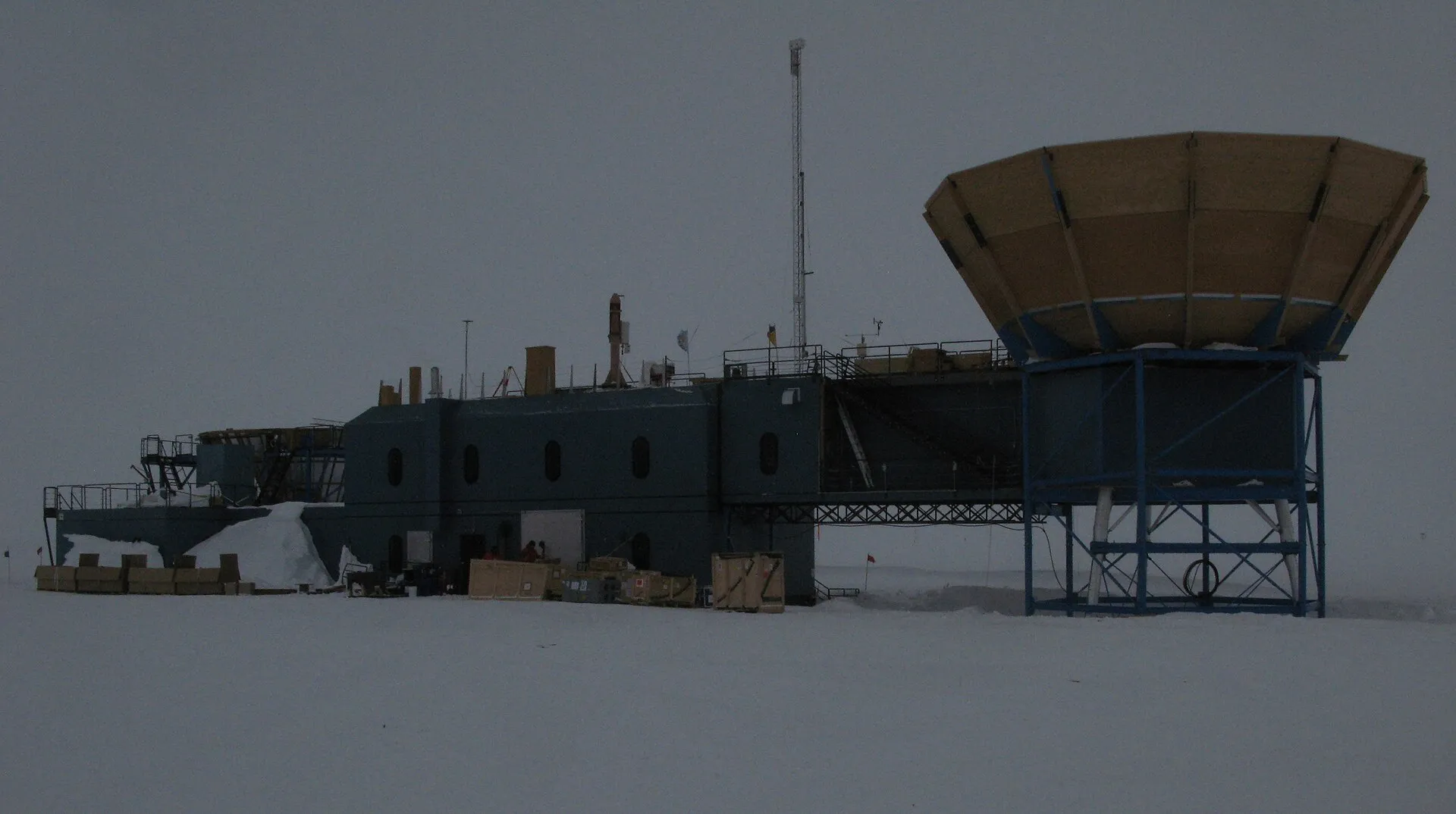
The Antarctic Muon And Neutrino Detector Array deployed PMTs on strings in boreholes 1.5–2 km deep at the South Pole. It mapped atmospheric neutrinos and set limits on cosmic sources before being absorbed into IceCube.
Compare all experiments → · World map →
In plain words
AMANDA was the experiment that showed the Antarctic ice sheet itself could become a neutrino detector. Instead of building a tank, the team melted narrow holes into the ice with hot water, lowered strings of light sensors into them and let the water refreeze. The sensors were then locked into some of the clearest and darkest material on Earth, ready to catch the faint glow of particles created by passing neutrinos.
How the detector worked
The first attempt, AMANDA-A, placed sensors at 800 to 1000 m depth in 1993–94. It revealed that the ice there was full of tiny air bubbles that scattered light so strongly that tracks could not be reconstructed. The collaboration went deeper: below about 1400 m the pressure had turned the bubbles into clathrate crystals, and the ice was clear enough. AMANDA-B10, with ten strings, operated from 1997, and the full AMANDA-II reached 19 strings and 677 optical modules in 2000, at depths of mostly 1500 to 2000 m.
AMANDA looked for upward-going muons, produced by muon neutrinos that had crossed the Earth from the Northern sky. The Earth filters out the far more numerous downward-going cosmic-ray muons, leaving neutrino-induced tracks.
Key results
- Thousands of atmospheric neutrinos recorded and their energy spectrum measured into the TeV range.
- Upper limits on point sources, diffuse astrophysical fluxes, gamma-ray bursts and dark-matter annihilation in the Sun and Earth.
- Detailed measurements of the optical properties of deep South Pole ice, essential for the design and analysis of its successor.
- Proof that hot-water drilling and frozen-in electronics could be operated reliably for years.
History
AMANDA was founded in the early 1990s, with Francis Halzen and colleagues at the University of Wisconsin–Madison and partners in Germany (including DESY Zeuthen, where Christian Spiering played a leading role), Sweden and the USA. It ran until 2009, when it was switched off and its tasks taken over by IceCube, which had been built around it.
Why it matters for neutrino physics
Without AMANDA, the case for a cubic-kilometre detector in the ice would have been hard to make. It established the ice Cherenkov technique, its calibration and its analysis methods, and it showed that the astrophysical neutrino flux must lie below its limits – which in turn told IceCube how large it had to be.
Frequently asked questions
What does AMANDA stand for?
Antarctic Muon And Neutrino Detector Array.
Did AMANDA discover cosmic neutrinos?
No. It detected atmospheric neutrinos and set limits on cosmic sources. The first astrophysical neutrinos were found by its successor IceCube in 2013.
Original papers
- First resultE. Andres et al. (AMANDA Collaboration), Observation of high-energy neutrinos using Čerenkov detectors embedded deep in Antarctic ice, Nature 410, 441 (2001)DOI 10.1038/35068509
- Final resultR. Abbasi et al. (IceCube Collaboration), Search for point sources of high energy neutrinos with final data from AMANDA-II, Phys. Rev. D 79, 062001 (2009)DOI 10.1103/PhysRevD.79.062001arXiv:0809.1646
Related terms
People
On the timeline
Mentioned in 26 pages
Lessons 1
Milestones 8
- 1960 · Markov proposes deep underwater neutrino detection
- 1976 · DUMAND plans a deep-ocean neutrino telescope
- 1993 · First underwater neutrino telescope in Lake Baikal
- 1994 · AMANDA deploys detectors in the South Pole ice
- 2005 · IceCube deploys its first string
- 2008 · ANTARES completes the first deep-sea telescope
- 2013 · IceCube finds high-energy astrophysical neutrinos
- 2026 · Nobel Prize for Francis Halzen and IceCube
People 11
Last updated: · Editorial standard
Cite this page
Text
Neutrino Atlas (2026). “AMANDA”. Retrieved 22 November 2026, from https://neutrino-atlas.com/terms/amanda/BibTeX
@misc{neutrinoatlas2026termsamanda,
  title        = {AMANDA},
  author       = {{Neutrino Atlas}},
  year         = {2026},
  url          = {https://neutrino-atlas.com/terms/amanda/},
  note         = {Accessed 2026-11-22},
  language     = {english}
}