1976Experiment
DUMAND plans a deep-ocean neutrino telescope
Following discussions at the 1973 International Cosmic Ray Conference, a 1976 workshop in Honolulu organised by Arthur Roberts, John Learned, Frederick Reines and others developed the DUMAND project. It aimed to place strings of photomultipliers nearly 5 km deep in the Pacific off Hawaii to detect high-energy neutrinos. A prototype string was operated from a ship in 1987, but funding problems led to cancellation in 1995. Its concepts and technology shaped all later neutrino telescopes.
- Date
- 1976
- Kind of event
- Experiment
- People involved
- Arthur Roberts, John G. Learned, Frederick Reines
- Experiments
- DUMAND
The situation before
In 1960 Moisey Markov had proposed detecting high-energy neutrinos with light sensors placed deep in a lake or the sea. For more than a decade nobody tried. Detectors in deep mines had seen atmospheric neutrinos since 1965, but they were far too small to catch the much rarer neutrinos expected from cosmic sources. During the 1973 International Cosmic Ray Conference in Denver, a group of physicists including Frederick Reines and John Learned discussed building a detector big enough for neutrino astronomy, and concluded that only the deep ocean offered the necessary volume.
What happened
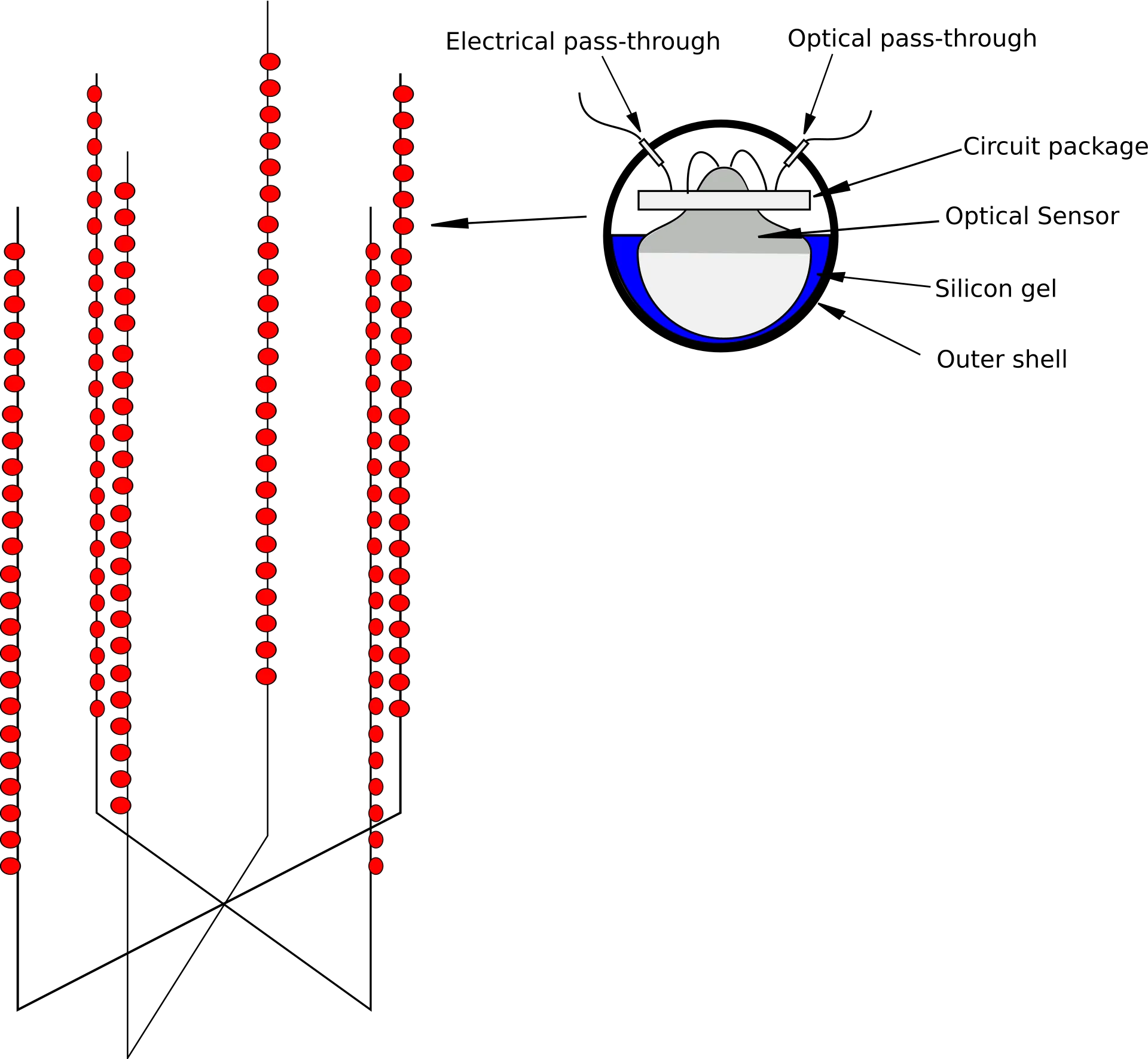
The idea took shape at a series of meetings: a first DUMAND workshop at Washington State University in 1975, and a two-week summer workshop in Honolulu in 1976. DUMAND stood for Deep Underwater Muon and Neutrino Detector. Arthur Roberts of Fermilab, one of the main organisers and later the editor of its proceedings, Learned, Reines, Hugh Bradner and others worked out how such a telescope could be built: vertical strings carrying optical modules, each a pressure-resistant glass sphere containing a large photomultiplier tube, anchored to the sea floor at a depth of nearly 5 km off the Big Island of Hawaii and connected to shore by an electro-optical cable. The modules would record the Cherenkov light of muons produced by neutrinos in the surrounding water and rock.
The early designs were enormous, with arrays approaching a cubic kilometre and tens of thousands of optical modules. Over the following years, cost pressure reduced the plan to a smaller first stage, DUMAND II, with nine strings in an octagon around a central string.
What followed
The engineering problems proved formidable: pressure of about 500 atmospheres, corrosion, the difficulty of making reliable underwater connections, and the cost of ship time. In 1987 the collaboration lowered a short prototype string with seven phototubes from a Navy vessel to several kilometres depth for some hours and measured the flux of cosmic-ray muons as a function of depth, demonstrating that the technique worked. In December 1993 the first full string was deployed and connected to the shore cable through a junction box on the sea floor, but leaks in some pressure housings and a short circuit in the junction box soon cut its communication with shore. Further deployments were delayed, and in 1995 the US Department of Energy ended the project.
Why it matters
DUMAND never recorded a neutrino, but it shaped every neutrino telescope that followed. Its basic architecture of strings of optical modules in a natural transparent medium was adopted by the Baikal telescope, which recorded the first underwater neutrinos in the 1990s, by AMANDA and then IceCube at the South Pole, and by ANTARES and KM3NeT in the Mediterranean. Many DUMAND physicists, including Learned, went on to work on these projects, and the project's studies of optical backgrounds, bioluminescence and deep-sea engineering became the reference for later designs. When IceCube announced the first high-energy astrophysical neutrinos in 2013, it realised the goal set out in Honolulu in 1976.
Frequently asked questions
What was DUMAND?
The Deep Underwater Muon and Neutrino Detector, a planned neutrino telescope with strings of photomultipliers about 5 km deep in the Pacific off Hawaii.
Why was DUMAND cancelled?
Technical problems with deep-sea deployment, including the failure of the first string in 1993, and the resulting delays and costs led the US Department of Energy to end the project in 1995.
What did DUMAND achieve?
A prototype string measured muons in the deep ocean in 1987, and its design concepts were adopted by Baikal, AMANDA, IceCube, ANTARES and KM3NeT.
Original papers
- ProposalA. Roberts (ed.), Proceedings of the 1976 DUMAND Summer Workshop, Honolulu, Fermilab (1977)
Concepts
Mentioned in 1 page
Lessons 1
Last updated: · Editorial standard
Cite this page
Text
Neutrino Atlas (2026). “1976: DUMAND plans a deep-ocean neutrino telescope”. Retrieved 22 November 2026, from https://neutrino-atlas.com/timeline/1976-dumand-workshop/BibTeX
@misc{neutrinoatlas2026meline1976dumandworkshop,
  title        = {1976: DUMAND plans a deep-ocean neutrino telescope},
  author       = {{Neutrino Atlas}},
  year         = {2026},
  url          = {https://neutrino-atlas.com/timeline/1976-dumand-workshop/},
  note         = {Accessed 2026-11-22},
  language     = {english}
}