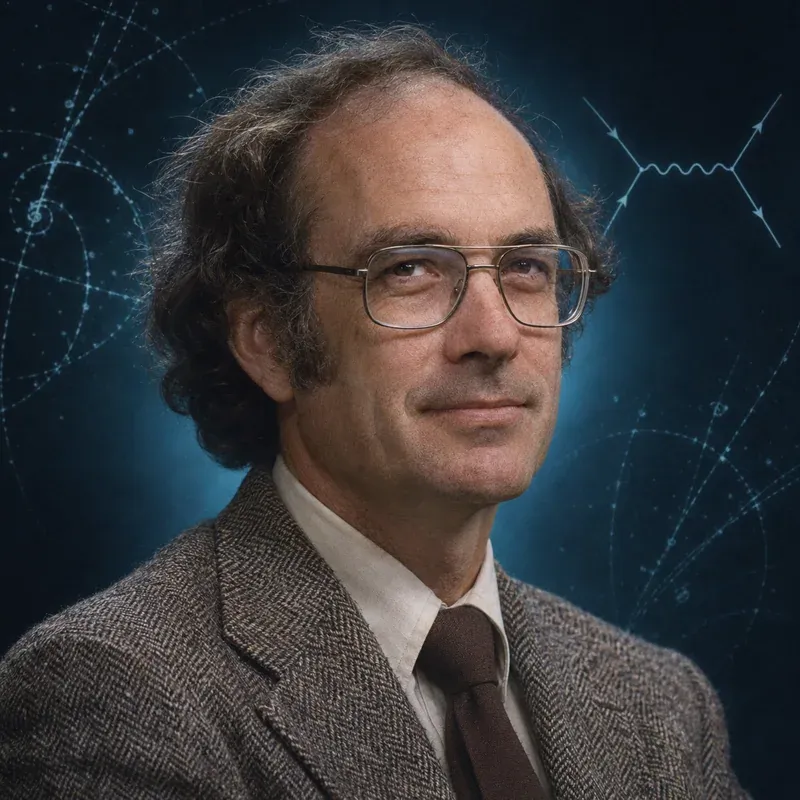
 Illustration
John G. Learned
In 1973 Learned, with Reines, Zatsepin and Miyake, discussed a deep-water neutrino detector, the origin of DUMAND off Hawaii. In 1977 he and six colleagues proposed IMB, which saw a first hint of atmospheric oscillation and SN 1987A neutrinos. In 1988 he and Francis Halzen published the case for neutrino detection in deep polar ice, which led to AMANDA and IceCube; his Hawaii group also took part in Super-Kamiokande, K2K and KamLAND.
- Born
- 1940
New York State, USA - Nationality
- American
- Field
- Neutrino and astroparticle physics
- Institutions
- University of Washington (PhD 1968), University of Wisconsin, UC Irvine, University of Hawaii at Manoa
Education and early career
John G. Learned was born in 1940 in New York State. He graduated from Columbia College in 1961 and took a master's degree at the University of Pennsylvania in 1963, then worked as an engineer in the aerospace industry, including at Boeing, which brought him to Seattle. He completed his PhD at the University of Washington in 1968. His dissertation already pointed to his later work: it contained the first open-water measurements of the cosmic-ray muon flux as a function of depth, made in Lake Chelan, Washington.
As a postdoc with the University of Wisconsin he studied high-energy hadron interactions at the High Altitude Laboratory on Mount Evans, Colorado. At UC Irvine and SLAC he took part in accelerator physics, including early observations at the SPEAR collider and the photoproduction of the J/ψ in 1975. Since 1980 he has been professor of physics at the University of Hawaii at Manoa.
DUMAND and the idea of a neutrino telescope
At the 1973 International Cosmic Ray Conference Learned, Frederick Reines, Georgy Zatsepin and Saburo Miyake discussed building a detector in the deep ocean, using the sea as both target and Cherenkov medium for high-energy neutrinos. This became DUMAND, the Deep Underwater Muon and Neutrino Detector, planned at a depth of almost 5 km off the island of Hawaii. DUMAND developed many of the concepts later used in every neutrino telescope – strings of pressure-resistant optical modules, timing reconstruction of muon tracks, and the use of the Earth as a filter for upward-going events. The project lost its funding in the mid-1990s before a full array was built, but its ideas and people carried over to the next generation.
IMB
In 1977 Learned was one of seven physicists, with Frederick Reines, Lawrence Sulak and others, who proposed IMB, the Irvine–Michigan–Brookhaven detector. Built in a salt mine near Cleveland, Ohio, it was a large water Cherenkov detector designed to search for proton decay. Proton decay was never seen, but IMB found an apparent deficit of muon-like events among atmospheric neutrinos, an early hint of oscillations, and on 23 February 1987 it recorded eight neutrinos from SN 1987A, together with Kamiokande the first neutrinos detected from a supernova. The IMB and Kamiokande teams shared the 1989 Rossi Prize of the American Astronomical Society for this observation.
Antarctic ice and later work
In 1988 Learned and Francis Halzen published the case for detecting high-energy neutrinos in the deep, transparent ice of the Antarctic, which avoids the engineering difficulties of the deep ocean and offers low optical noise. The proposal led to AMANDA and then to IceCube; Learned co-wrote the first letter of intent for IceCube to the U.S. National Science Foundation with Halzen. His Hawaii group also joined Super-Kamiokande, whose 1998 discovery of atmospheric neutrino oscillations confirmed the IMB hint, as well as K2K and KamLAND, the latter as a charter member, which observed reactor antineutrino oscillations and detected geoneutrinos. More recently he has worked on compact neutrino and neutron detectors for reactor monitoring.
Honours
Besides the Rossi Prize, Learned received the Asahi Prize (1998) and the University of Hawaii Regents' Medal for Excellence in Research (1999), and he was among the members of collaborations honoured with the 2016 Breakthrough Prize in Fundamental Physics for neutrino oscillation discoveries.
Known for
- Co-founder of IMB (1977)
- DUMAND deep-ocean neutrino telescope
- Proposed Antarctic ice neutrino detection with Halzen (1988)
- Super-K, K2K and KamLAND
Chronology
- 1973Deep-water detector discussed at ICRC (DUMAND origins)
- 1977Co-proposes IMB
- 1980Professor at University of Hawaii
- 1988Halzen & Learned paper on detection in polar ice
- 1998Super-K oscillation discovery
Original papers
- F. Halzen, J. G. Learned, High energy neutrino detection in deep polar ice, Proc. 5th Int. Symp. on Very High Energy Cosmic Ray Interactions, Łódź (1988)
Experiments
Connected people
Frequently asked questions
What was DUMAND?
A planned deep-ocean neutrino telescope off Hawaii, conceived in the 1970s. It was never completed, but it pioneered the techniques used by Baikal, ANTARES, KM3NeT and IceCube.
Why did Learned and Halzen propose using Antarctic ice?
Deep polar ice is very transparent and free of the bioluminescence and potassium-40 light of seawater, and detectors can be installed by drilling from a stable surface instead of working from ships.
What did IMB observe?
Eight neutrinos from supernova SN 1987A and an early deficit of atmospheric muon neutrinos, later understood as oscillations.
On the timeline
- 1976DUMAND plans a deep-ocean neutrino telescope
- 1983Large water Cherenkov detectors begin operation
- 1994AMANDA deploys detectors in the South Pole ice
- 1998Super-Kamiokande discovers neutrino oscillation
Mentioned in 17 pages
Lessons 1
Milestones 6
- 1976 · DUMAND plans a deep-ocean neutrino telescope
- 1983 · Large water Cherenkov detectors begin operation
- 1994 · AMANDA deploys detectors in the South Pole ice
- 1998 · Super-Kamiokande discovers neutrino oscillation
- 2012 · First message sent with neutrinos
- 2026 · Nobel Prize for Francis Halzen and IceCube
Last updated: · Editorial standard
Cite this page
Text
Neutrino Atlas (2026). “John G. Learned”. Retrieved 22 November 2026, from https://neutrino-atlas.com/people/john-learned/BibTeX
@misc{neutrinoatlas2026peoplejohnlearned,
  title        = {John G. Learned},
  author       = {{Neutrino Atlas}},
  year         = {2026},
  url          = {https://neutrino-atlas.com/people/john-learned/},
  note         = {Accessed 2026-11-22},
  language     = {english}
}