1994Experiment
AMANDA deploys detectors in the South Pole ice
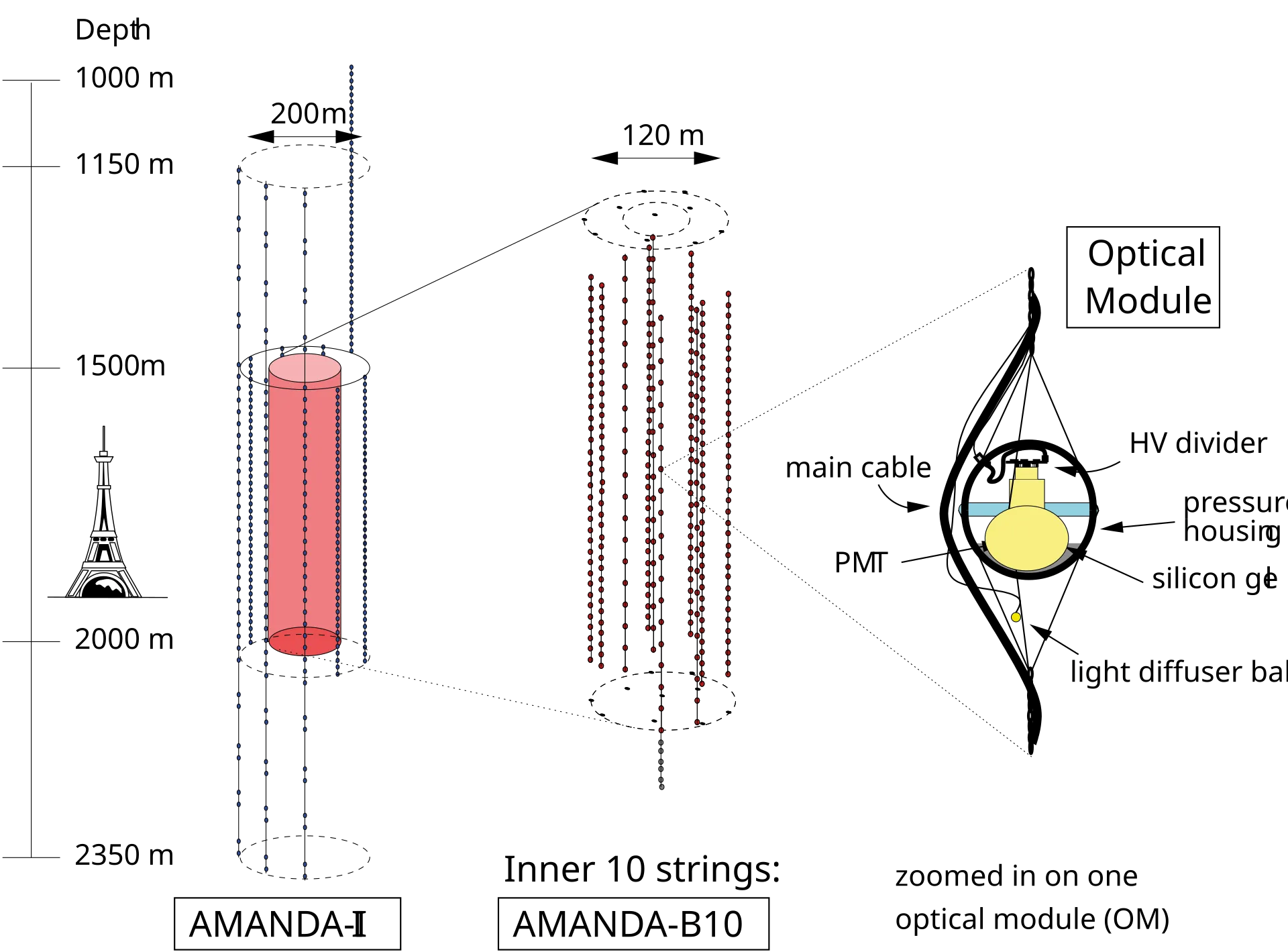
Following proposals by Francis Halzen, John Learned and Buford Price to use Antarctic ice as a Cherenkov medium, the AMANDA collaboration deployed its first strings of photomultipliers at the South Pole in the 1993/94 season. At 800–1000 m depth, residual air bubbles scattered the light too strongly, so later strings went to 1500–2000 m, where the ice is clearer. AMANDA-II was completed in 2000 and detected atmospheric neutrinos, paving the way for IceCube.
- Date
- 1994
- Kind of event
- Experiment
- People involved
- Francis Halzen, P. Buford Price, John G. Learned, Christian Spiering
- Experiments
- AMANDA, IceCube Neutrino Observatory
The situation before
Water-based neutrino telescopes had proved hard to build: DUMAND in the Pacific suffered from the difficulty of deep-sea operations, and Baikal was limited in size. In the late 1980s Francis Halzen and John Learned pointed out that the Antarctic ice sheet, almost 3 km thick at the South Pole, could serve the same purpose. Ice is a stable, solid medium in which sensors can be frozen in place, and the Amundsen–Scott station offered logistics. P. Buford Price at Berkeley led studies of how light propagates in deep ice. The biggest unknown was its optical quality.
What happened
In the austral summer of 1993/94 the AMANDA collaboration, then mainly from Wisconsin, Berkeley, Irvine and Stockholm, drilled holes with hot water and lowered four strings with 80 optical modules to depths of 800–1000 m. The ice refroze around them within days. The modules worked, but the light did not travel as hoped. Muon signals arrived spread out in time, showing that the photons were being scattered every few tens of centimetres. The cause was residual air bubbles, compressed but not yet dissolved at that depth. Absorption, by contrast, turned out to be extremely low, with absorption lengths of order 100 m or more.
The measurement taught the collaboration where to go. Theory and later measurements showed that below about 1,400 m the bubbles convert to clathrate crystals with almost the same refractive index as ice, so scattering drops sharply. In 1995/96 four new strings were installed at 1,500–2,000 m; in 1996/97 six more followed, forming AMANDA-B10 with 302 modules. DESY Zeuthen, with Christian Spiering, had joined and contributed strongly.
Reaction
The bubble problem was a setback, but the low absorption and the success of deeper strings showed that ice Cherenkov detectors could reach very large volumes. In 2001 the collaboration reported in Nature the observation of upward-going atmospheric neutrinos with AMANDA-B10, demonstrating that the ice detector worked as a neutrino telescope.
Consequences
- AMANDA-II, with 677 modules on 19 strings, was completed in 2000 and searched for point sources and diffuse fluxes for most of the following decade.
- Its experience with drilling, deployment and ice properties led directly to IceCube, built between 2004 and 2010 with 5,160 modules in a cubic kilometre of ice.
- AMANDA was integrated into IceCube and switched off in 2009.
- In 2013 IceCube announced the discovery of a flux of high-energy astrophysical neutrinos, the goal for which AMANDA had first gone into the ice.
Frequently asked questions
When was AMANDA started?
The first strings were deployed at the South Pole in the 1993/94 season.
What went wrong with the first strings?
At 800–1000 m depth, remaining air bubbles scattered the Cherenkov light so strongly that muon directions were hard to reconstruct. Deeper ice proved much clearer.
How is AMANDA related to IceCube?
AMANDA was the prototype. Its technology and knowledge of the ice made the cubic-kilometre IceCube detector possible.
Original papers
- First resultE. Andrés et al. (AMANDA), Observation of high-energy neutrinos using Čerenkov detectors embedded deep in Antarctic ice, Nature 410, 441 (2001)DOI 10.1038/35068509
Concepts
Mentioned in 1 page
Lessons 1
Last updated: · Editorial standard
Cite this page
Text
Neutrino Atlas (2026). “1994: AMANDA deploys detectors in the South Pole ice”. Retrieved 22 November 2026, from https://neutrino-atlas.com/timeline/1994-amanda-first-strings/BibTeX
@misc{neutrinoatlas2026ne1994amandafirststrings,
  title        = {1994: AMANDA deploys detectors in the South Pole ice},
  author       = {{Neutrino Atlas}},
  year         = {2026},
  url          = {https://neutrino-atlas.com/timeline/1994-amanda-first-strings/},
  note         = {Accessed 2026-11-22},
  language     = {english}
}