1995Award
Nobel Prize for neutrino detection
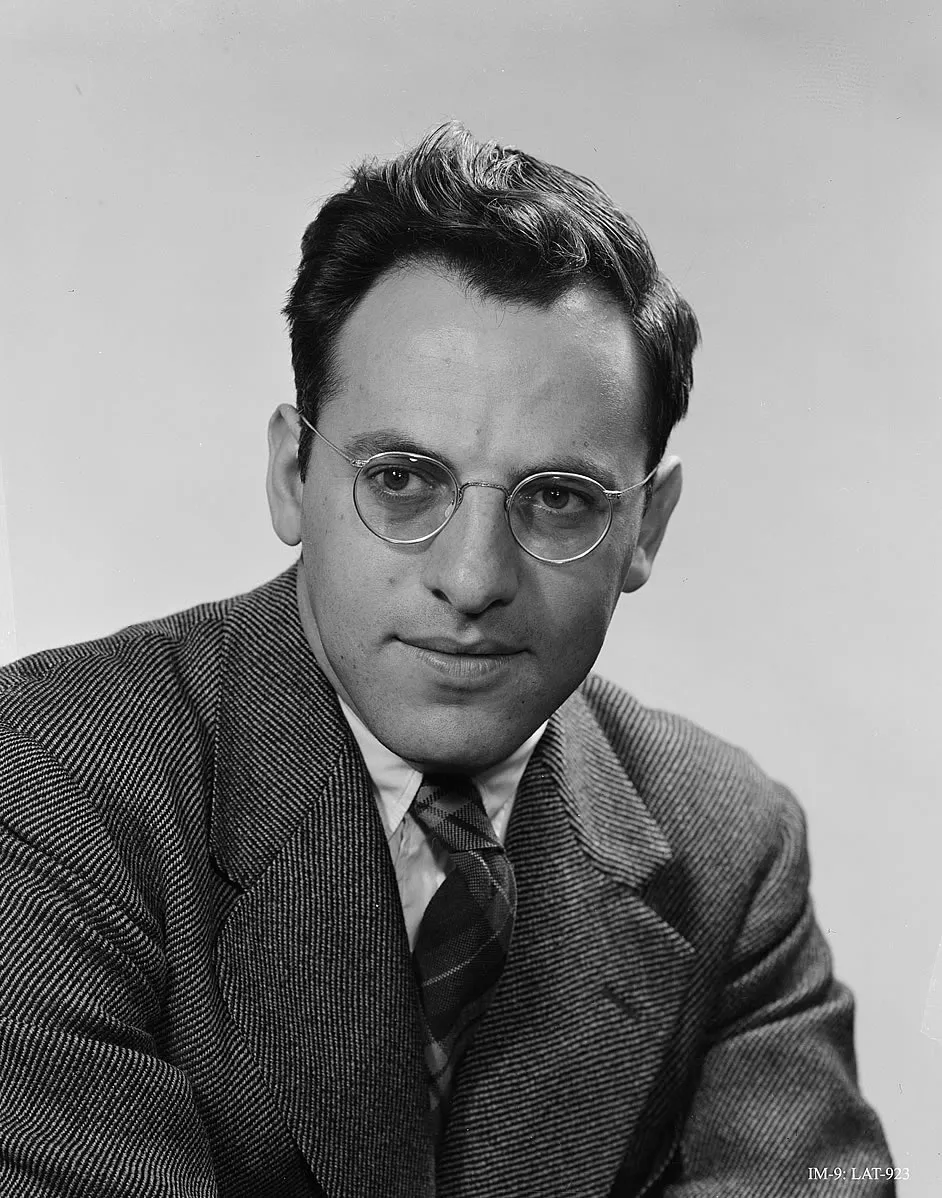
Frederick Reines received half of the 1995 Nobel Prize in Physics 'for the detection of the neutrino', shared with Martin Perl, honoured for the discovery of the tau lepton. The award came 39 years after the Savannah River experiment. Clyde Cowan, who had died in 1974, could not be included because the prize is not awarded posthumously.
- Date
- 1995
- Kind of event
- Award
- People involved
- Frederick Reines, Clyde L. Cowan Jr.
- Experiments
- Cowan–Reines Neutrino Experiment
The situation before
Wolfgang Pauli had proposed the neutrino in 1930 and thought it might never be detected. In 1956 Frederick Reines and Clyde Cowan of Los Alamos proved him wrong. At the Savannah River reactor in South Carolina, their detector of water with dissolved cadmium chloride, sandwiched between tanks of liquid scintillator, recorded the delayed coincidence of a positron and a neutron capture produced by inverse beta decay of reactor antineutrinos. On 14 June 1956 they sent Pauli a telegram announcing the result, and the paper 'Detection of the free neutrino: a confirmation' appeared in Science on 20 July 1956.
For almost four decades the Nobel committee did not honour the experiment, although neutrino physics produced several prizes in the meantime, including the 1988 award for the muon neutrino. Cowan died on 24 May 1974, at the age of 54.
What happened
On 11 October 1995 the Royal Swedish Academy of Sciences awarded the Nobel Prize in Physics 'for pioneering experimental contributions to lepton physics'. One half went to Martin Perl of Stanford 'for the discovery of the tau lepton', found at SLAC in 1975. The other half went to Reines, then 77 and professor emeritus at the University of California, Irvine, 'for the detection of the neutrino'. Since the prize is not awarded posthumously, Cowan could not share it. The two halves fitted together: the tau was the first member of a third lepton generation, implying a third, tau neutrino, which had not yet been observed directly.
Reaction
The award was widely seen as overdue. It came 39 years after the Savannah River experiment and 65 years after Pauli's letter. Reines had remained active throughout. In 1965 his group, with Friedel Sellschop, detected neutrinos produced by cosmic rays in a deep gold mine in South Africa, among the first observations of atmospheric neutrinos. He searched for neutrino oscillation and neutrino-electron scattering at reactors, and he was a founder of the IMB proton-decay detector, which recorded eight neutrinos from supernova SN 1987A. He gave his Nobel lecture in Stockholm in December 1995 under the title 'The neutrino: from poltergeist to particle', tracing how a particle once thought undetectable had become a tool for physics and astronomy.
Why it matters
- The prize recognised reactor neutrino detection, the technique on which later experiments – from Bugey and CHOOZ to KamLAND, Daya Bay, RENO, Double Chooz and JUNO – are built. The delayed coincidence of positron and neutron is still their signature.
- With the 1988 and 1995 prizes, two of the three neutrinos had been honoured through their discoverers; the tau neutrino was observed by DONUT in 2000.
- Later Nobel Prizes for neutrino physics followed in 2002, for Raymond Davis Jr. and Masatoshi Koshiba, and in 2015, for Takaaki Kajita and Arthur B. McDonald.
Reines died on 26 August 1998, a few weeks after Super-Kamiokande announced evidence that neutrinos have mass.
Frequently asked questions
Who won the 1995 Nobel Prize in Physics?
Frederick Reines, for the detection of the neutrino, and Martin Perl, for the discovery of the tau lepton.
Why did Clyde Cowan not receive the prize?
He died in 1974, and the Nobel Prize is not awarded posthumously.
How long after the discovery was the prize awarded?
39 years: the neutrino was detected in 1956 and the prize was announced on 11 October 1995.
Original papers
- DiscoveryC. L. Cowan Jr., F. Reines, F. B. Harrison, H. W. Kruse, A. D. McGuire, Detection of the Free Neutrino: a Confirmation, Science 124, 103 (1956)DOI 10.1126/science.124.3212.103
- DiscoveryM. L. Perl et al., Evidence for Anomalous Lepton Production in e+e− Annihilation, Phys. Rev. Lett. 35, 1489 (1975)DOI 10.1103/PhysRevLett.35.1489
Concepts
Mentioned in 1 page
Lessons 1
Last updated: · Editorial standard
Cite this page
Text
Neutrino Atlas (2026). “1995: Nobel Prize for neutrino detection”. Retrieved 22 November 2026, from https://neutrino-atlas.com/timeline/1995-nobel-reines/BibTeX
@misc{neutrinoatlas2026timeline1995nobelreines,
  title        = {1995: Nobel Prize for neutrino detection},
  author       = {{Neutrino Atlas}},
  year         = {2026},
  url          = {https://neutrino-atlas.com/timeline/1995-nobel-reines/},
  note         = {Accessed 2026-11-22},
  language     = {english}
}