1998Experiment
CHOOZ sees no reactor antineutrino disappearance
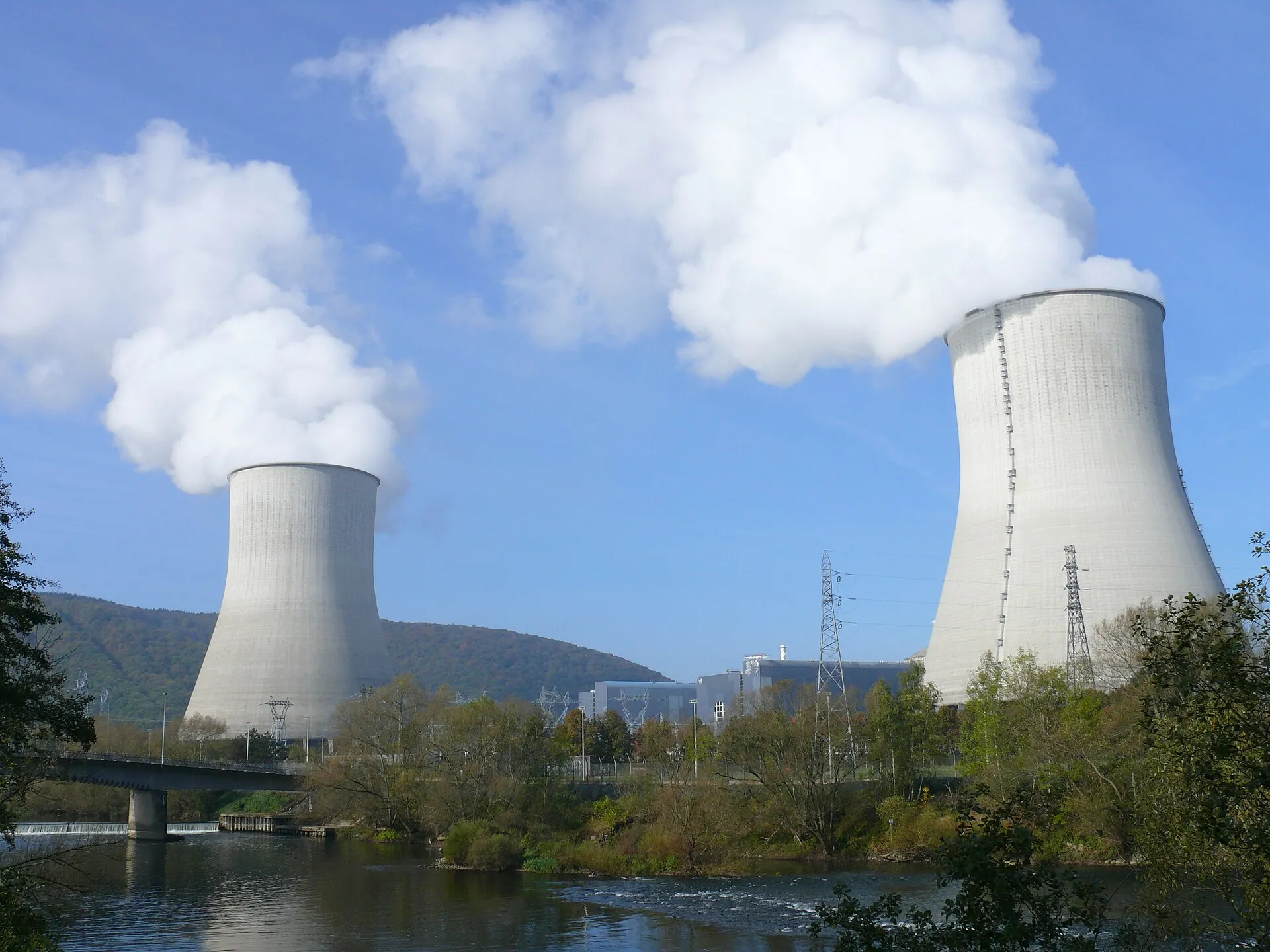
The CHOOZ experiment, a gadolinium-loaded scintillator detector about 1 km from the Chooz power plant in France, found no deficit of electron antineutrinos. This ruled out muon-to-electron neutrino oscillation as the explanation of the atmospheric anomaly. It also set an upper limit on the mixing angle θ₁₃ that stood for more than a decade, until Double Chooz, Daya Bay and RENO measured it.
- Date
- 1998
- Kind of event
- Experiment
- Experiments
- CHOOZ
The situation before
In the mid-1990s Kamiokande's atmospheric anomaly pointed to a mass-squared difference around 10⁻³–10⁻² eV², but it was not clear which flavours were involved. Muon neutrinos might oscillate into tau neutrinos or into electron neutrinos. The second option could be tested independently with reactor antineutrinos: at energies of a few MeV, an oscillation with Δm² of 10⁻³ eV² develops over about a kilometre. Earlier reactor experiments had been placed only tens of metres from their cores.
What happened
The CHOOZ experiment, a French-Italian-Russian-American collaboration, installed a detector in an underground laboratory about 1 km from the two new pressurised-water reactors of the Chooz B power station in the French Ardennes, with a combined thermal power of about 8.5 GW. About 300 metres of water equivalent of rock shielded it from cosmic rays. The central target held 5 tonnes of liquid scintillator loaded with gadolinium, which captures neutrons and emits about 8 MeV of gamma rays, giving a clean delayed coincidence with the positron from inverse beta decay.
Data taking began in April 1997, as the reactors were still being commissioned. This was a rare advantage: periods with one or both reactors off allowed a direct measurement of the background. The first results were published in Physics Letters B in early 1998. The measured rate agreed with the no-oscillation expectation; there was no sign of disappearance of electron antineutrinos. At 90 percent confidence, the experiment excluded oscillation for Δm² above about 0.9 × 10⁻³ eV² at maximal mixing, and for sin²2θ above 0.18 at large Δm². The final analysis of the full data set, through July 1998, appeared in 2003 and tightened these limits.
Reaction
The result arrived months before Super-Kamiokande's discovery and settled one question for it: the atmospheric anomaly was not muon-to-electron oscillation. Combined with the Super-K data, it pointed to νμ → ντ. The American Palo Verde experiment in Arizona reached a similar conclusion in 2000.
Consequences
- In the three-flavour framework the CHOOZ limit translates into an upper bound on the mixing angle θ₁₃, of order sin²2θ₁₃ < 0.1–0.15 depending on the atmospheric mass difference. For more than a decade it remained the best constraint.
- Because a small θ₁₃ would make CP violation in neutrinos hard to measure, the limit shaped the planning of the next generation of experiments.
- Double Chooz, at the same site with a near detector added, reported a first hint of θ₁₃ in 2011; Daya Bay and RENO measured it in 2012, finding sin²2θ₁₃ ≈ 0.09, just below the CHOOZ limit.
Frequently asked questions
What did CHOOZ measure?
The flux of electron antineutrinos about 1 km from a French nuclear power plant. It found no deficit.
Why was the CHOOZ result important?
It showed that the atmospheric anomaly was not caused by muon-to-electron neutrino oscillation and set the best limit on θ₁₃ for over a decade.
When was θ₁₃ finally measured?
In 2012, by Daya Bay and RENO, after a first hint from Double Chooz in 2011.
Original papers
- First resultM. Apollonio et al. (CHOOZ), Initial results from the CHOOZ long baseline reactor neutrino oscillation experiment, Phys. Lett. B 420, 397 (1998)arXiv:hep-ex/9711002
- Final resultM. Apollonio et al. (CHOOZ), Search for neutrino oscillations on a long base-line at the CHOOZ nuclear power station, Eur. Phys. J. C 27, 331 (2003)arXiv:hep-ex/0301017
Concepts
Last updated: · Editorial standard
Cite this page
Text
Neutrino Atlas (2026). “1998: CHOOZ sees no reactor antineutrino disappearance”. Retrieved 22 November 2026, from https://neutrino-atlas.com/timeline/1998-chooz-limit/BibTeX
@misc{neutrinoatlas2026timeline1998choozlimit,
  title        = {1998: CHOOZ sees no reactor antineutrino disappearance},
  author       = {{Neutrino Atlas}},
  year         = {2026},
  url          = {https://neutrino-atlas.com/timeline/1998-chooz-limit/},
  note         = {Accessed 2026-11-22},
  language     = {english}
}