1999Experiment
K2K starts the first long-baseline experiment
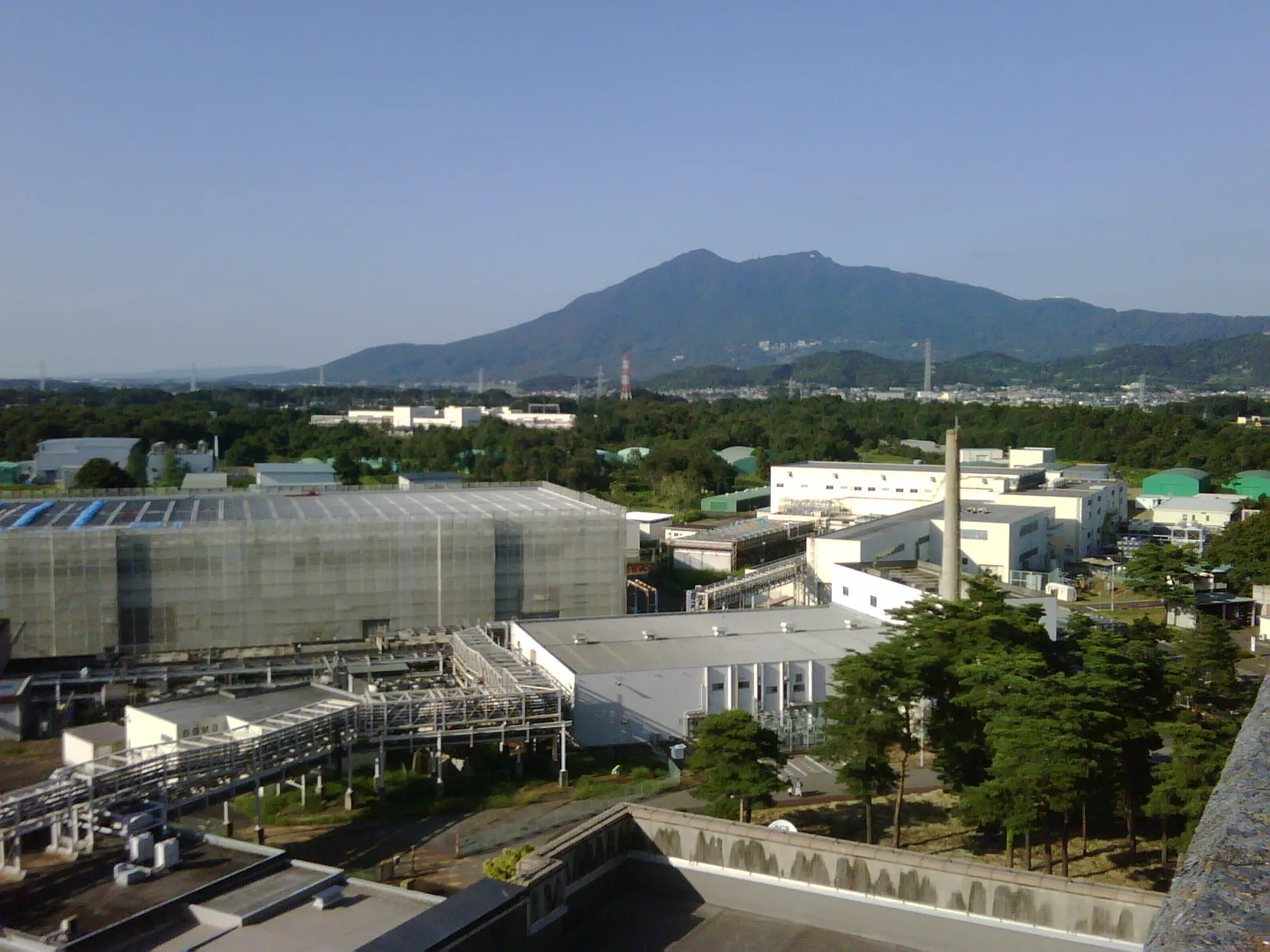
In June 1999 the KEK-to-Kamioka experiment began sending a muon-neutrino beam 250 km from the KEK proton synchrotron in Tsukuba to Super-Kamiokande, with a near detector at KEK. It was the first accelerator experiment over hundreds of kilometres. By 2004 K2K had confirmed the atmospheric oscillation with an artificial source, observing fewer events and a distorted energy spectrum. It established the near-far technique used by T2K.
- Date
- 1999
- Kind of event
- Experiment
- People involved
- Kōichirō Nishikawa
- Experiments
- K2K, Super-Kamiokande
The situation before
Super-Kamiokande's 1998 evidence for oscillation came from natural atmospheric neutrinos, whose flux and direction are known only through models. A decisive confirmation needed a beam whose source, energy and timing were controlled, sent over a distance matched to the measured Δm² of a few times 10⁻³ eV². For neutrinos of about 1 GeV that meant hundreds of kilometres. Planning for such an experiment in Japan had begun before the discovery, led by Koichiro Nishikawa of Kyoto University and KEK.
What happened
KEK, the High Energy Accelerator Research Organization in Tsukuba, built a new beamline from its 12 GeV proton synchrotron. Protons hit an aluminium target, magnetic horns focused the pions, and a 200 m decay tunnel produced a nearly pure muon-neutrino beam with a mean energy of about 1.3 GeV, aimed at Super-Kamiokande 250 km away. About 300 m downstream of the target, a set of near detectors – including a 1,000-tonne water Cherenkov detector built like a small Super-K – measured the beam before any oscillation. Comparing the near and far detectors cancels much of the uncertainty in flux and interaction rates.
The beam began operating in June 1999, and soon afterwards Super-Kamiokande recorded the first neutrino interaction from an artificial beam ever seen over such a distance. Events were identified by their timing relative to the beam spill, synchronised with GPS clocks at both sites.
Reaction and results
The first results, published in 2003 with data up to 2001, showed 56 events against about 80 expected without oscillation. The Super-K accident of November 2001 interrupted the run; data taking resumed in 2003 with the partly restored detector. In 2005 K2K reported in Physical Review Letters that the probability of its data arising without oscillation was 0.005 percent, a significance of 4.0σ. Besides the deficit, the energy spectrum of muon-like events was distorted as expected for oscillation. The final analysis of 2006 found 112 events against about 158 expected, with a mass-squared difference consistent with the atmospheric value.
Consequences
- K2K was the first accelerator experiment over hundreds of kilometres and confirmed atmospheric oscillation with a man-made source.
- In the United States, MINOS began sending the NuMI beam 735 km from Fermilab to the Soudan mine in 2005 and measured Δm² more precisely.
- K2K's near-far technique, beam monitoring and event selection carried over to T2K, which from 2010 used a far more intense beam from J-PARC to Super-Kamiokande and discovered electron-neutrino appearance in 2013.
- The same principles shape the next long-baseline experiments, DUNE and Hyper-Kamiokande.
Frequently asked questions
What was K2K?
The KEK-to-Kamioka experiment, which from 1999 to 2004 sent a muon-neutrino beam 250 km from KEK to Super-Kamiokande.
What did K2K show?
That fewer muon neutrinos arrived than expected and that their energy spectrum was distorted, confirming atmospheric neutrino oscillation with an artificial beam at about 4σ.
What followed K2K?
MINOS in the United States and T2K in Japan, which used the same near-far detector method with more intense beams.
Original papers
- First resultS. H. Ahn et al. (K2K), Detection of accelerator produced neutrinos at a distance of 250 km, Phys. Lett. B 511, 178 (2001)arXiv:hep-ex/0103001
- Final resultM. H. Ahn et al. (K2K), Measurement of neutrino oscillation by the K2K experiment, Phys. Rev. D 74, 072003 (2006)DOI 10.1103/PhysRevD.74.072003arXiv:hep-ex/0606032
Concepts
Mentioned in 1 page
Last updated: · Editorial standard
Cite this page
Text
Neutrino Atlas (2026). “1999: K2K starts the first long-baseline experiment”. Retrieved 22 November 2026, from https://neutrino-atlas.com/timeline/1999-k2k-start/BibTeX
@misc{neutrinoatlas2026timeline1999k2kstart,
  title        = {1999: K2K starts the first long-baseline experiment},
  author       = {{Neutrino Atlas}},
  year         = {2026},
  url          = {https://neutrino-atlas.com/timeline/1999-k2k-start/},
  note         = {Accessed 2026-11-22},
  language     = {english}
}