2000Discovery
DONUT observes the tau neutrino
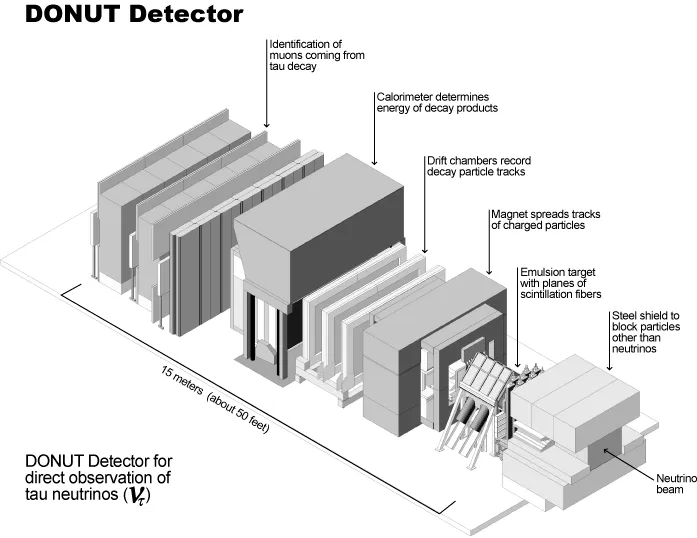
The DONUT collaboration at Fermilab announced on 21 July 2000 the first direct observation of tau neutrino interactions. An 800 GeV proton beam produced charmed Ds mesons whose decays yield tau neutrinos, which were recorded in layers of nuclear emulsion interleaved with steel. Four events showed the characteristic short track of a tau lepton followed by a kink at its decay. It completed the three-generation lepton picture.
- Date
- 21 July 2000
- Kind of event
- Discovery
- People involved
- Kimio Niwa, Byron G. Lundberg, Koichi Kodama, Regina A. (Gina) Rameika, Vittorio Paolone
- Experiments
- DONUT
The situation before
When Martin Perl discovered the tau lepton at SLAC in 1975, physicists assumed it had its own neutrino, just as the electron and muon do. Indirect evidence accumulated: tau decays showed missing energy carried off by a neutral particle, and in 1989 LEP showed that exactly three light neutrinos couple to the Z boson. But no one had seen a tau neutrino interact and produce a tau. The difficulty was twofold. Tau neutrinos are rare in ordinary beams, and the tau produced in an interaction lives only about 0.3 picoseconds, travelling around a millimetre before decaying.
What happened
The DONUT experiment (Direct Observation of the Nu Tau, Fermilab E872) was designed to overcome both problems. Byron Lundberg of Fermilab was its spokesperson, and the emulsion techniques came from the group of Kimio Niwa at Nagoya University, with Koichi Kodama, Regina Rameika and Vittorio Paolone among the key collaborators. An 800 GeV proton beam from the Tevatron was dumped into a block of tungsten. Some collisions produced charmed Ds mesons, which decay promptly into a tau and a tau neutrino, so the neutrino flux behind the dump contained a few percent of tau neutrinos. Magnets and shielding removed charged particles.
The target, about 36 m downstream, consisted of steel plates interleaved with sheets of nuclear emulsion, a photographic material that records charged tracks with micrometre precision. Electronic detectors behind the emulsion located candidate interactions. Data were taken from April to September 1997. Then came three years of scanning the developed emulsion with automated microscopes developed in Nagoya.
Out of 203 neutrino interactions located in the emulsion, four showed the signature the team was looking for: a short track of about a millimetre leaving the interaction point, followed by a kink where the tau decayed into a single charged particle and invisible neutrinos. The expected background was 0.34 events. Fermilab announced the result on 21 July 2000, and the paper 'Observation of tau neutrino interactions' appeared in Physics Letters B in 2001.
Reaction
The announcement was received as the completion of a long-expected picture rather than a surprise: all three neutrinos of the Standard Model had now been observed directly. Fermilab presented it as the first direct evidence for the tau neutrino. The small number of events reflected how demanding the measurement was; the emulsion had to be searched for tracks only a millimetre long.
Consequences
- In 2008 DONUT published a final analysis with nine tau-neutrino candidates and the first measurement of the tau-neutrino interaction cross section, with large uncertainties.
- The emulsion method was scaled up in OPERA, which from 2010 observed tau neutrinos appearing in a muon-neutrino beam sent from CERN to Gran Sasso, direct confirmation of νμ → ντ oscillation.
- Super-Kamiokande and IceCube have since identified tau-neutrino appearance statistically in atmospheric neutrinos, and IceCube has found astrophysical tau-neutrino candidates.
- The tau neutrino remains the least studied particle of the Standard Model; experiments at the LHC such as FASER and SND@LHC, and the planned SHiP experiment, aim to record many more of its interactions.
Frequently asked questions
When was the tau neutrino discovered?
Fermilab's DONUT collaboration announced the first direct observation on 21 July 2000.
How many tau neutrinos did DONUT see?
Four events in the first analysis, against an expected background of 0.34; the final 2008 analysis reported nine.
Why was the tau neutrino so hard to detect?
It is rarely produced, and the tau it creates travels only about a millimetre before decaying, so its track can only be seen in high-resolution emulsion.
Original papers
- DiscoveryK. Kodama et al. (DONUT), Observation of tau neutrino interactions, Phys. Lett. B 504, 218 (2001)
- Final resultK. Kodama et al. (DONuT), Final tau-neutrino results from the DONuT experiment, Phys. Rev. D 78, 052002 (2008)DOI 10.1103/PhysRevD.78.052002
Concepts
Mentioned in 2 pages
Last updated: · Editorial standard
Cite this page
Text
Neutrino Atlas (2026). “2000: DONUT observes the tau neutrino”. Retrieved 22 November 2026, from https://neutrino-atlas.com/timeline/2000-donut-tau-neutrino/BibTeX
@misc{neutrinoatlas2026line2000donuttauneutrino,
  title        = {2000: DONUT observes the tau neutrino},
  author       = {{Neutrino Atlas}},
  year         = {2026},
  url          = {https://neutrino-atlas.com/timeline/2000-donut-tau-neutrino/},
  note         = {Accessed 2026-11-22},
  language     = {english}
}