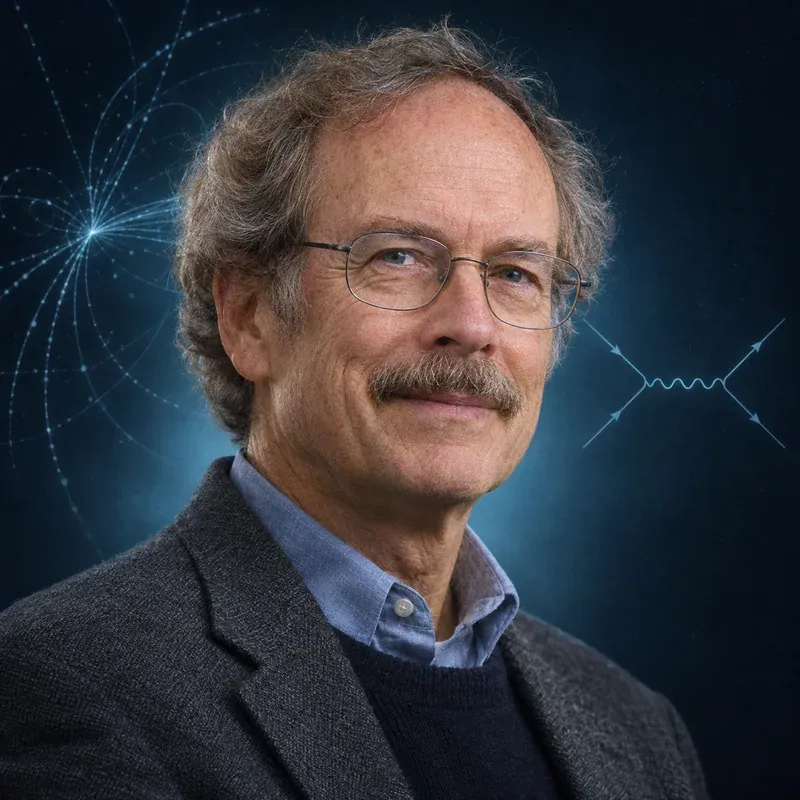
 Illustration
Byron G. Lundberg
Lundberg was co-spokesperson of the DONUT experiment at Fermilab, which used a Tevatron neutrino beam and an emulsion–iron target to make the first direct observation of tau-neutrino interactions, announced on 21 July 2000. He shared the 2022 Panofsky Prize for this result.
- Nationality
- American
- Field
- Experimental particle physics
- Institutions
- Fermilab
The problem DONUT solved
By the 1990s the Standard Model had three lepton families, and measurements at LEP had shown that there are exactly three light neutrino types (see number of light neutrinos). The electron and muon neutrinos had been observed directly in 1956 and 1962, but nobody had yet seen a tau neutrino interact. The obstacle was practical: tau neutrinos are rare in ordinary beams, and the tau lepton they produce decays after travelling only about a millimetre.
Key contributions
Byron G. Lundberg, a physicist at Fermilab, was spokesperson of DONUT (experiment E872), a collaboration of 54 scientists from Japan, Greece, Korea and the United States. The experiment aimed protons from the Tevatron at a dense tungsten beam dump, where short-lived charmed mesons decayed and produced a small fraction of tau neutrinos. Magnets and tonnes of iron and concrete removed most other particles. The neutrinos then entered a target of iron plates interleaved with nuclear emulsion, followed by scintillators and drift chambers.
A tau-neutrino interaction was identified by its topology in the emulsion: a short track from the charged-current vertex that bends, or "kinks", where the tau lepton decays. From about 6.6 million triggered events, the collaboration found four such interactions with an expected background of about 0.34 events. Lundberg presented this first direct evidence at a Fermilab colloquium on 21 July 2000, describing the search as hunting for a needle in a haystack. The final analysis, published in 2008, reported nine tau-neutrino events among 578 neutrino interactions.
Legacy
DONUT completed the direct observation of all three neutrino flavours. Its emulsion technique, developed with the group of Kimio Niwa at Nagoya, was carried forward by OPERA, which detected tau neutrinos appearing through oscillation in a muon-neutrino beam, and is used today in FASER at the LHC. In 2022 Lundberg shared the W.K.H. Panofsky Prize of the American Physical Society with Vittorio Paolone, Regina Rameika and Kimio Niwa "for the first direct observation of the tau neutrino through its charged-current interactions in an emulsion detector."
Known for
- Co-spokesperson of DONUT
- First direct observation of the tau neutrino (2000)
- Panofsky Prize 2022
Chronology
- 2000DONUT announces tau neutrino observation
- 2022Panofsky Prize
Original papers
- K. Kodama et al. (DONUT), Observation of tau neutrino interactions, Phys. Lett. B 504, 218 (2001)DOI 10.1016/S0370-2693(01)00307-0
Experiments
Connected people
Frequently asked questions
What did DONUT discover?
The first direct evidence for tau-neutrino interactions, announced in July 2000 on the basis of four events.
Why was the tau neutrino so hard to detect?
Tau neutrinos are rare in accelerator beams, and the tau lepton they create travels only about a millimetre before decaying, so finding it requires micrometre-resolution emulsion detectors.
On the timeline
Mentioned in 8 pages
Lessons 1
Milestones 1
Terms 1
Last updated: · Editorial standard
Cite this page
Text
Neutrino Atlas (2026). “Byron G. Lundberg”. Retrieved 22 November 2026, from https://neutrino-atlas.com/people/byron-lundberg/BibTeX
@misc{neutrinoatlas2026peoplebyronlundberg,
  title        = {Byron G. Lundberg},
  author       = {{Neutrino Atlas}},
  year         = {2026},
  url          = {https://neutrino-atlas.com/people/byron-lundberg/},
  note         = {Accessed 2026-11-22},
  language     = {english}
}