FASER / FASERν
An LHC experiment that observed the first neutrinos produced at a particle collider.
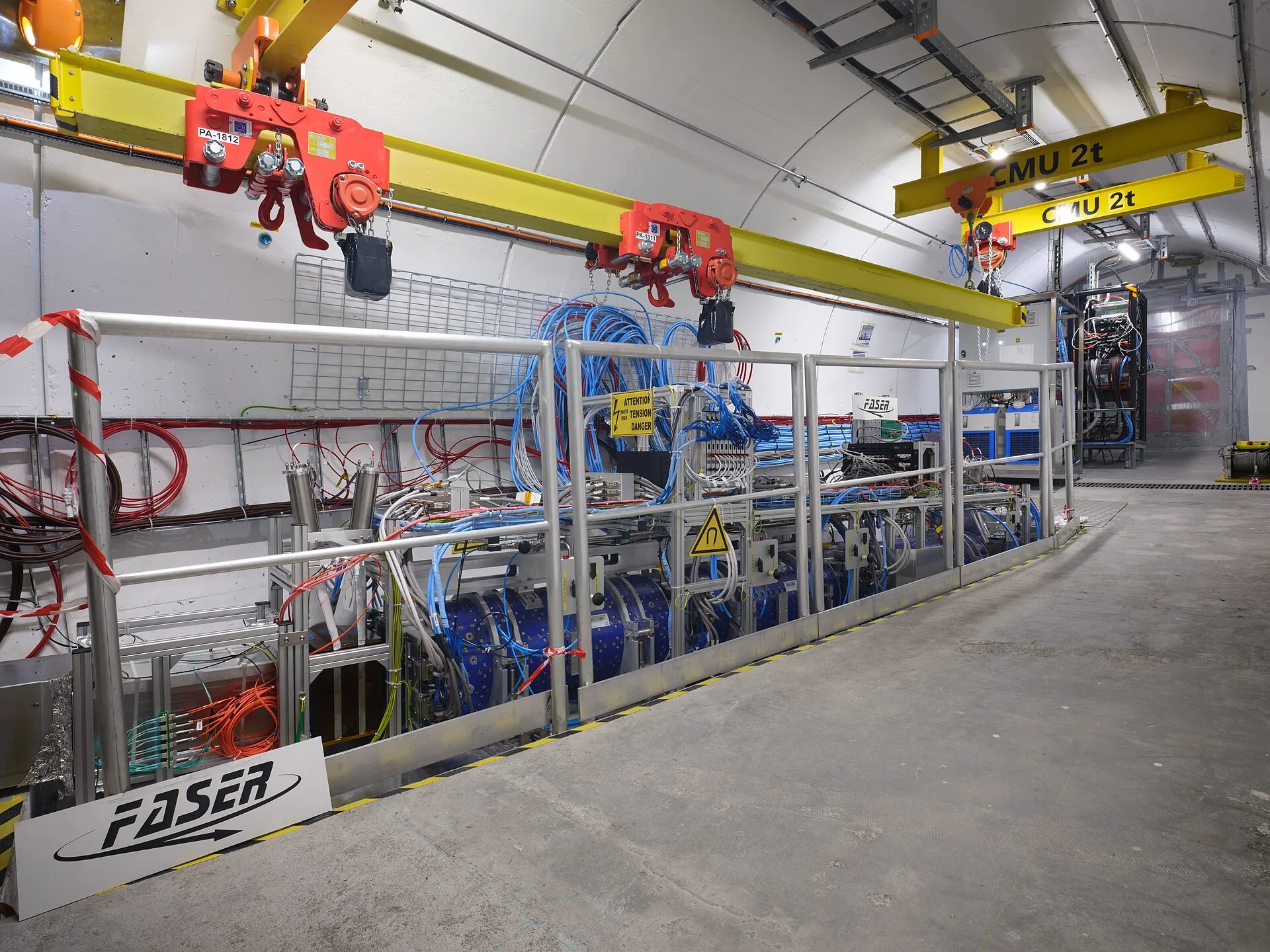
Placed 480 m downstream of the ATLAS interaction point along the beam axis, FASER detects TeV-energy neutrinos from forward meson decays using an emulsion–tungsten target (FASERν) and an electronic spectrometer. In 2023 FASER reported the first observation of collider neutrinos, and SND@LHC reported a similar observation shortly after.
Compare all experiments → · World map →
In plain words
The Large Hadron Collider produces enormous numbers of neutrinos, but almost all of them fly off along the beam line, where the large detectors have holes for the beam pipe. FASER sits in an old service tunnel exactly on that line, far behind the ATLAS collision point, and catches a small fraction of them. These are the most energetic neutrinos ever produced in a laboratory.
How the detector works
FASER is installed in the TI12 tunnel about 480 metres from the ATLAS interaction point, shielded by roughly 100 metres of rock and concrete. Neutrinos come mostly from the decay of pions, kaons and charmed hadrons produced at small angles. The FASERν part is a stack of tungsten plates interleaved with nuclear emulsion films, which records interactions with micrometre precision and can identify electrons, muons and tau leptons. Behind it, scintillator veto planes reject incoming charged particles, and a silicon-strip tracking spectrometer in a magnetic field measures muon momentum and charge.
Key results
A small pilot detector placed in 2018 recorded the first neutrino interaction candidates at the LHC, published in 2021. With data from July to November 2022, FASER's electronic detectors identified 153 muon-neutrino candidate events, a 16-standard-deviation signal, reported in Physical Review Letters in 2023. The neighbouring SND@LHC experiment, on the other side of ATLAS, reported eight events shortly afterwards. In 2024 FASER published the first measurements of electron- and muon-neutrino interaction cross sections at TeV energies, using the emulsion detector.
Why it matters for neutrino physics
Collider neutrinos fill a gap between accelerator beams of a few GeV and the astrophysical neutrinos seen by IceCube. Their rates test models of forward hadron and charm production, which also govern the background of atmospheric neutrinos at high energy. FASER's three-flavour capability allows tau-neutrino studies of the kind pioneered by DONUT. FASER also searches for light, weakly coupled particles such as dark photons, and larger successors are proposed for a future Forward Physics Facility at the High-Luminosity LHC.
Frequently asked questions
How energetic are FASER's neutrinos?
They range from a few hundred GeV to several TeV, about a thousand times more than typical accelerator neutrino beams used for oscillation studies.
What is the difference between FASER and SND@LHC?
Both detect forward LHC neutrinos from ATLAS collisions. FASER sits on the beam axis in tunnel TI12, while SND@LHC sits in tunnel TI18 on the opposite side and slightly off axis, so it samples a different angular range.
Original papers
- DiscoveryH. Abreu et al. (FASER Collaboration), First Direct Observation of Collider Neutrinos with FASER at the LHC, Phys. Rev. Lett. 131, 031801 (2023)DOI 10.1103/PhysRevLett.131.031801arXiv:2303.14185
- MeasurementR. Mammen Abraham et al. (FASER Collaboration), First Measurement of the νe and νμ Interaction Cross Sections at the LHC with FASER's Emulsion Detector, Phys. Rev. Lett. 133, 021802 (2024)DOI 10.1103/PhysRevLett.133.021802arXiv:2403.12520
Related terms
Latest research on this topic
- Constraints on a Long-Lived X17 Vector Boson with FASERFASER Collaboration · 2 November 2026
- Muon Tridents at FASER and NA64μ: Motivation, Predictions, and Prospects for Precision MeasurementsFrancener, Reinaldo, Goncalves, Victor P., Kling, Felix et al. · 23 October 2026
- First Search for Quirks at the LHC with FASERFASER Collaboration · 28 July 2026
- Electromagnetic shower reconstruction and identification in FASER's emulsion detector for LHC forward neutrino measurementsFASER Collaboration · 16 June 2026
- Neutrino research with the FASER experimentYang, Heng, Zhang, Shunliang, Wang, Yuxiao et al. · 15 June 2026
- The FASER experiment at the Large Hadron ColliderBoyd, Jamie · 21 April 2026
On the timeline
Mentioned in 12 pages
People 2
Last updated: · Editorial standard
Cite this page
Text
Neutrino Atlas (2026). “FASER / FASERν”. Retrieved 22 November 2026, from https://neutrino-atlas.com/terms/faser/BibTeX
@misc{neutrinoatlas2026termsfaser,
  title        = {FASER / FASERν},
  author       = {{Neutrino Atlas}},
  year         = {2026},
  url          = {https://neutrino-atlas.com/terms/faser/},
  note         = {Accessed 2026-11-22},
  language     = {english}
}