CDHS (WA1)
Jack Steinberger's 1,250-tonne magnetised-iron neutrino detector at the CERN SPS (1976–1984), a workhorse of neutrino deep-inelastic scattering.
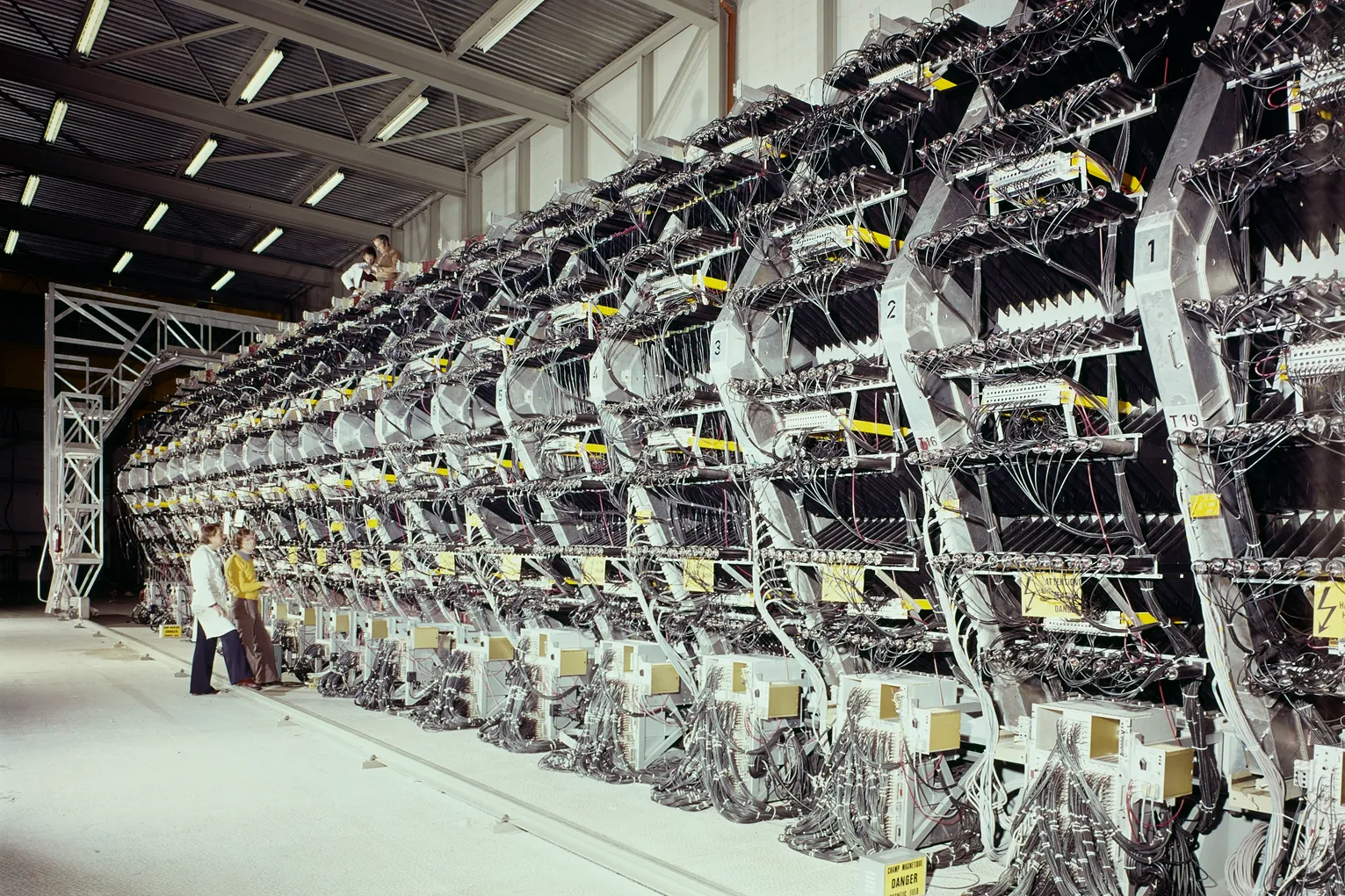
CDHS stacked 19 (later 20) magnetised iron modules interleaved with scintillators and drift chambers, so each module served as target, calorimeter and muon spectrometer. It measured nucleon structure functions and QCD scaling violations, the neutral- to charged-current ratio and the strange sea. In 1983–84 it used two detectors at 130 m and 885 m in a low-energy PS beam to search for νµ disappearance.
Compare all experiments → · World map →
In plain words
A high-energy neutrino can hit a single quark inside a proton or neutron and knock it out. Because neutrinos feel only the weak interaction, the debris carries clean information about how quarks are distributed in the nucleon. CDHS was a giant iron block designed to record millions of such collisions and read off that internal structure.
How the detector works
The collaboration of CERN, Dortmund, Heidelberg and Saclay, later joined by Warsaw, was led by Jack Steinberger. Proposed in 1973 and completed in 1976, the detector was about 20 m long and weighed roughly 1,250 tonnes. It consisted of 19 toroidally magnetised iron modules with plastic scintillator inserted between the iron plates and drift chambers between the modules. The iron was the neutrino target, the scintillators measured the hadronic energy, and the bending of the outgoing muon in the magnetised iron gave its momentum and charge. A 1980 upgrade added a twentieth module and more drift chambers. Beams came from the 400 GeV SPS through the West Area neutrino facility.
Key results
- Precise deep-inelastic structure functions whose slow change with energy supported quantum chromodynamics.
- The ratio of neutral-current to charged-current events, giving the weak mixing angle.
- Dimuon events from charm production, which measured the strange-quark sea.
- The refutation of a "high-y anomaly" reported at Fermilab that had seemed to contradict the Standard Model.
In 1983–84 CDHS turned to oscillations. Using a 19.2 GeV proton beam from the CERN PS, it compared event rates in two detectors at 130 m and 885 m from the target. No νµ disappearance appeared, and the limit reached down to Δm² of a few tenths of eV². The two-detector method became the template for later near and far detector comparisons.
Legacy
CDHS, its neighbour CHARM and later CCFR and NuTeV at Fermilab made neutrino scattering a precision tool for the structure of matter.
Frequently asked questions
Did CDHS win a Nobel Prize?
No. Jack Steinberger's 1988 Nobel Prize recognised the 1962 discovery of the muon neutrino at Brookhaven, not CDHS.
What does WA1 mean?
It was the first experiment approved in CERN's SPS West Area, where the neutrino beams were delivered.
Original papers
- MeasurementF. Dydak et al. (CDHS Collaboration), A search for νμ oscillations in the Δm² range 0.3–90 eV², Phys. Lett. B 134, 281 (1984)
Related terms
- Deep inelastic scattering
- Tracking calorimeter
- CHARM / CHARM-II
- CERN West Area Neutrino Facility (WANF)
- Neutral-current interaction
Mentioned in 5 pages
Last updated: · Editorial standard
Cite this page
Text
Neutrino Atlas (2026). “CDHS (WA1)”. Retrieved 22 November 2026, from https://neutrino-atlas.com/terms/cdhs/BibTeX
@misc{neutrinoatlas2026termscdhs,
  title        = {CDHS (WA1)},
  author       = {{Neutrino Atlas}},
  year         = {2026},
  url          = {https://neutrino-atlas.com/terms/cdhs/},
  note         = {Accessed 2026-11-22},
  language     = {english}
}