Gargamelle
CERN's giant heavy-liquid bubble chamber that discovered weak neutral currents in 1973.
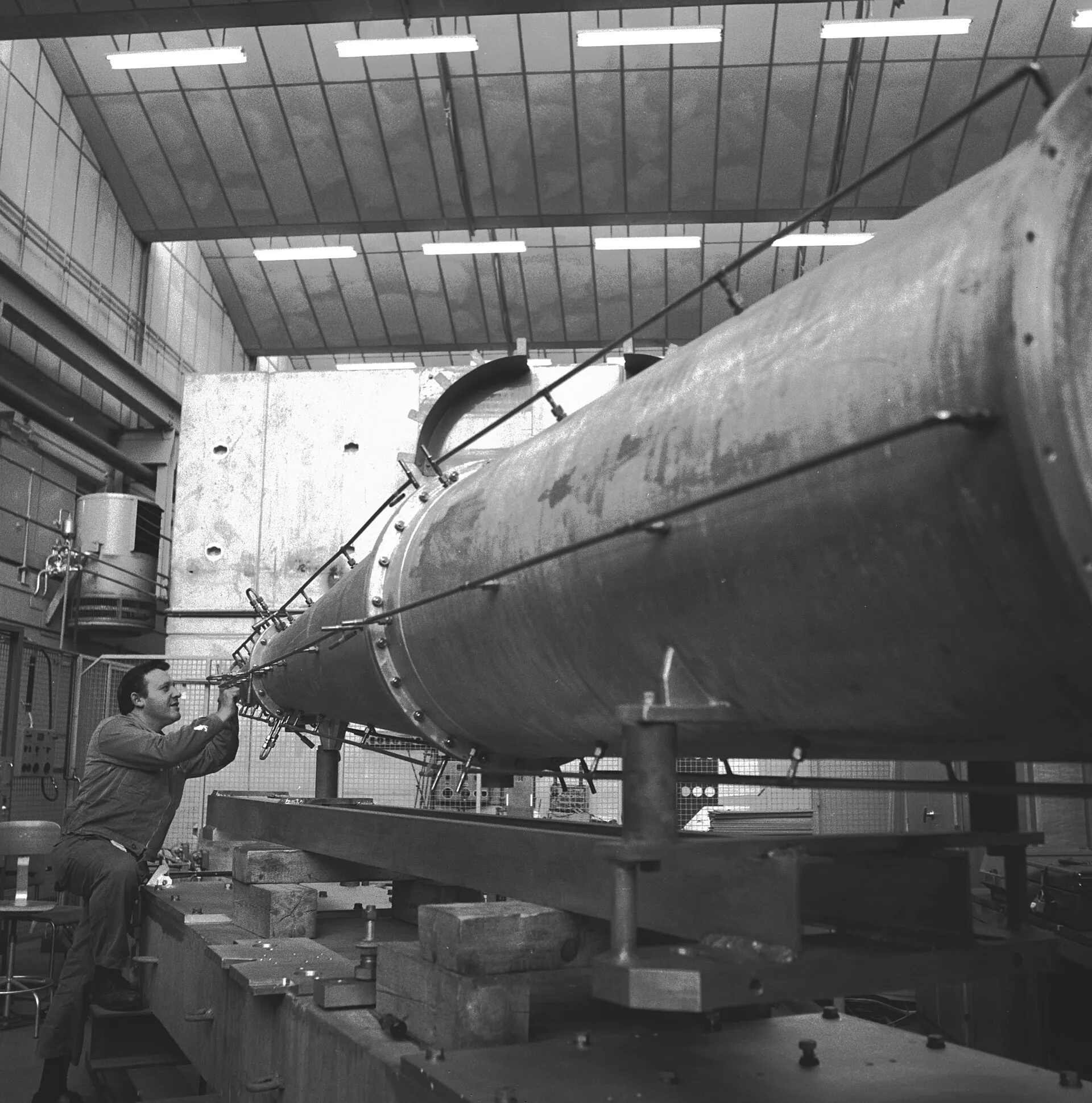
The 4.8 m long chamber, filled with about 12 m³ of freon, recorded neutrino interactions in which no charged lepton emerged, the hallmark of Z-mediated neutral currents. The discovery strongly supported electroweak unification.
Compare all experiments → · World map →
In plain words
A bubble chamber is a tank of superheated liquid in which a charged particle leaves a trail of tiny bubbles that can be photographed. Gargamelle, named after the giantess in Rabelais' novels, was an unusually large and dense one. Its heavy liquid made it a good target for neutrinos and a good absorber for the particles they produce. In its photographs physicists found something the old theory of weak interactions did not allow: neutrinos that hit matter and scattered away again without turning into a muon.
In detail
The chamber was built at Saclay on the initiative of André Lagarrigue and took its first pictures at CERN in December 1970. It held about 18 tonnes of liquid freon (CF₃Br) in a body about 4.8 m long and 1.9 m in diameter. Neutrino and antineutrino beams from the Proton Synchrotron were sent through it, and the films were scanned by seven European laboratories.
Key results
In December 1972 Franz-Josef Hasert, a student at Aachen, found a single isolated electron in the antineutrino film, a clean example of the purely leptonic process. By March 1973 the collaboration had 166 hadronic candidates without a muon. The difficult part was proving that neutrons from interactions in the surrounding material did not fake them. Paul Musset presented both analyses at a CERN seminar on 19 July 1973, and the papers appeared together in Physics Letters in September 1973. After a period of doubt in 1974, experiments in the United States confirmed the effect.
Gargamelle also compared neutrino and electron scattering on nucleons. Donald Perkins and colleagues used this to support fractional quark charges and the quark structure of the nucleon.
Why it matters for neutrino physics
Neutral currents were a central prediction of the electroweak theory of Sheldon Glashow, Steven Weinberg and Abdus Salam. Their discovery made the Z boson a concrete target, found at CERN in 1983, and gave a first value of the weak mixing angle. Today the same process lets SNO count all neutrino flavours and underlies CEvNS. The chamber cracked in 1978 and stopped running in 1979; it is now displayed at CERN.
Frequently asked questions
Why was the neutral-current discovery so hard to establish?
Neutrons produced by neutrinos in the walls and magnet could enter the chamber and create hadron showers that look like neutral-current events. The collaboration had to show, through careful background studies, that this source could not explain all the muonless events.
Original papers
- DiscoveryF. J. Hasert et al. (Gargamelle Collaboration), Observation of neutrino-like interactions without muon or electron in the Gargamelle neutrino experiment, Phys. Lett. B 46, 138 (1973)DOI 10.1016/0370-2693(73)90499-1
- DiscoveryF. J. Hasert et al. (Gargamelle Collaboration), Search for elastic muon-neutrino electron scattering, Phys. Lett. B 46, 121 (1973)DOI 10.1016/0370-2693(73)90494-2
Related terms
People
- Abdus Salam
- André Lagarrigue
- Sheldon Lee Glashow
- Steven Weinberg
- Carlo Rubbia
- Daniel Z. Freedman
- Donald Hill Perkins
- Ettore Fiorini
- Simon van der Meer
- Luciano Maiani
- Alfred K. Mann
- Paul Musset
- Gerardus 't Hooft
- John Clive Ward
- Martinus J. G. Veltman
On the timeline
Mentioned in 46 pages
Comparisons 1
Milestones 5
People 21
Terms 16
Last updated: · Editorial standard
Cite this page
Text
Neutrino Atlas (2026). “Gargamelle”. Retrieved 22 November 2026, from https://neutrino-atlas.com/terms/gargamelle/BibTeX
@misc{neutrinoatlas2026termsgargamelle,
  title        = {Gargamelle},
  author       = {{Neutrino Atlas}},
  year         = {2026},
  url          = {https://neutrino-atlas.com/terms/gargamelle/},
  note         = {Accessed 2026-11-22},
  language     = {english}
}