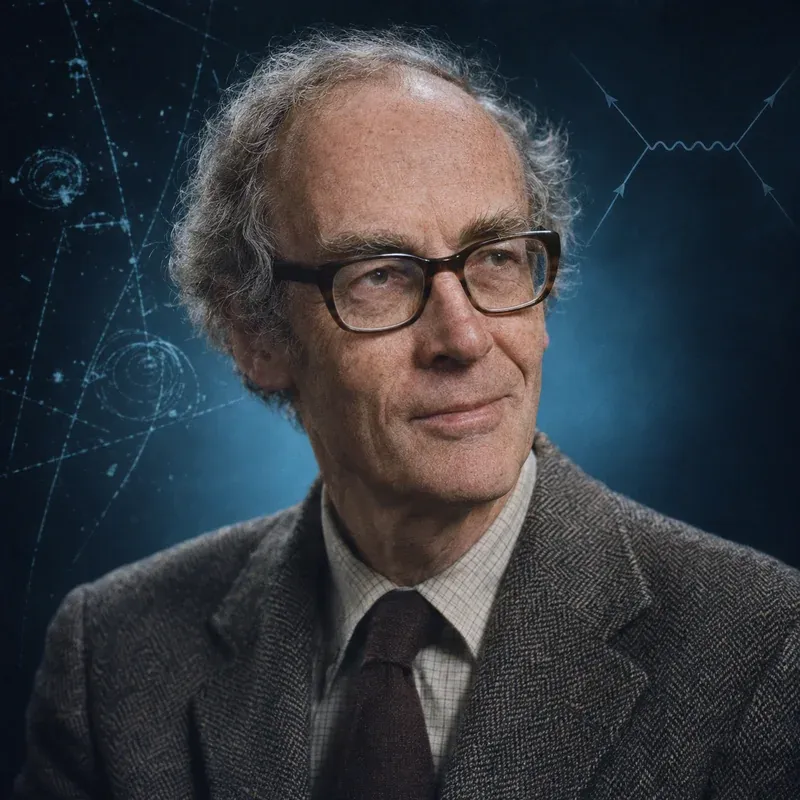
 Illustration
Donald Hill Perkins
Perkins led the Oxford group in the Gargamelle collaboration, contributing to the 1973 discovery of weak neutral currents. He recognised that combining neutrino and electron scattering data showed both scatter off quarks inside the nucleon. In later work on proton decay detectors he found an early indication of neutrino oscillations, and he championed the Soudan-2 experiment.
- Born
- 15 October 1925
Kingston upon Hull, England - Died
- 30 October 2022
Headington, Oxford, England - Nationality
- British
- Field
- Experimental particle physics
- Institutions
- Imperial College London, University of Bristol, University of Oxford, CERN
Early life and education
Donald Hill Perkins was born in 1925 in Kingston upon Hull, the son of two schoolteachers. He studied at Imperial College London, receiving his BSc in 1945 and his PhD in 1948 under the Nobel laureate George Paget Thomson. For his thesis he flew stacks of photographic emulsion aboard an RAF aircraft to record cosmic rays at high altitude. One of his emulsions showed a negative pion being captured by a nucleus and causing it to disintegrate, an event published in Nature in 1947 and later recognised as one of the first observations of the pion.
Path to neutrino physics
In 1949 Perkins joined Cecil Powell's cosmic-ray group at the University of Bristol, the leading centre of emulsion physics. With Peter Fowler he studied the decay properties of pions using emulsions carried to mountain tops and into the stratosphere by balloons. With Powell and Fowler he wrote a standard text on the emulsion technique, published in 1959. In 1961 he and Fowler were also the first to suggest that beams of negative pions might be used to treat cancer.
In 1965 Perkins became professor of elementary particle physics at the University of Oxford, where he helped build one of Britain's leading particle physics groups. Oxford's involvement in CERN's neutrino programme brought him into the field for which he is best remembered here.
Key contributions
Perkins led the Oxford group in the Gargamelle collaboration at CERN. Gargamelle was a large heavy-liquid bubble chamber exposed to a beam of muon neutrinos and antineutrinos. In 1973 the collaboration, led by André Lagarrigue with Paul Musset among its key physicists, reported events in which a neutrino scattered without producing a muon: the first evidence for weak neutral currents, a central prediction of the electroweak theory.
Perkins also recognised the significance of Gargamelle's measurements of neutrino deep inelastic scattering. Comparing the neutrino cross sections with those of electron scattering at SLAC, he showed that both kinds of probe scatter off the same point-like constituents inside the nucleon, and that their charges matched the fractional values assigned to quarks. This was among the early quantitative evidence that quarks are real constituents rather than a bookkeeping device, and Perkins was an early supporter of quantum chromodynamics.
In the early 1980s Perkins turned to underground physics. He became a leading advocate of the Soudan-2 experiment in Minnesota, a fine-grained iron tracking calorimeter built to search for proton decay. Proton decay was not found, but such detectors recorded atmospheric neutrinos as their main background. Perkins is credited with an early indication, in 1982, of what was later understood as neutrino oscillation; Soudan-2 later contributed its own measurement of the atmospheric muon-neutrino deficit.
Legacy
Perkins's textbook ‘Introduction to High Energy Physics’, first published in 1972 and based on his Oxford lectures, became a standard work through several editions. In 2003 he published ‘Particle Astrophysics’. He chaired the Nuclear Physics Board of the UK Science and Engineering Research Council and CERN's Scientific Policy Committee. He was elected a Fellow of the Royal Society in 1966 and received the Guthrie Medal (1979), the Holweck Prize (1992), the Royal Medal (1997) and the European Physical Society's High Energy and Particle Physics Prize (2001). He retired in 1998 and died at home in Headington, Oxford, in October 2022 at the age of 97.
Known for
- Gargamelle neutral-current discovery
- Neutrino evidence for quark structure of the nucleon
- Early indication of atmospheric neutrino anomaly
- Textbook 'Introduction to High Energy Physics'
Chronology
- 1965Professor at Oxford
- 1966Fellow of the Royal Society
- 1973Gargamelle neutral currents
- 1997Royal Medal
Original papers
- F. J. Hasert et al. (Gargamelle), Observation of neutrino-like interactions without muon or electron in the Gargamelle neutrino experiment, Phys. Lett. B 46, 138 (1973)DOI 10.1016/0370-2693(73)90499-1
Experiments
Connected people
Frequently asked questions
What was Donald Perkins's role in the discovery of neutral currents?
He led the Oxford group in the Gargamelle collaboration, which in 1973 found neutrino interactions without an outgoing muon, the first evidence for weak neutral currents.
How did neutrino experiments help confirm quarks?
Perkins compared neutrino and electron deep inelastic scattering data and showed that both probe the same point-like constituents with the fractional charges expected for quarks.
On the timeline
Mentioned in 8 pages
Last updated: · Editorial standard
Cite this page
Text
Neutrino Atlas (2026). “Donald Hill Perkins”. Retrieved 22 November 2026, from https://neutrino-atlas.com/people/donald-perkins/BibTeX
@misc{neutrinoatlas2026peopledonaldperkins,
  title        = {Donald Hill Perkins},
  author       = {{Neutrino Atlas}},
  year         = {2026},
  url          = {https://neutrino-atlas.com/people/donald-perkins/},
  note         = {Accessed 2026-11-22},
  language     = {english}
}