1973Discovery
Gargamelle discovers weak neutral currents
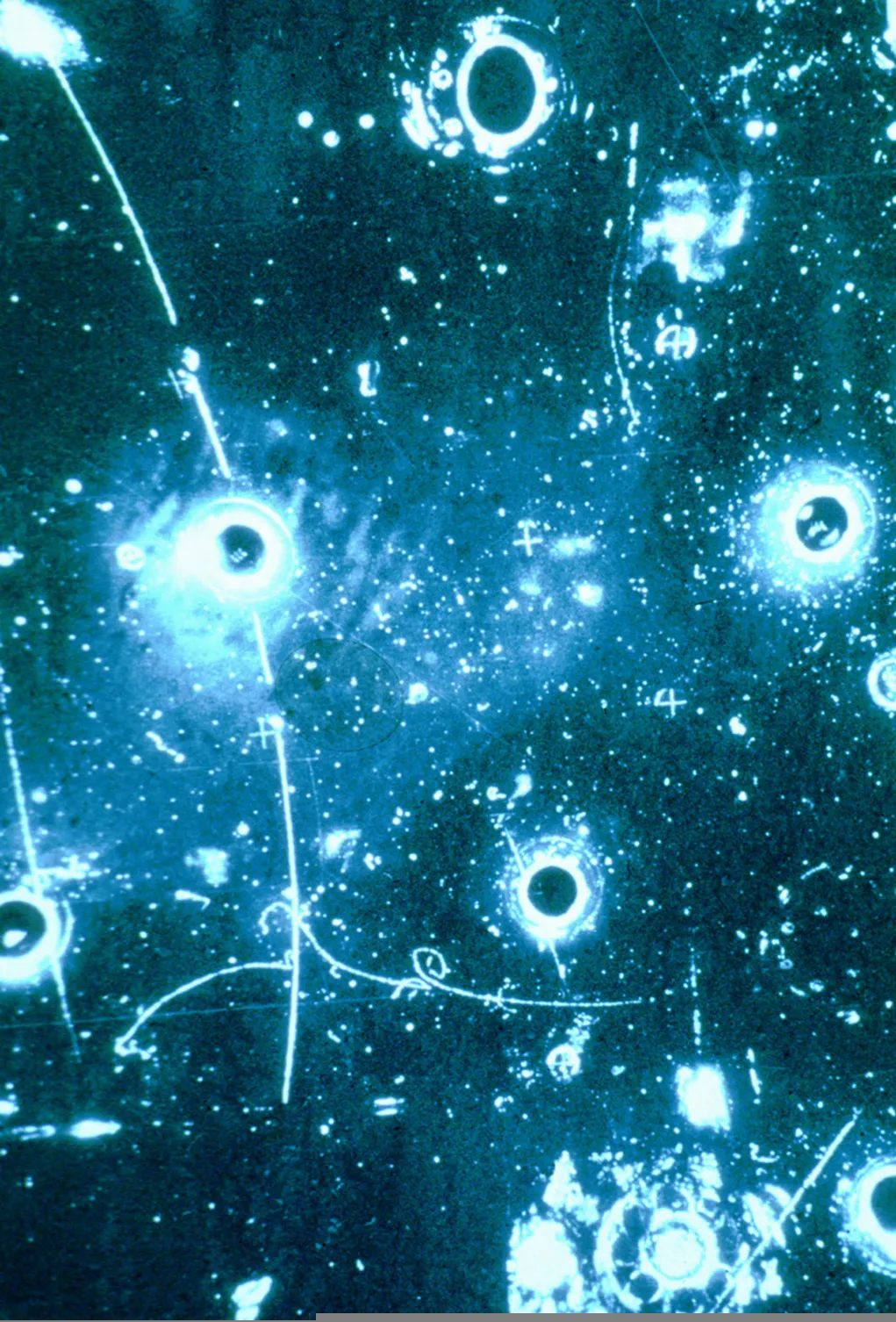
The Gargamelle heavy-liquid bubble chamber collaboration at CERN, led by André Lagarrigue, announced on 19 July 1973 events in which neutrinos scattered off nucleons or electrons without producing a muon. These neutral-current interactions, mediated by the Z boson, had been predicted by the electroweak theory. Experiment E1A at Fermilab confirmed the observation in 1974 after initial doubts. The discovery was a decisive test of the Glashow–Weinberg–Salam model.
- Date
- 19 July 1973
- Kind of event
- Discovery
- People involved
- André Lagarrigue, Paul Musset, Donald Hill Perkins, Ettore Fiorini, Alfred K. Mann, Carlo Rubbia
- Experiments
- Gargamelle
The situation before
All weak processes observed until the early 1970s involved a change of electric charge: a neutrino turned into a muon or an electron, a neutron into a proton. The electroweak theory of Sheldon Glashow, Steven Weinberg and Abdus Salam predicted something new: a neutral boson, the Z, which would let a neutrino scatter off matter and leave as a neutrino. Earlier neutrino experiments at CERN in the 1960s had seen events without a muon, but they had been attributed to neutrons entering the detector, and published limits suggested such processes were rare. Interest grew sharply after 1971, when Gerard 't Hooft showed that the theory was renormalisable.
What happened
Gargamelle was a giant bubble chamber, 4.8 m long and nearly 2 m in diameter, filled with about 12 cubic metres of the heavy liquid freon CF₃Br. It was designed and built at Saclay under André Lagarrigue and installed in CERN's neutrino beam from the Proton Synchrotron in 1970–71. The heavy liquid made it possible to see the whole final state of an interaction, including photons. A collaboration of European laboratories, among them Aachen, Brussels, Milan, Orsay, Oxford, University College London and CERN, analysed the photographs. Members included Paul Musset, Donald Perkins and Ettore Fiorini.
Two kinds of evidence emerged. In December 1972 Franz-Josef Hasert, a doctoral student in Aachen, found a single event in the antineutrino film in which an electron recoiled from the chamber with no other particles: a muon antineutrino had scattered elastically off an electron, a purely leptonic neutral-current process with very low expected background. In parallel, the group searched for hadronic neutral-current events, showers of hadrons with no muon. By March 1973 they had identified 102 such events in the neutrino film and 64 in the antineutrino film. The crucial work was to show that neutrons produced in the surrounding material could not account for them; the analysis, much of it by Dieter Haidt and colleagues, used the distribution of events along the chamber to rule this out.
Paul Musset presented the results at a CERN seminar on 19 July 1973. The two papers, received by Physics Letters B on 2 and 23 July, appeared together on 3 September 1973. The ratio of neutral- to charged-current events was about 0.2 for neutrinos and 0.4 for antineutrinos, consistent with the Weinberg–Salam model for a weak mixing angle of the order expected.
Reaction
The announcement was met with scepticism, especially in the United States. Experiment E1A at Fermilab, the Harvard–Pennsylvania–Wisconsin–Fermilab collaboration including Carlo Rubbia and Alfred Mann, had seen a neutral-current signal itself in 1973, but after changes to its detector the signal seemed to vanish, an episode later nicknamed "alternating neutral currents". The Gargamelle collaboration carried out further checks, including a dedicated measurement of the neutron background with a proton beam. In 1974 E1A and other experiments at Fermilab and Argonne confirmed the effect, and by the summer conferences of 1974 neutral currents were generally accepted.
Why it matters
The discovery of neutral currents was the first direct confirmation of the electroweak theory and the first evidence for the Z boson. It led to the 1979 Nobel Prize for Glashow, Salam and Weinberg. It also measured the weak mixing angle well enough to predict the W and Z masses, which guided the construction of CERN's proton–antiproton collider; there Rubbia's UA1 and the UA2 experiment found the W and Z in 1983. Rubbia and Simon van der Meer received the 1984 Nobel Prize for that achievement. Lagarrigue died in 1975 and did not see the full consequences. In 2009 the Gargamelle collaboration received the European Physical Society High Energy Physics Prize for the discovery.
For neutrino physics, neutral currents opened new tools and questions: coherent scattering on nuclei, predicted by Daniel Freedman in 1974; the neutral-current channel in supernovae; and the measurement of the total solar neutrino flux by SNO in 2002, which used neutral-current reactions on deuterium to count all neutrino flavours.
Frequently asked questions
When were weak neutral currents discovered?
The Gargamelle collaboration announced the discovery at CERN on 19 July 1973; the papers were published on 3 September 1973.
Why was the discovery important?
It confirmed a key prediction of the electroweak theory and was the first evidence for the Z boson, leading to the 1979 Nobel Prize for Glashow, Salam and Weinberg.
Why were physicists sceptical at first?
Neutrons from the surrounding material could mimic neutral-current events, and a competing experiment at Fermilab briefly seemed to lose its signal. Further checks and confirmations in 1974 settled the question.
Original papers
- DiscoveryF. J. Hasert et al. (Gargamelle Collaboration), Observation of neutrino-like interactions without muon or electron in the Gargamelle neutrino experiment, Phys. Lett. B 46, 138 (1973)DOI 10.1016/0370-2693(73)90499-1
Concepts
Mentioned in 2 pages
Last updated: · Editorial standard
Cite this page
Text
Neutrino Atlas (2026). “1973: Gargamelle discovers weak neutral currents”. Retrieved 22 November 2026, from https://neutrino-atlas.com/timeline/1973-gargamelle-neutral-currents/BibTeX
@misc{neutrinoatlas2026argamelleneutralcurrents,
  title        = {1973: Gargamelle discovers weak neutral currents},
  author       = {{Neutrino Atlas}},
  year         = {2026},
  url          = {https://neutrino-atlas.com/timeline/1973-gargamelle-neutral-currents/},
  note         = {Accessed 2026-11-22},
  language     = {english}
}