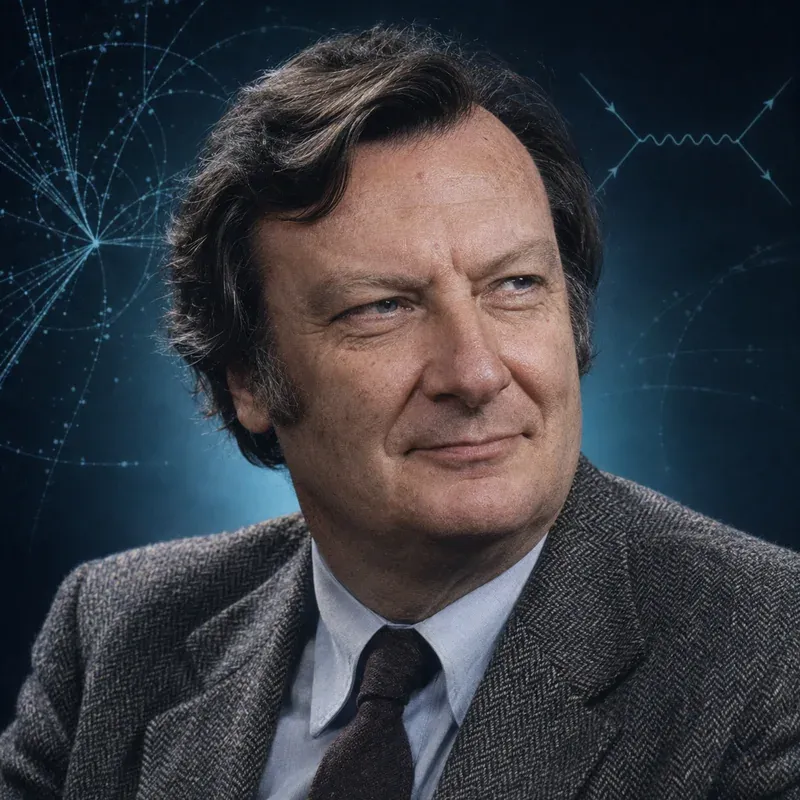
 Illustration
Carlo Rubbia
In 1977 Rubbia proposed the liquid-argon time projection chamber as 'a new concept for neutrino detectors' and initiated the ICARUS programme, which led to the T600 detector operated at Gran Sasso from 2010 in the CNGS beam and later moved to Fermilab's Short-Baseline Neutrino programme. LAr-TPC technology is now the basis of MicroBooNE, SBND and DUNE.
- Born
- 31 March 1934
Gorizia, Italy - Nationality
- Italian
- Field
- Experimental particle physics
- Nobel Prize
- Physics 1984 (shared with Simon van der Meer) – for their decisive contributions to the large project, which led to the discovery of the field particles W and Z, communicators of weak interaction
- Institutions
- CERN, Harvard University, Columbia University, INFN / Laboratori Nazionali del Gran Sasso
Early life and education
Carlo Rubbia was born in 1934 in Gorizia in north-eastern Italy. He studied physics at the Scuola Normale Superiore in Pisa, then spent about a year and a half as a postdoctoral researcher at Columbia University, working on muon decay and muon capture by nuclei, both processes governed by the weak interaction. In 1960 he joined the young European laboratory CERN, which remained the centre of his career. From 1970 to 1988 he was also Higgins Professor of Physics at Harvard University, dividing his time between Geneva and Cambridge, Massachusetts.
Weak interactions and the W and Z
In the early 1970s Rubbia was one of the leaders, with David Cline and Alfred Mann, of the Harvard–Pennsylvania–Wisconsin–Fermilab neutrino experiment, which confirmed the existence of weak neutral currents soon after their discovery at Gargamelle. Neutral currents implied the existence of a heavy neutral carrier of the weak force, the Z boson, alongside the charged W boson.
To produce these particles, Rubbia proposed in 1976 to convert CERN's Super Proton Synchrotron into a proton–antiproton collider. The scheme depended on accumulating dense antiproton beams with the stochastic cooling technique developed by Simon van der Meer. Rubbia led the UA1 collaboration, which in 1983 reported the discovery of the W and Z bosons. He and van der Meer received the 1984 Nobel Prize in Physics for their decisive contributions to the project. From 1989 to 1993 Rubbia was Director-General of CERN, a period that saw the LEP collider begin operation.
The liquid-argon time projection chamber
Rubbia's most lasting contribution to neutrino detection came in a 1977 CERN internal note titled ‘The liquid-argon time projection chamber: a new concept for neutrino detectors’. The idea combines the electronic readout of a time projection chamber with the density of liquid argon. A charged particle crossing the argon ionises it; a strong electric field drifts the freed electrons over metres to wire planes, where they are recorded. The arrival time gives the third coordinate, so the detector produces three-dimensional images with millimetre detail, comparable to a bubble chamber but fully electronic and scalable to thousands of tonnes. Argon also scintillates, giving a fast trigger signal.
Rubbia initiated the ICARUS programme to develop the technique. After years of prototypes, the ICARUS T600 detector, holding about 760 tonnes of liquid argon, was tested in Pavia in 2001 and began operating at the Gran Sasso laboratory in 2010, recording neutrinos from the CNGS beam sent 730 kilometres from CERN. In 2012 ICARUS measured the speed of these neutrinos and found it consistent with the speed of light, helping to resolve the OPERA anomaly. The detector was refurbished at CERN, moved to Fermilab in 2017 and began taking data in the Short-Baseline Neutrino programme in 2021.
The liquid-argon TPC is now a central technology of accelerator neutrino physics. It is used in MicroBooNE, SBND and ProtoDUNE, and it is the basis of the far detectors of DUNE. Its fine imaging allows electron–photon separation, which is essential for measuring electron-neutrino appearance.
Later work
Rubbia also proposed the ‘energy amplifier’, an accelerator-driven subcritical reactor that could burn thorium and transmute long-lived nuclear waste. He was president of the Italian energy agency ENEA from 1999 to 2005, and in August 2013 he was appointed a senator for life of the Italian Republic.
Known for
- Discovery of the W and Z bosons (Nobel 1984)
- Invention of the liquid-argon time projection chamber (1977)
- ICARUS
- CERN Director-General (1989–1993)
Chronology
- 1977Proposes the liquid-argon TPC for neutrino detection
- 1984Nobel Prize in Physics
- 1989CERN Director-General (to 1993)
- 2010ICARUS T600 starts at Gran Sasso
Original papers
- C. Rubbia, The liquid-argon time projection chamber: a new concept for neutrino detectors, CERN-EP-INT-77-8 (1977)
Experiments
Connected people
Frequently asked questions
What did Carlo Rubbia contribute to neutrino physics?
In 1977 he proposed the liquid-argon time projection chamber for neutrino detection and led the ICARUS programme that developed it. The technology is now used by DUNE and the Fermilab short-baseline experiments.
Why did Carlo Rubbia win the Nobel Prize?
He shared the 1984 Nobel Prize in Physics with Simon van der Meer for the project that discovered the W and Z bosons, the carriers of the weak force.
On the timeline
Mentioned in 20 pages
Lessons 1
FAQ 1
Comparisons 1
Milestones 2
People 8
Last updated: · Editorial standard
Cite this page
Text
Neutrino Atlas (2026). “Carlo Rubbia”. Retrieved 22 November 2026, from https://neutrino-atlas.com/people/carlo-rubbia/BibTeX
@misc{neutrinoatlas2026peoplecarlorubbia,
  title        = {Carlo Rubbia},
  author       = {{Neutrino Atlas}},
  year         = {2026},
  url          = {https://neutrino-atlas.com/people/carlo-rubbia/},
  note         = {Accessed 2026-11-22},
  language     = {english}
}