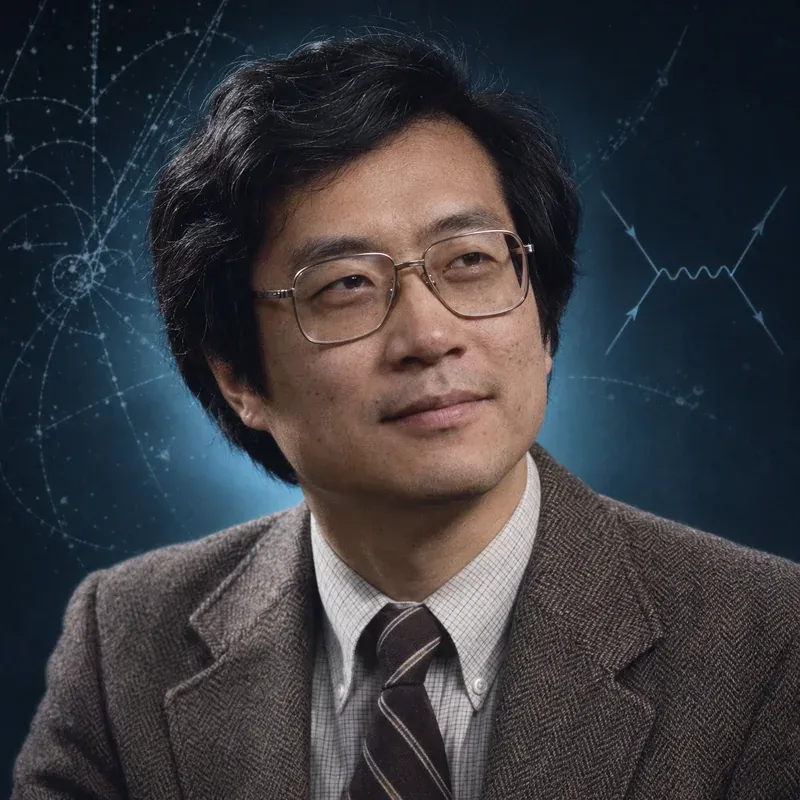
 Illustration
Herbert H. Chen
In 1984 Chen proposed using the deuterium in a large heavy-water detector to observe solar neutrinos and distinguish between flavours, via charged- and neutral-current reactions on deuterons. This idea became the Sudbury Neutrino Observatory, of which he was the US leader and spokesman alongside George Ewan. He died of leukaemia in 1987, before SNO was built.
- Born
- 16 March 1942
Chongqing, China - Died
- 7 November 1987
Irvine, California, USA - Nationality
- American (Chinese-born)
- Field
- Experimental particle physics
- Institutions
- University of California, Irvine, Caltech, Princeton University
Early life and education
Herbert H. Chen was born in Chongqing, China, in 1942 and emigrated to the United States in 1955. After Cushing Academy in Massachusetts he studied physics at Caltech (BS 1964) and received his PhD in theoretical physics from Princeton in 1968 with a thesis on electromagnetic simulation of time-reversal violation, supervised by Sam Treiman.
Path to neutrino physics
In 1968 Chen joined the newly founded physics department of the University of California, Irvine, as a postdoctoral theorist and soon became a member of Frederick Reines' neutrino group, where he turned to experiment. He became associate professor in 1974 and full professor in 1980. From 1975 he led experiment E-225 at the Los Alamos Meson Physics Facility (LAMPF), which used electron neutrinos from muon decays at rest to measure neutrino–electron elastic scattering. This process is special because charged-current and neutral-current amplitudes interfere; E-225's final results, published in 1993, agreed with the Standard Model and confirmed the predicted destructive interference. In 1976 Chen and colleagues from Irvine and Caltech proposed one of the first liquid-argon time projection chambers, independently of and almost at the same time as Carlo Rubbia's CERN proposal.
The heavy-water idea
By the early 1980s the solar neutrino problem had lasted fifteen years: the Homestake chlorine experiment saw only about a third of the predicted electron neutrinos. Either the solar model was wrong or the neutrinos changed on the way, and no experiment could tell which. Chen's 1985 paper in Physical Review Letters, ‘Direct approach to resolve the solar-neutrino problem’, proposed a detector that could. In a large tank of heavy water, solar neutrinos react with deuterons in two ways. In the charged-current reaction νₑ + d → p + p + e⁻ only electron neutrinos take part. In the neutral-current reaction ν + d → p + n + ν all three flavours take part with equal strength. Comparing the two rates measures the total solar ⁸B flux independently of flavour: if the total agreed with the solar model while the electron-neutrino part was low, neutrinos must be changing flavour.
The plan rested on Canadian resources. Canada held large stocks of heavy water for its CANDU reactors, and a deep nickel mine near Sudbury, Ontario, offered a site some 2,100 metres underground. He became US leader and spokesman of the project, with George Ewan leading the Canadian side, and began negotiating the loan of 1,000 tonnes of heavy water from Atomic Energy of Canada Limited. The name ‘observatory’ reflected the plan to detect neutrinos from astronomical events, a case strengthened by SN 1987A in February 1987.
Death and legacy
During the intense planning phase Chen was diagnosed with leukaemia. He died in Irvine in November 1987, aged 45, before construction began. The Sudbury Neutrino Observatory started operation in 1999 under the direction of Arthur McDonald. Its 2001 and 2002 results showed that the total ⁸B neutrino flux matched the solar model while only about a third arrived as electron neutrinos, exactly the test Chen had designed. McDonald shared the 2015 Nobel Prize in Physics for this work. UC Irvine honours Chen with an award for an outstanding junior physics student, and a symposium in his memory was held there in January 1988.
Known for
- LAMPF E-225 neutrino-electron scattering experiment
- Early liquid-argon TPC proposal (1976)
- Proposed a heavy-water solar neutrino detector (1985) – the idea behind SNO
- US leader of SNO
Chronology
- 1975Begins LAMPF E-225 neutrino-electron scattering experiment
- 1976Co-proposes liquid-argon time projection chamber
- 1984Proposes heavy-water solar neutrino detector (SNO)
- 1985PRL proposing heavy-water detector
- 1987Dies in Irvine
Original papers
- H. H. Chen, Direct approach to resolve the solar-neutrino problem, Phys. Rev. Lett. 55, 1534 (1985)DOI 10.1103/PhysRevLett.55.1534
Experiments
- SNO (Sudbury Neutrino Observatory)
- LAMPF E-225
Connected people
Frequently asked questions
What did Herbert Chen propose?
In 1984–85 he proposed using a large heavy-water detector to measure solar neutrinos through both charged- and neutral-current reactions on deuterium. This makes it possible to measure the total flux of all flavours and the electron-neutrino flux separately, which directly tests flavour change.
Did Herbert Chen share the Nobel Prize for SNO?
No. He died in 1987, twelve years before SNO began taking data, and Nobel Prizes are not awarded posthumously. Arthur McDonald received the 2015 prize for the SNO results.
On the timeline
Mentioned in 12 pages
Milestones 4
People 2
Last updated: · Editorial standard
Cite this page
Text
Neutrino Atlas (2026). “Herbert H. Chen”. Retrieved 22 November 2026, from https://neutrino-atlas.com/people/herbert-h-chen/BibTeX
@misc{neutrinoatlas2026peopleherberthchen,
  title        = {Herbert H. Chen},
  author       = {{Neutrino Atlas}},
  year         = {2026},
  url          = {https://neutrino-atlas.com/people/herbert-h-chen/},
  note         = {Accessed 2026-11-22},
  language     = {english}
}