1985Experiment
Chen proposes a heavy-water solar detector
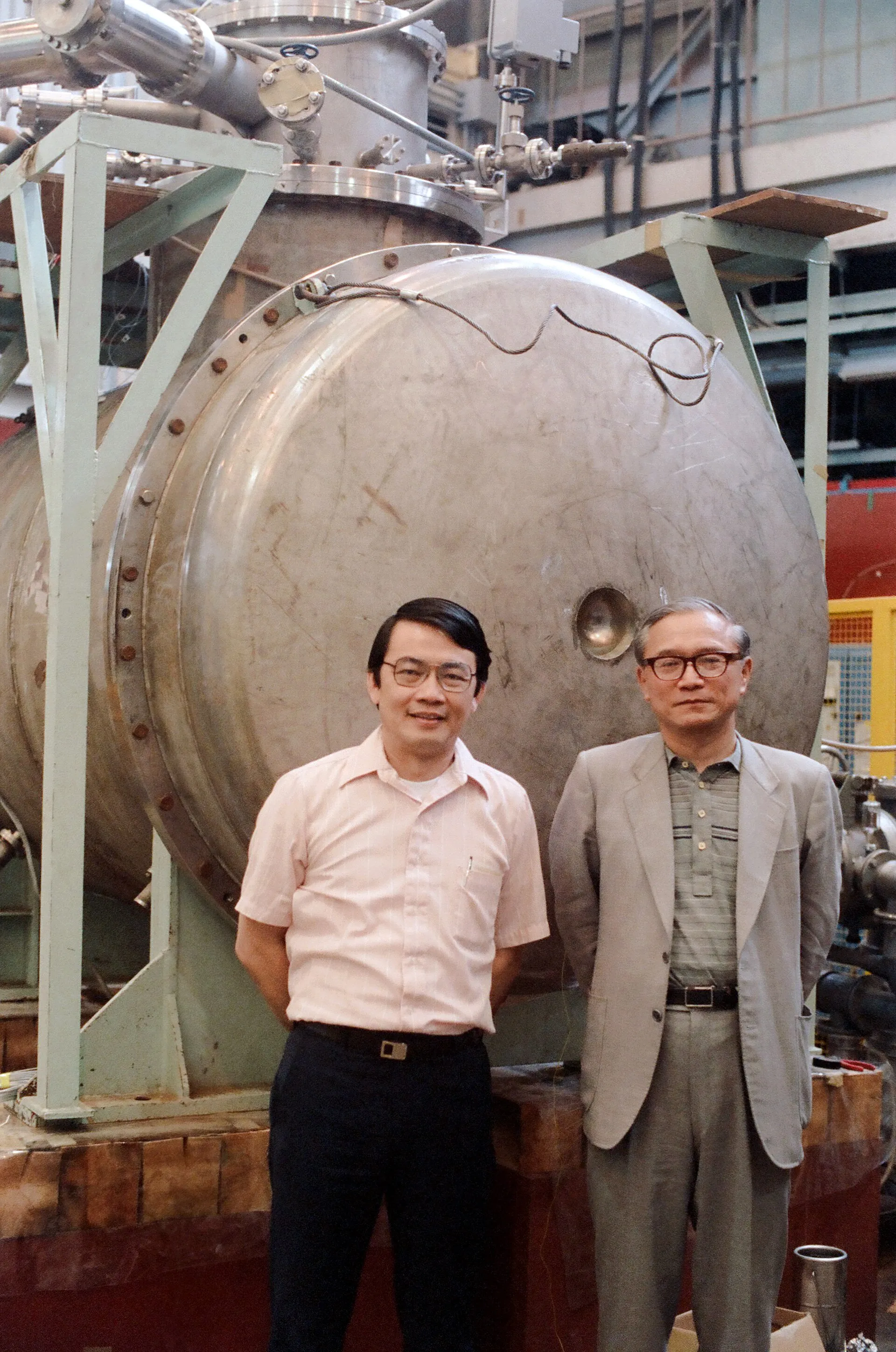
Herbert Chen pointed out in Physical Review Letters that heavy water could measure solar boron-8 neutrinos through two reactions: charged-current absorption, sensitive only to electron neutrinos, and neutral-current deuteron breakup, equally sensitive to all flavours. Comparing the two would test flavour change independently of solar models. Canada's large heavy-water stocks made the Sudbury Neutrino Observatory possible. Chen died in 1987 before SNO was built.
- Date
- 1985
- Kind of event
- Experiment
- People involved
- Herbert H. Chen, Arthur B. McDonald, George Ewan
- Experiments
- SNO (Sudbury Neutrino Observatory)
The situation before
By the mid-1980s two kinds of experiment had measured solar neutrinos: the Homestake chlorine detector, which saw only about a third of the predicted rate, and soon the water detector Kamiokande. Both relied on comparison with the standard solar model. Critics could always argue that the model, not the neutrinos, was wrong, for example that the solar core was slightly cooler than calculated. What was missing was a measurement that did not depend on knowing the total solar flux in advance.
What happened
Herbert H. Chen, a theorist and experimentalist at the University of California, Irvine, published 'Direct approach to resolve the solar-neutrino problem' in Physical Review Letters in 1985. He pointed out that heavy water, D₂O, offers two different reactions for boron-8 neutrinos:
- Charged current: νₑ + d → p + p + e⁻, possible only for electron neutrinos and giving an electron whose energy follows the neutrino spectrum.
- Neutral current: νₓ + d → p + n + νₓ, with a threshold of 2.2 MeV, equally sensitive to all three flavours; the free neutron is captured and produces a detectable gamma signal.
The ratio of the two rates would show directly whether electron neutrinos had turned into other flavours on the way, whatever the total flux. Elastic scattering on electrons offered a third channel. Chen also noted that the ideal place for such a detector was Canada: its CANDU reactors are moderated with heavy water, and Atomic Energy of Canada Limited held large stocks.
Reaction
Physicists in Canada and the United States took up the idea quickly. A collaboration formed in 1984, with Chen as the American leader and spokesman and George Ewan of Queen's University leading the Canadian side. It proposed a detector with 1,000 tonnes of heavy water in the Creighton nickel mine near Sudbury, Ontario, about 2 km underground. The heavy water, worth several hundred million Canadian dollars, was to be loaned. Chen did not see the project realised: he died of leukaemia in November 1987, aged 45.
Consequences
- Arthur B. McDonald became director of the project in 1989; funding was approved in 1990.
- The Sudbury Neutrino Observatory started taking data in 1999.
- In June 2001 its charged-current measurement, compared with Super-Kamiokande, showed flavour change at 3.3σ; in April 2002 the neutral-current measurement found the full predicted flux.
- The CC and NC channels Chen described thus solved the solar neutrino problem, and McDonald shared the 2015 Nobel Prize in Physics for the result.
Frequently asked questions
Who proposed the heavy-water solar neutrino detector?
Herbert H. Chen of UC Irvine, in Physical Review Letters in 1985.
Why heavy water?
Deuterium allows both a charged-current reaction, only for electron neutrinos, and a neutral-current breakup equally sensitive to all flavours. Comparing them tests flavour change independently of solar models.
Did Chen see SNO operate?
No. He died in November 1987; SNO began taking data in 1999.
Original papers
- ProposalH. H. Chen, Direct Approach to Resolve the Solar-Neutrino Problem, Phys. Rev. Lett. 55, 1534 (1985)DOI 10.1103/PhysRevLett.55.1534
Concepts
Mentioned in 1 page
Lessons 1
Last updated: · Editorial standard
Cite this page
Text
Neutrino Atlas (2026). “1985: Chen proposes a heavy-water solar detector”. Retrieved 22 November 2026, from https://neutrino-atlas.com/timeline/1985-chen-heavy-water-proposal/BibTeX
@misc{neutrinoatlas202685chenheavywaterproposal,
  title        = {1985: Chen proposes a heavy-water solar detector},
  author       = {{Neutrino Atlas}},
  year         = {2026},
  url          = {https://neutrino-atlas.com/timeline/1985-chen-heavy-water-proposal/},
  note         = {Accessed 2026-11-22},
  language     = {english}
}